Who Gets to Guide Whom When Recovery Becomes a Question of Power?
Zizi Masizana reviews ‘The Fifth Step’ at Baxter Theatre
Share this piece
Pass the story on to your people.
Script: David Ireland
Direction: Charmaine Weir-Smith
Starring: Albert Pretorius and Lyle October
Venue: Baxter Theatre
Genre: Dark Comedy
Performance Dates: 8 September 2026 – 26 September 2026
Masculinity.
Responsibility.
Manhood.
Boyhood.
Male friendship.
The curators at the Baxter Theatre should be proud of themselves for bringing together back-to-back productions that place men, masculinity and male relationships at the forefront of contemporary South African theatre. First came Brasse, Tot Laat Toe, written by Zubayr Charles and directed by Carlo Daniels; then Art, written by Yasmina Reza and directed by Marthinus Basson; and now The Fifth Step, written by David Ireland and directed by Charmaine Weir-Smith.
Though vastly different in style and context, all three productions interrogate what it means to be a man, the expectations placed on men, and the often complicated ways in which men relate to one another. This is an especially interesting curatorial choice coming directly off the back of Women’s Month, shifting the focus toward masculinity and asking audiences to consider not only how men behave, but how they are shaped by friendship, responsibility, vulnerability, and the pressures of manhood.
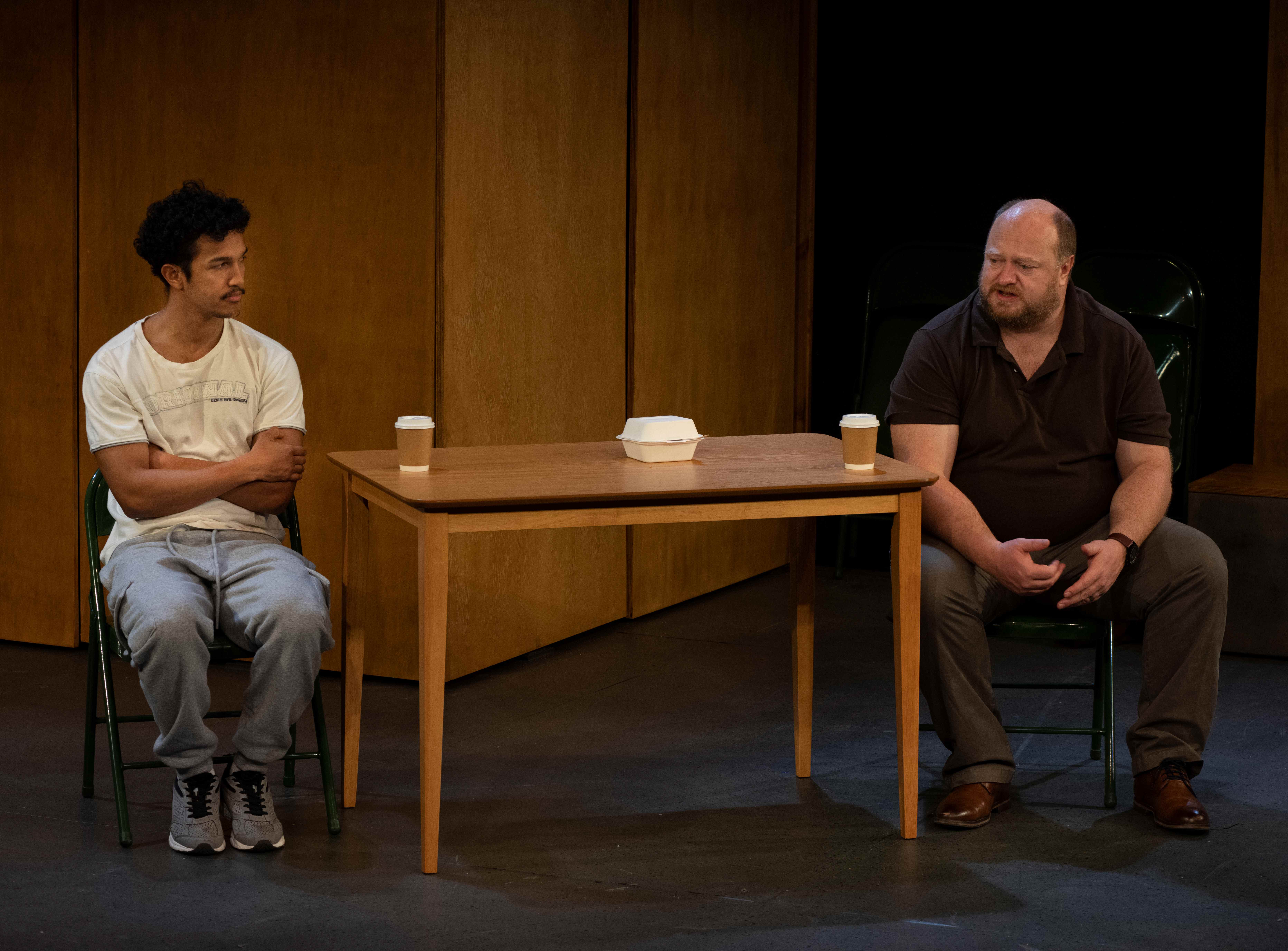
Directed by Charmaine Weir-Smith and staged at the Baxter’s Studio Theatre, David Ireland’s The Fifth Step takes on a distinctly different resonance when placed on a South African stage for a South African audience.
First performed in 2024 at the Edinburgh International Festival by the National Theatre of Scotland before transferring to London’s West End in 2025, The Fifth Step is a darkly comic, psychologically tense two-hander about Alcoholics Anonymous. The title refers to the fifth of Alcoholics Anonymous’s Twelve Steps, wherein the recovering alcoholic admits to and comes to terms with the wrongdoings they have committed, fuelled by their addiction and dependency. This acknowledgement comes in the form of confessions to God, a higher power, or another human being. Luka, a newly recovering alcoholic, asks James to be his sponsor. James is an older man with years of sobriety behind him.
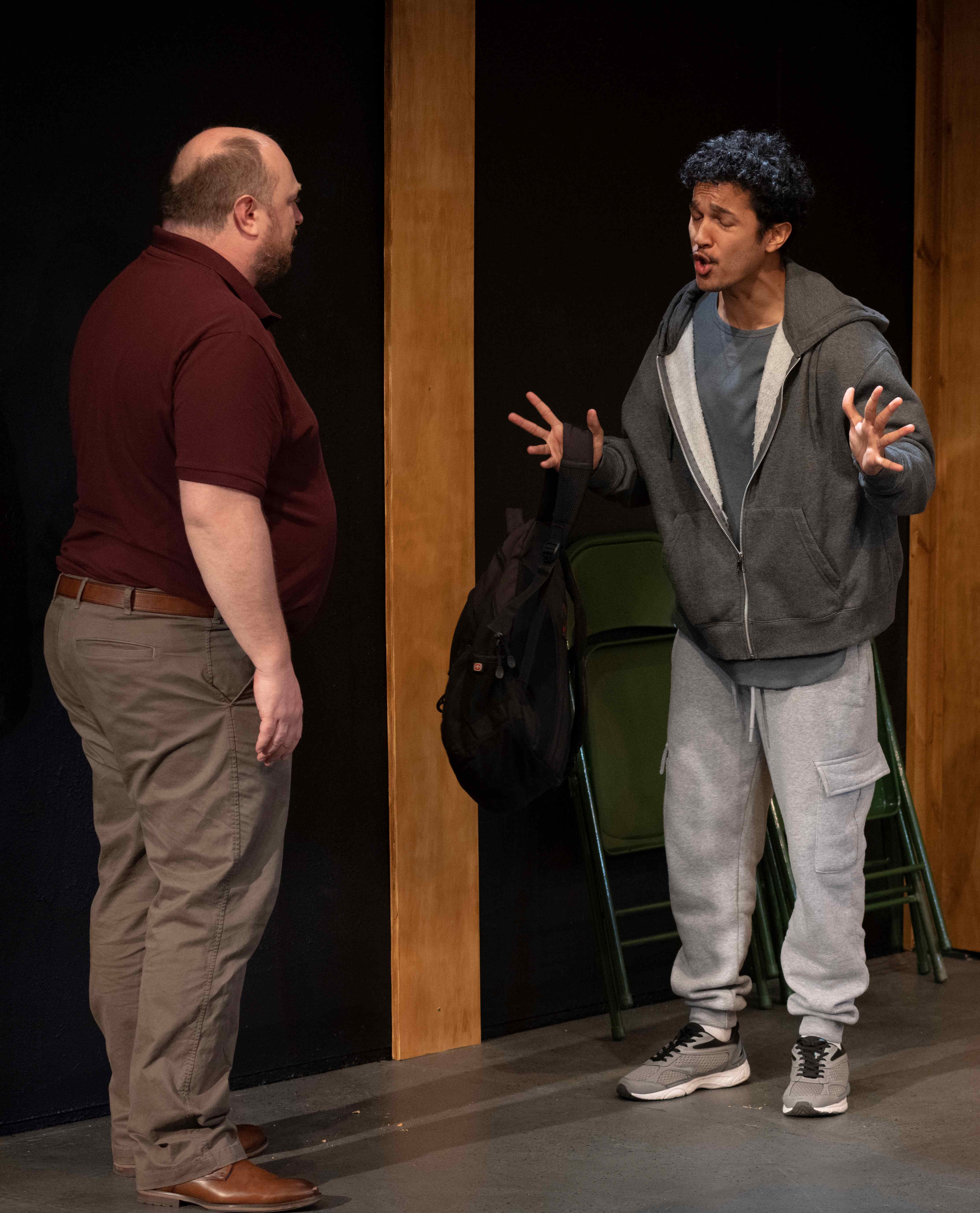
Luka is played by Lyle October, a Coloured South African actor, with a distinctly Coloured accent; James is played by Albert Pretorius, a white Afrikaans South African actor.
An adaptation is never simply the importation of a script from one country to another. When a work written within one cultural and historical context is transferred to another geographical setting, the casting and directorial choices become part of the adaptation: the performers’ accents, racial identities, histories, and the social meanings attached to their bodies are inevitably on stage. A white Afrikaans man and a Coloured man do not arrive on a South African stage as racially neutral bodies. There is no specific moment in the performance where the actors’ racial identities explicitly inform their interactions; however, it is worth noting that the casting choice was just that: a choice. There are racial stereotypes and historical associations familiar within the South African context, and audiences do not necessarily leave these associations at the theatre door. Considering this context and these choices, the bodies I saw onstage inevitably evoked thoughts about the history of the Cape Coloured man. The subtext I read into the production, and the assumptions I brought to it, were therefore shaped by the racialised bodies before me as an audience member.
Now, with Luka being a Coloured man and James a white Afrikaans man, rather than two white Scottish men, the relationship between these identities becomes historically loaded in a South African context, and this history makes their relationship potentially explosive. James is Luka’s sponsor – an experienced member who guides and supports another person through the Twelve Steps and their recovery. This gives James a subtle but significant authority over Luka.
James has lived.
He knows the steps, the rules, the AA community, and ostensibly knows the road to recovery.
Luka is younger, newly sober, unemployed, and lonely. He needs guidance and structural support.
But sponsorship in AA is not meant to be purely one-way: sponsors often share their own experiences, struggles, and recovery stories to support the person they are sponsoring.
Who gets to guide whom, and who is granted the authority to do so?
Who gets to confess, and who is placed in the position of receiving that confession?
Who is expected to be accountable, and who is allowed to hold the other to account?
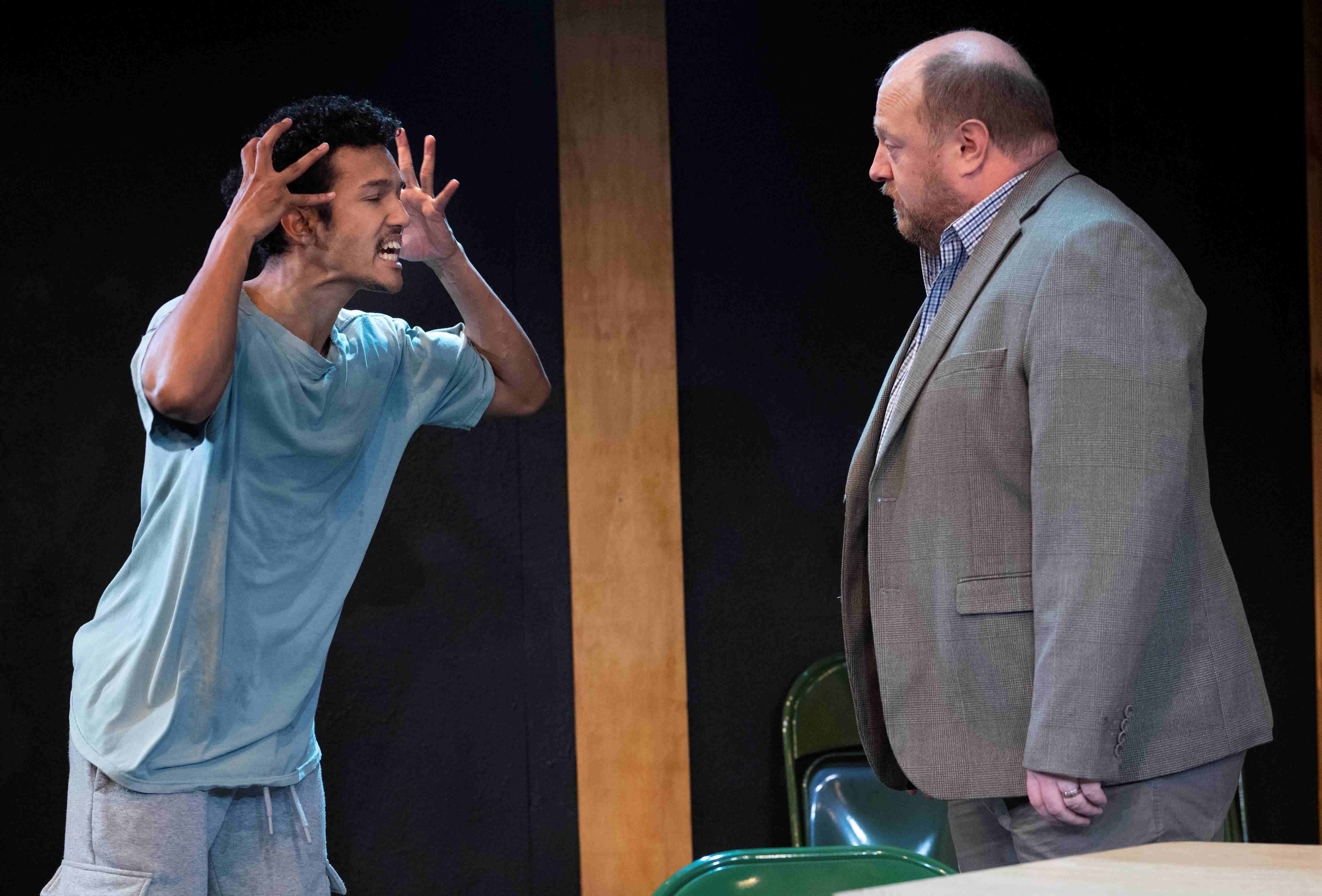
These racial and historical tensions are not actively foregrounded within the production; however, in the way James speaks of Luka’s friends, and through their later argument, it seemed to me that the racialised power dynamics between the two men quietly surfaced, complicating the apparent equality of their relationship.
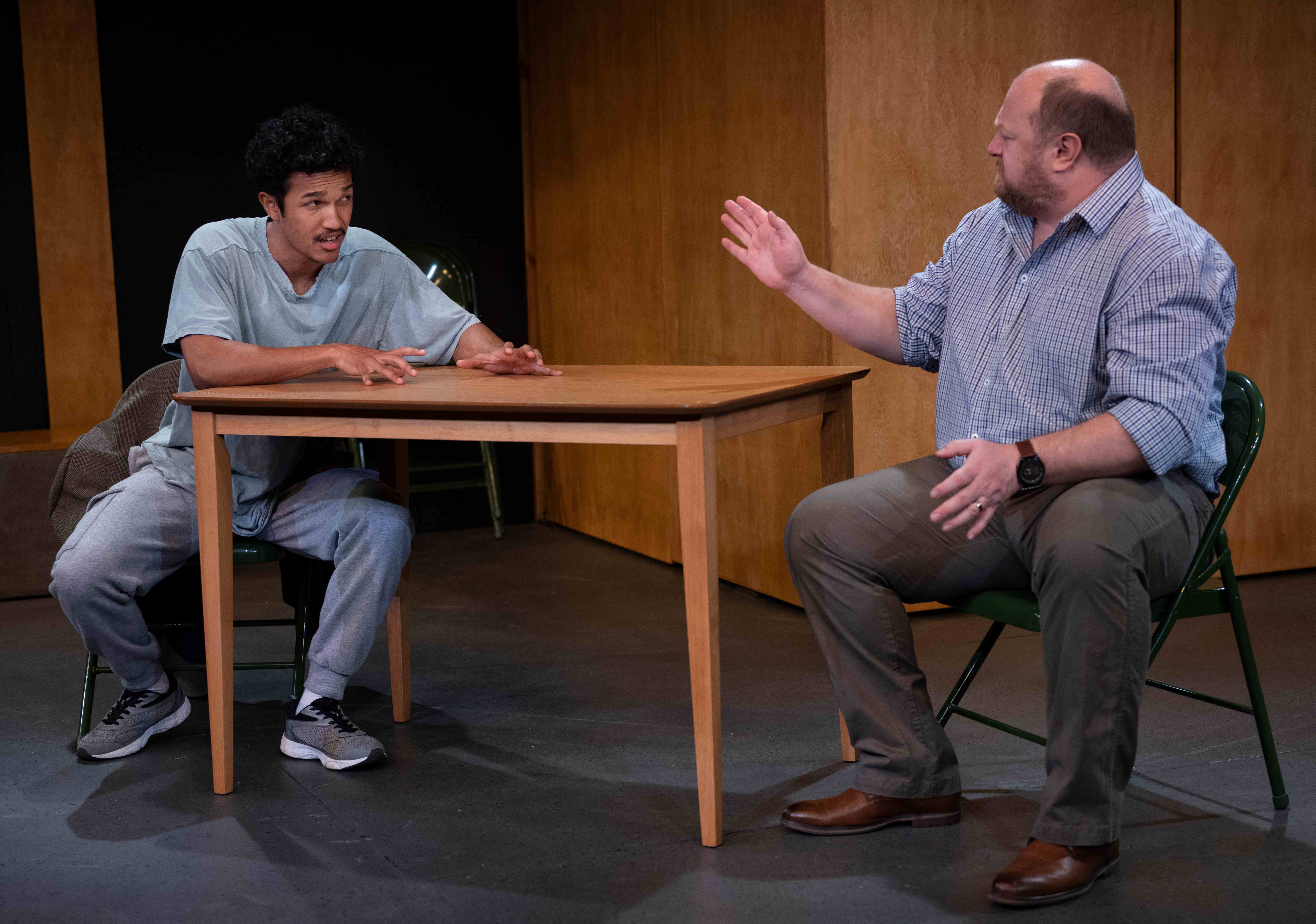
The text itself provides rich material for this interrogation. Ireland writes beyond alcoholism into masculinity, shame, trauma, faith, power, dependency, responsibility, and the complicated intimacy of two men attempting to save themselves and preserve the relevance of their relationship, through one another.
James initially offers Luka safety, trust, accountability, and confidentiality. He is an endorser of Luka’s sobriety, and Luka takes this seriously – absorbing and acting on everything James tells him, as James’ word is gospel… until it is not.
There is a transaction beneath that offer: James himself gains power, relevance, and influence, something that we come to realise is important to him considering the condition of his current home life. Nowhere is this clearer than in their final argument, when James refuses to “be sacked”. Throughout this argument and its resolution, his desperation to cling to this relationship with Luka and, even more, his function in Luka’s life is palpable.
Luka needs James. James, in turn, occupies the position of the man who knows how to survive. But does he also need someone to depend on him in order to do better, to be better?
What happens when men are allowed to need one another?
When there’s an arrangement to hold someone accountable?
When does sameness of time and place, similarities, and a “been-there-done-that” experience qualify someone for authority and mentorship?
What happens when male friendship is organised not around drinking, competition or rape culture but around confession, compassion and perhaps co-misery?
The Fifth Step requires Luka to reveal himself. It requires him to surrender the masculine armour of secrecy, self-sufficiency and suffering in silence, yet the man demanding that honesty from him is not necessarily as transparent as he presents himself to be.
The play therefore asks a devastating question: can one damaged person ethically become another damaged person’s guide?
The play led me to consider the social rituals through which men are permitted to gather and express themselves, and the extent to which alcohol, and beer in particular, often facilitates these spaces. Men frequently meet around drinking: at social events, after work, at sports gatherings, around braais and in other seemingly relaxed environments. Yet these spaces can remain emotionally surface-level, offering companionship but without necessarily creating the conditions for vulnerability.
In this sense, The Fifth Step brought me to a broader question about what men are actually seeking when they gather: are they looking for connection, absolution, escape, or simply a space in which they can exist alongside one another without having to articulate what they are carrying?
Then, thinking about South African drinking culture and masculinity, and about Luka’s own abusive alcoholic father, who I imagine spent weekends sitting in taverns or bars, I was struck by the extraordinary juxtaposition between the world of Alcoholics Anonymous presented in The Fifth Step and the Gabola (drinking) Church, an independent South African Christian movement that explicitly incorporates alcohol into worship and emerged from South Africa’s township religious landscapes and tavern culture – spaces where men often go to decompress. Gabola disrupts the conventional Christian opposition between alcohol and holiness as presented in The Fifth Step by creating a space where drinking and worship coexist.
Alcoholics Anonymous’ recovery model is built around surrendering alcohol and submitting oneself to a programme of accountability. Gabola offers a radically different relationship between alcohol, spirituality and community, drawing on the presence and use of wine by Jesus and his disciples, asserting that drinking does not necessarily exclude one from communion with God.
One community understands alcohol as something from which the individual must recover. The other challenges the assumption that alcohol necessarily prevents spiritual belonging.
The English word church is ultimately derived from the Greek kyriakón, broadly meaning “belonging to the Lord”. The New Testament’s ekklesia refers to an assembly or gathering. Before church is a building, it is people gathering together.
An Alcoholics Anonymous meeting is not a church, but it performs some of the functions we traditionally associate with religious community.
There is ritual.
There are steps.
There is confession.
And there is fellowship, moral accountability, and a higher power.
The promise is that transformation can happen through belonging to something larger than oneself, with the sponsor
becoming a kind of secular spiritual guide.
If Alcoholics Anonymous asks the individual to transform themselves by renouncing the substance, the fifth step itself complicates this idea further by questioning whether sobriety necessarily makes one morally better. Luka engages in a morally questionable relationship, and we later find out that James, although judging Luka for his decisions, has also made poor choices throughout his sobriety – highlighting the fact that no one individual, however experienced or well-practised, is perfect or even entirely good.
And we do not encounter alcoholism without thinking about the social and economic realities that shape drinking cultures in South Africa. These things don’t have to be explicitly stated in the script to exist within the theatrical encounter.
The set is beautiful, perhaps too beautiful for a play of this nature – or, more accurately, too clean and too new. Yes, there is a trash bag filled with cups hanging beneath the visibly used beverage station. Yes, the set is relatively simple, but it still looks too pristine and glossy. With its shiny green folding chairs, freshly varnished wooden wall panels, and sophisticated doors, the set lacks the visual deliberateness of a provisional space. It feels too constructed; its refinement occasionally overwhelms the simplicity of the dramatic proposition.
That provisional quality matters because it gives physical form to the liminality in which Luka finds himself. He is taking things as they come, remaining sober one day at a time. Like the addicts who enter the AA meeting in the second scene, he exists in a state of isolation and displacement, searching for somewhere – and someone – to hold him. A meeting space that can be packed away into boxes, with rolled-up posters, a portable urn and instant coffee, underscores the idea that healing happens through community and within the individual, rather than because of any particular place. Recovery can be facilitated anywhere.
I imagine that making the space feel more worn, temporary, and frequently assembled would further strengthen the production’s dramatic value. The meeting room is, after all, momentary: there is an illusion of safety here, but we, the audience, know that it will eventually be dismantled, packed away, and reconstructed somewhere else. That impermanence could mirror Luka’s own precarious state of recovery, where safety is real but never guaranteed, and stability must continually be rebuilt.
Despite the initial polish, through transitions, the pop-up, makeshift quality of the set becomes clearer from scene to scene. For instance, James’s entrance during Kendrick Lamar’s ‘Swimming Pools’, whilst pleasantly surprising and solidifying the idea that things aren’t quite as they seem, visually clarified the function of the swing doors, recalling those often found in community or church halls. This brief, one-time use of the doors demonstrated that Weir-Smith is capable of making use of cleverness and sophistication in her staging to reveal how the set could shift in function and meaning beyond its initial appearance.
The lighting, however, was effective, concise, and gradual in its depiction of both the evolving relationship between the two men and the different environments in which we encountered them. The beginning had what felt and looked like the cool fluorescence of a school or church hall. As the show progressed, so did the clever use of lighting – the design contributing effectively to the production's sense of emotional fragility and psychological exposure, using blackouts and blue light to transition between spaces and scenes effortlessly. Later on, when uncertainty and contempt begin to brew, the light again does well to reflect this with a momentary dramatic shift and then a lingering green tint.
Apart from the Kendrick Lamar moment, even during recollections of past experiences, the lighting remained an effective component in creating seamless images. At its strongest, the lighting and sound design supported what was already there; elsewhere, the staging worked too hard to create complexity that the play itself already contained.
The show is fundamentally two men talking, and I wanted so badly for the production to trust that. It is precisely because the relationship between these two men already carries so much of the dramatic weight that the additional attempts to externalise Luka’s inner world needed to feel especially deliberate and consistent.
The introduction of the Easter bunny – part of a series of surreal images that seem to exist only within Luka’s perception – is too sparse, unestablished, and inconsistent to create a clear theatrical language around his mental state. This single surreal image feels too isolated to establish Luka's inner world, as it comes nearly halfway through the play, and the following surreal images are staged completely differently. It is one of only two instances before the final moments of the play in which we see him explicitly and physically interact with an object that functions in this way.
At one point, Luka recounts a dream in which James appears as a giant rabbit; later, James enters wearing bunny ears, seemingly making Luka’s private vision visible onstage. Whilst the image is interesting and invites a deeper interrogation of what is actually real, the moment feels insufficiently grounded through the staging. It is never made clear, beyond what the text implies, that Luka alone can see the ears before he eventually removes them from James himself. It is these decisions – these attempts to externalise Luka’s mental state onstage – that had me thinking too hard about what was and wasn’t real, rather than allowing me to experience his uncertainty with him.
There is also an intriguing theatrical language around absence and presence. Objects, space, and actions seem at times to occupy an uncertain position between physical reality and Luka’s imagination.
Ambiguity can be productive and profound. Confusion is not necessarily a failure of theatre. The audience can be made to question what is real because the character himself cannot distinguish reality from imagination. But for that uncertainty to deepen the storytelling, the production needs to establish enough of a reality for us to understand what is being disrupted.
I wanted to feel the psychological fracture. The makeshift quality would further Luka’s sense of fracture from reality, from alcohol, from his friend group, and eventually from James. There exists a vulnerability in the temporary. Perhaps, if we had watched the transitions as Luka moved the set and reconstructed the next meeting environment in dim light rather than during a blackout, the eventual fracture might have felt more earned, or at least more physically apparent.
Pretorius has strong performance stamina, a confident physical presence and an almost athletic demeanour that gives his stage presence energy and control. In a two-hander, stamina and command of space are not insignificant achievements, and the actors find creative ways of managing entrances and exits within the contained environment.
Yet the character of James felt emotionally static to me in moments, despite Pretorius being a strong performer; the text did not always give him enough to work with.
The character begins with authority and, as the relationship deteriorates, I wanted that authority to become increasingly unstable. I wanted to watch the sponsor become the man who is no longer certain that he deserves to be the sponsor, or to see him overcome by the humiliation of having his position within their dynamic undermined or rendered disposable.
Instead, James often seemed to remain the same man up until the last few minutes. Up until Luka confronts James about the true nature of his sobriety and his alleged past actions, Pretorius maintains much of the same measured tone he uses in the opening scene. Even when that composure briefly breaks – for instance, when James becomes annoyed and frustrated by Luka’s perception of him through his mind’s eye – he returns almost immediately to the same controlled register, making James feel detached or emotionally stagnant at times.
That emotional consistency worked against one of the play’s most interesting ideas: that the person who appears to be saving someone may simultaneously be exercising power over them while also requiring rescue himself.
Not necessarily louder, not more elaborate.
More precise.
I wanted more of the two men simply existing with what had been said.
While Pretorius projects and maintains the cool, concealed energy of “a respectable elder” onto James, October’s Luka requires a contrasting energy. October plays Luka with a volatile mania, both vocally and physically. He vibrates through conversations like a yo-yo, existing in the space with no semblance of calm or stillness. His agitation manifests in over-the-top hand gestures and the frantic, constant grabbing of his own shirt, signalling deep-seated distress. His erratic momentum dominates the performance until a psychological fracture occurs during his encounter with Jesus – a shift beautifully mirrored when he finally slows down on the treadmill.
Vocally, he embodies this erratic energy through a kind of vocal whiplash, shifting violently across pitch, tone and volume, often collapsing into a quieter register before erupting into another explosive thought. In the text alone, Luka’s seemingly manic rants can be understood as merely the aggressive bravado of an incel, as he defines himself at the top of the play. However, October’s delivery grounds the character’s erratic energy, allowing Luka to appear vulnerable during his sudden, mid-sentence drops into physical and vocal stillness.
In these fractures, his vulnerability does not feel like a cry for sympathy, but rather like the exposure of an inner voice that he can no longer contain. These moments reveal a breakdown in the bravado he otherwise performs and expose the severe psychological toll of generational trauma. October’s use of distinctly Cape Coloured enunciation and cadence further demands emotional space for Luka’s vulnerability – it is not often that we see Coloured men, marginalised men, this psychologically and emotionally bare.
October’s performance ultimately returns us to the broader question of how men are permitted to express vulnerability, and how much space the production gives that vulnerability to exist. Men are taught to solve, not to speak, and even when they do speak, they are taught to conceal their struggles through hypersexuality, misplaced morality and respectability. For instance, Luka shares with James that he one day envisions himself getting married and having a family of his own; however, Luka quickly redirects the conversation to his lust. He never speaks of women without eventually sexualising them in explicitly degrading ways, even those he respects or cares for. The character of James, on the other hand, performs respectability, positioning himself as calm and collected whilst remaining emotionally concealed. This is reflected in the play, but the production did not always allow enough silence or stillness for those behaviours to register fully. At times, the use of staging moved on before the discomfort, tension and emotional consequences of what had been said could settle.
It is worth acknowledging that I saw the production on preview night. A two-hander can be particularly vulnerable in its early performances; rhythm, chemistry, pacing and audience energy are still settling. Since watching this preview on Thursday 3 September, I also acknowledge that Weir-Smith still has the opportunity to refine, recalibrate and deepen aspects of the production before opening night – which is, after all, part of what previews are for. My response therefore belongs specifically to the performance I experienced rather than to the entire life of the production.
My critique is aimed at propelling the production further into its most fascinating element – the volatile structures of control, dependency and intimacy that define this male friendship. James knows the programme; Luka needs the programme. James’s knowledge of the programme needn’t – and doesn’t – make him any better than Luka. However long someone has been in recovery, they remain one bad decision – one drink – away from returning to the first step. Neither man necessarily knows how to simply be with another human being without occupying a role: sponsor and addict, teacher and student, saviour and saved, white and Coloured, older and younger. These roles give the relationship its structure, but they also create the very tensions the play is most interested in unsettling.
It is these questions that stayed with me after The Fifth Step. I was underwhelmed by aspects of the staging, but not by the questions the production opened up around race, manhood, mentorship, faith and authority. Bringing a Scottish play about Alcoholics Anonymous to South Africa means placing confession and male dependency inside a very different social and historical context.
Perhaps the most interesting question, then, is not whether Luka can remain sober, but whether either man can surrender the need to save himself or the other, and encounter the person in front of him without the protection of a role. That is a much harder kind of recovery and reckoning.
I look forward to a warmer second viewing and wish the actors the very best as they grow with and continue telling this story.
About the author
Zizi Masizana
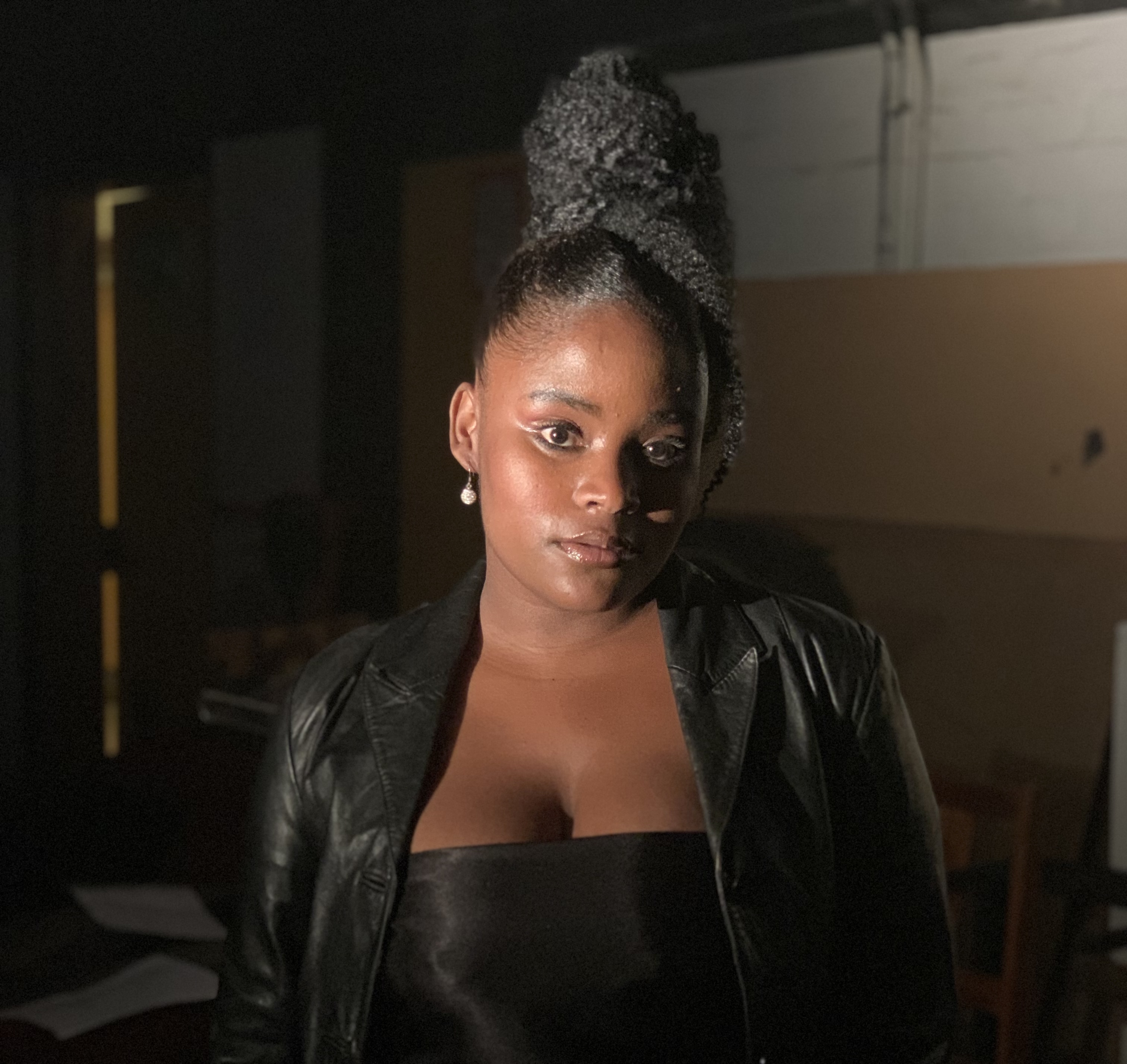
Zizi is an emerging performance artist, theatre maker and technician from Cape Town. She can be found at the theatre doing any and everything; honing her craft, learning and exploring. Her practice right now is about remaining curious, observant and cultivating rituals that’ll aid her craft. Her eventual aim is to create overwhelming sensory experiences as live art, theatre and storytelling.
View all work by Zizi Masizana