The Jackal: A Name Meant to Wound. A Woman Who Resists.
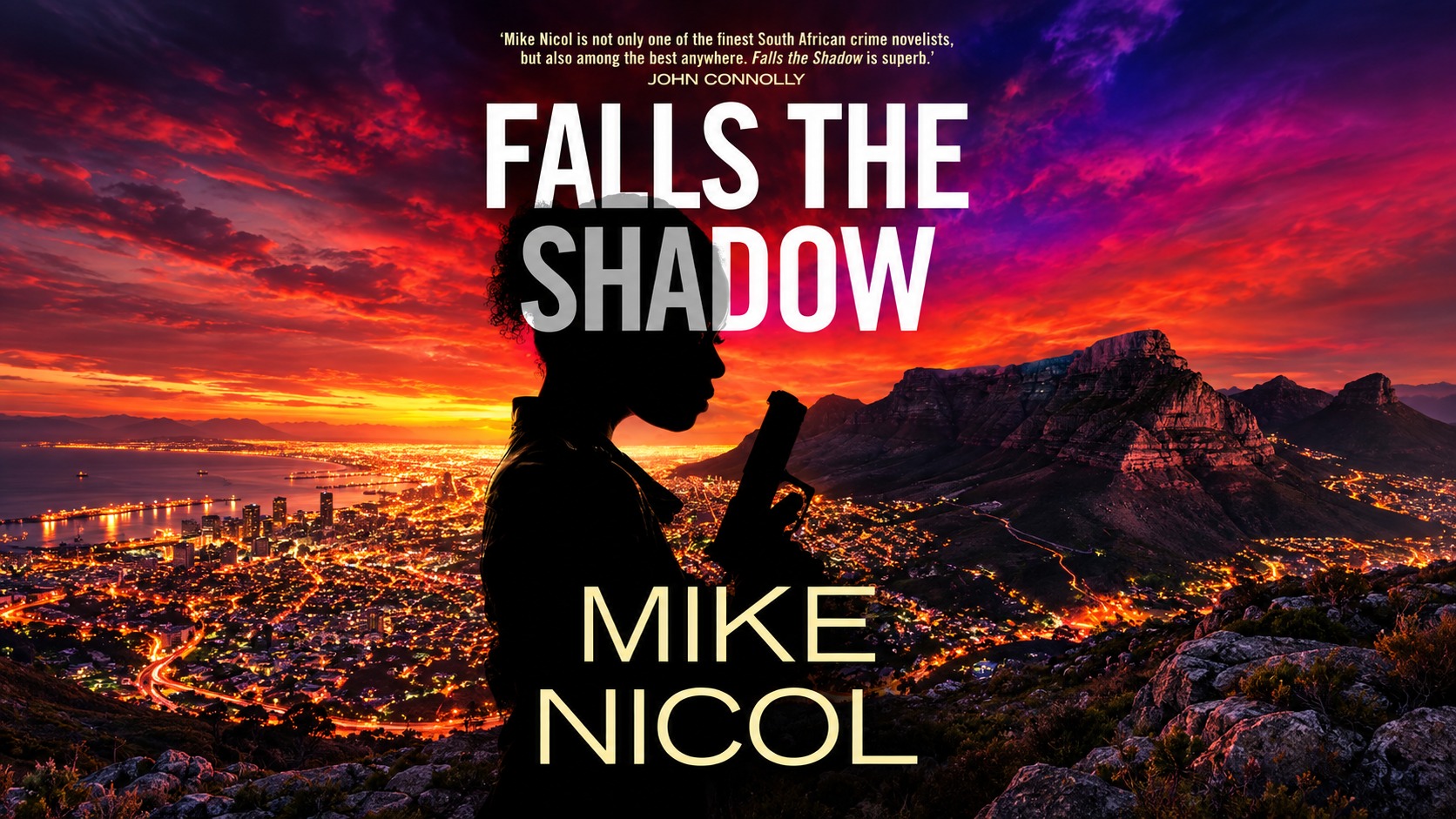
Rushdiyah Narker reviews 'Falls the Shadow' by Mike Nicol
Share this piece
Pass the story on to your people.
Publisher: Pan Macmillan South Africa
Type: Novel
Date Released: February 2026
Retail Price: +/- R370.00
Format: Paperback (384 pages)
I originally planned to read Falls the Shadow in short sprints over a few busy weeks.
With work deadlines, university commitments with my supervisor, and deadlines for an upcoming writing project with my editor, I didn't have much free time to read during August and September.
Reading is my me time. It’s where I can get lost in other worlds, immerse myself in another writer’s mind. Where all I am responsible for is turning the page.
Despite the demands on my time, as soon as I had a few hours to read, I ended up finishing Falls the Shadow in one go, and the reason comes down to the writing style.
Nicol’s writing took me a beat to adjust to. Based on the stories I have read in my lifetime, I have noticed that if a story is written in third-person narration, it’s usually in the past tense; this book, however, is written in third-person narration yet in the present tense, and I found it jarring at first. I had to go back to certain sections and re-read sentences, which forced me to concentrate fully on the story being told. I then realised that my initial discomfort was actually what hooked me straight in.
Once again, it also meant I couldn’t just merely read the novel in short sprints.
I tried. Every time I picked it up between busy days, I had to re-read a few lines before my brain, once again, had to adjust to the style.
So, I decided to leave the novel alone until I had a full day to read it through to the end, and man, was that the best decision I made.
For anyone who hasn’t picked it up yet, Falls the Shadow follows a policeman (in Cape Town) who murders his family and then turns the gun on himself. In the shed behind his cottage, investigators discover a cache of Russian automatics, handguns, 9mms and .38s. You don’t need to be a forensic expert to realise something is amiss. The dead cop appears to have been running an illicit side racket – a secondary, usually informal or illicit, money-making activity run alongside a person’s main job or business. The term has a shady connotation, implying the activity is dishonest, unauthorised, or at least not entirely above board, and that is what catches the attention of Captain Zara Dewane of the Internal Crime Unit and her partner, Warrant Officer Wynston Adams. A single mother known among her colleagues as “The Jackal”, Zara must soon discover that there is far more to the family murder than first appears – and what she uncovers puts her directly in the firing line.
There are cops running guns stolen from the police armoury.
There are cops selling guns to gangsters.
There are money chains running deep into the police hierarchy and even implicating the political bosses.
Then comes the order from on high: close her down. Kill her, in other words. Suddenly, Zara and her family are targets, with only one way out.
One of the strongest themes running throughout the novel is corruption, and how it filters into politics and the systems that govern the country. In South Africa, where corruption makes headlines all too often, this story feels especially relevant – especially how deeply corruption can be embedded in the systems meant to serve the public, and how far those involved will go to protect themselves.
The social commentary is especially strong here.
Even though this is fiction, Zara’s growing danger feels disturbingly plausible: the more links she uncovers while investigating what initially appears to be a family murder, the closer she gets to people with the power – and the motive – to silence her.
Running alongside this critique of corruption is another of the novel's most urgent concerns: violence against women. Because Zara is a policewoman, she is, of course, exposed to various dangers – but as a woman, she is also expected to respond to those dangers with fear and submission. Instead, she refuses to make herself meek or small simply because her life is under threat. This defiance shows up closer to home too. Her narcissistic ex, and the father of her child, expects her to be compliant in their joint custody arrangement.
As a woman reading this home dynamic, I was uncomfortable because it is so familiar. We often hear stories of narcissistic partners with no emotional intelligence who refuse to be supportive because their main aim is to punish the person who left, by whatever means necessary, including using a child. Most of us know of women through living this, or are living it ourselves.
Zara’s therapist advises her not to confront him, to placate him and make him believe she is going along with his wishes, because that is the only way to keep herself safe from his manipulation. It is a chilling piece of advice, and it echoes the endless headlines of women in South Africa murdered by their partners.
What makes Zara more compelling is the contrast between her home and work lives.
At work, she is able to call out corruption when she sees it and is unafraid to confront men about their behaviour: she goes to places alone, including places she has been explicitly told not to go, and investigates high-ranking people with no regard for the consequences; in her private life, she does not.
The disrespect women face in the workplace stems from the same attitudes that play out in the home. Her ex has the power to hurt her emotionally, though he has never been physically violent; yet, the strict, military-style institution she works for is a place of real violence, where her life is in danger because she is a woman in a space dominated by men.
This is why she earns the nickname “The Jackal”. One character says, “Dewane was like those animals: howling on the veld, skulking under bushes” (Page 15). For those committing crimes, her relentlessness is a hazard. Through the characters’ interactions with Zara, we see their ideas about what a woman is good for: when her life is threatened, she is expected to be meek, submissive, and to give in to pressure to stop pursuing leads.
With South Africa having some of the highest levels of gender-based violence in the world, it is hard to ignore this aspect of the novel, especially given the recent discovery of multiple bodies in Johannesburg and an alleged serial killer.
The police are urging the public not to make assumptions, but I would argue that it is worse if these lives were taken by different men. It would mean that at least ten women were killed by different men and their bodies discarded in a place all too familiar with neglect.
Despite marches in the streets and campaigns across social media, how do we ensure change so that fewer women end up dead or harassed, as in the case of the hotel owner who barged into a woman’s bathroom to threaten someone for refusing to give him her number?
Where does this disrespect for women begin? At home? In the absence of fathers? In political leaders who refuse to take accountability?
Perhaps we should start by recognising that patriarchy hurts men as much as it hurts women. We need to teach boys and girls what consent is, and that someone willing to push past a boundary you have set is not safe to be around. Women’s bodies are not for men to use and discard on a whim.
We also need men to shame those who continue to treat women as objects, so that they think twice, because clearly our laws are not a strong enough deterrent. The questions of what a woman is, and how she must behave, shows up in the various female characters within this book.
Viewed through a feminist and anthropological lenses, these threads, from the misogyny directed at Zara to the expectations of the men around her, all point to one idea: women must behave in ways that make them easier to control. This makes Zara Dewane a fully formed, complex character.
Zara is clear-cut about justice. She believes that cops should be held accountable for their actions. When she hears about a case where a police officer has shot his wife and two kids in their home in Saldanha, her gut tells her there’s more to it than meets the eye. She and Wynston drive out to the crime scene to investigate, and in the car she asks, “Something I don’t get is why dads shoot their kids” (Page 5). It’s a question I’ve asked myself when I see the headlines, because what pushes someone to take the lives of their own family members? What has to happen that allows this to occur so frequently?
Early in the novel, Zara’s conversations with Wynston reveal the way her mind works as an investigator. As a policewoman, she does not simply focus on what has happened; she wants to understand why it happened. She thinks about motive, emotion, and the circumstances shaping the people involved. That curiosity makes her a particularly perceptive investigator, someone who looks beyond the surface of a case and follows each lead with care.
But Zara’s complexity is not limited to the way she works; it also extends to the social and cultural world she inhabits. Her background stood out to me in particular. She is written as a Coloured character from the Cape Flats, and she is called a “Hotnot” by a superior – a derogatory term for someone who is Coloured. The term may not be regularly be used in a modern setting, but I still reeled in response to the term. I felt the venom with which it was spewed at the character.
In light of the hostility she encounters within the police force, the stability of Zara’s family life becomes all the more significant. She does, however, have a support system that is most evident in her parents, whom she is able to lean on to help care for her son while she works the case, and again when her life and the lives of those around her are placed in danger. I’d argue that she even has a found family who all rally around her, holding her up so that she can do the work she does. It’s not lost on me that the majority of the members of her found family are women – I find that interesting because the story is written by a man.
One of my favourite things about this novel was how tight the plot is and how none of the events in the narrative feel forced, particularly for a crime novel, where twists and revelations can so easily feel contrived. Zara’s tenacity for finding the truth is what moves the story so skilfully. Just as importantly, the characters who populate the larger story never feel as though they exist merely to serve the plot. They are fully realised individuals with their own flaws and strengths.
Sometimes I read novels, something happens, and I think to myself, “Is this only here for the plot?” Nicol’s characters, however, are robust and make choices that influence the plot, and those choices make sense for who they are and what they would choose. Nothing seems fabricated or forced on them. The beauty of Nicol’s writing is how he makes me believe each person is who they are, and that care in shaping each character also gives the relationships in the novel real depth.
Beyond Zara and Wynston, there are other characters we encounter along the way, and Nicol does a wonderful job of making us curious about them. He makes us care about them, so that when the bad stuff starts to happen to the people around Zara, it has an impact on me as the reader.
Then there is the novel’s exploration of corruption, and Nicol does not shy away from showing how corrupt the justice system can be, or how many layers of corruption can exist within South African institutions. Given his background in journalism, these ideas feel grounded in something more than imagination; there is a sense that the world of the novel has been shaped by close observation of the systems it critiques.
That sense of realism also strengthens the novel’s pacing. Each scene moves the story forward while keeping me on edge, because there is always the feeling that Zara is getting closer to something dangerous. The tension builds steadily, making it difficult not to keep reading just to find out what happens next.
Much of that momentum also comes from Nicol’s writing style. As I have mentioned, once I adjusted to the third-person present-tense narration, I found that his short, sharp prose helped sustain the novel’s pace. The dialogue works particularly well. It feels natural and flows easily, with a cadence that feels authentic. I did, however, wonder whether Zara would speak completely in English while in the comfort of her own home. With so many characters from different backgrounds, situated in Cape Town, I expected a bit more multilingualism in the dialogue, particularly in Zara’s home, because she is from the historically Coloured neighbourhood of Woodstock. There are moments when Zara uses phrases like “My lewe vok, Elouise,” but Coloured homes are known for their linguistic vibrancy and beautiful use of code-switching – these comments about dialogue don’t detract from the fact that each character still sounds distinctly like themselves rather than like a made-up person.
Finally, the ending is satisfying without Nicol tying everything up too neatly. Most of the questions raised throughout the novel are addressed, while a few are clearly left open to carry into the rest of the series, which is set to span three books. What I appreciated most was how carefully Nicol plants hints and clues and then follows through on them, rather than leaving major threads unresolved.
If there is a follow-up, I'm curious to see where Zara’s story goes next, what choices she makes, and how much further the corruption around her extends.
Falls the Shadow is a thrilling read filled with nail-biting suspense, social commentary about justice, and the question of who protects the people when the police are corrupt.
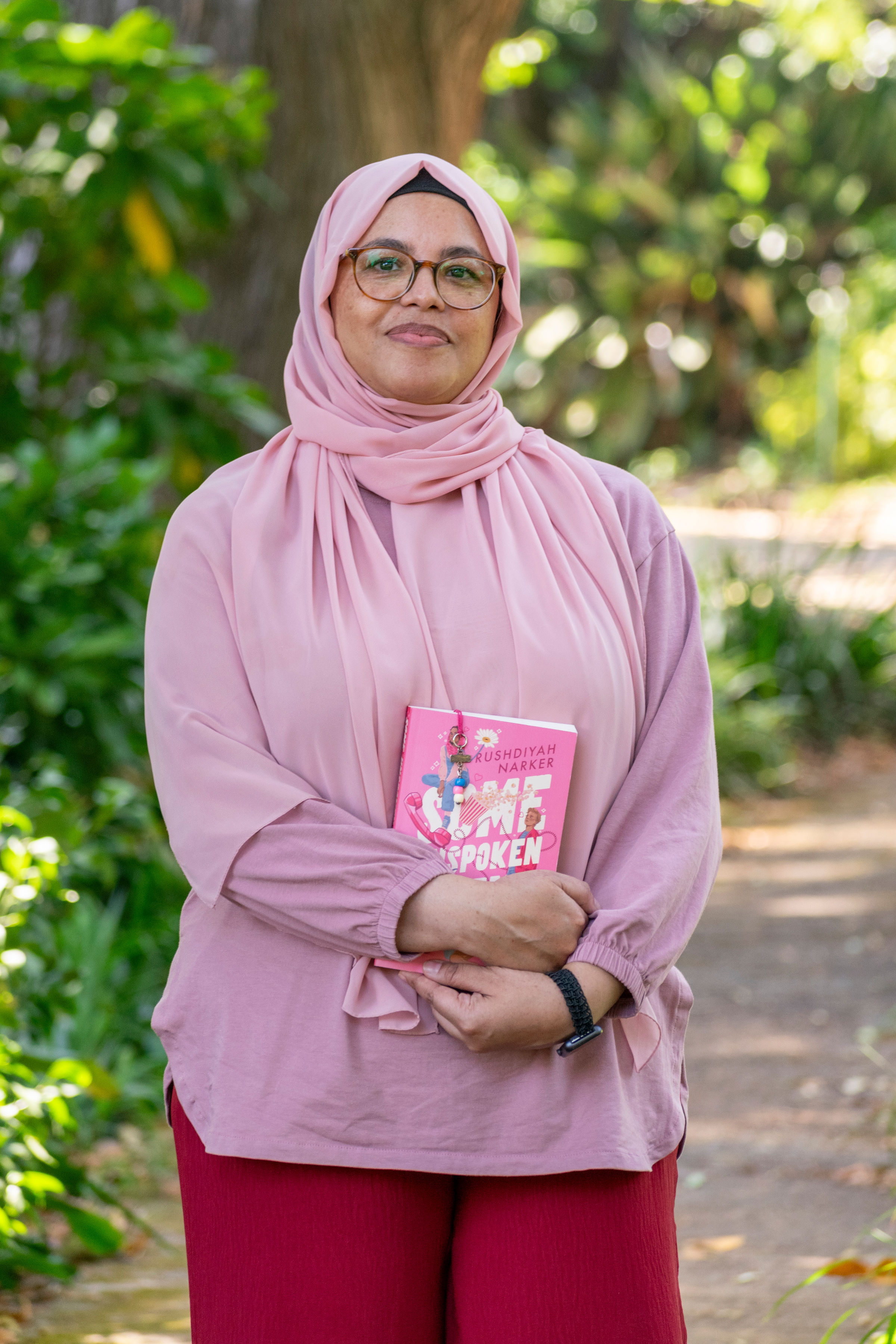
About the author
Rushdiyah Narker
Rushdiyah Narker has moved from making up stories in her head to writing them down. She uses the skills she learnt while getting her Masters in Social Anthropology to write stories about the culture she grew up in. 'Some Unspoken Thing' is her debut young adult novel enjoyed by kids 13 to 60 years of age. For funsies, she reads a book a day and loves to go to the theatre, galleries, and movies to experience different forms of storytelling.
View all work by Rushdiyah Narker