Where Euphoria Ends and Reality Begins
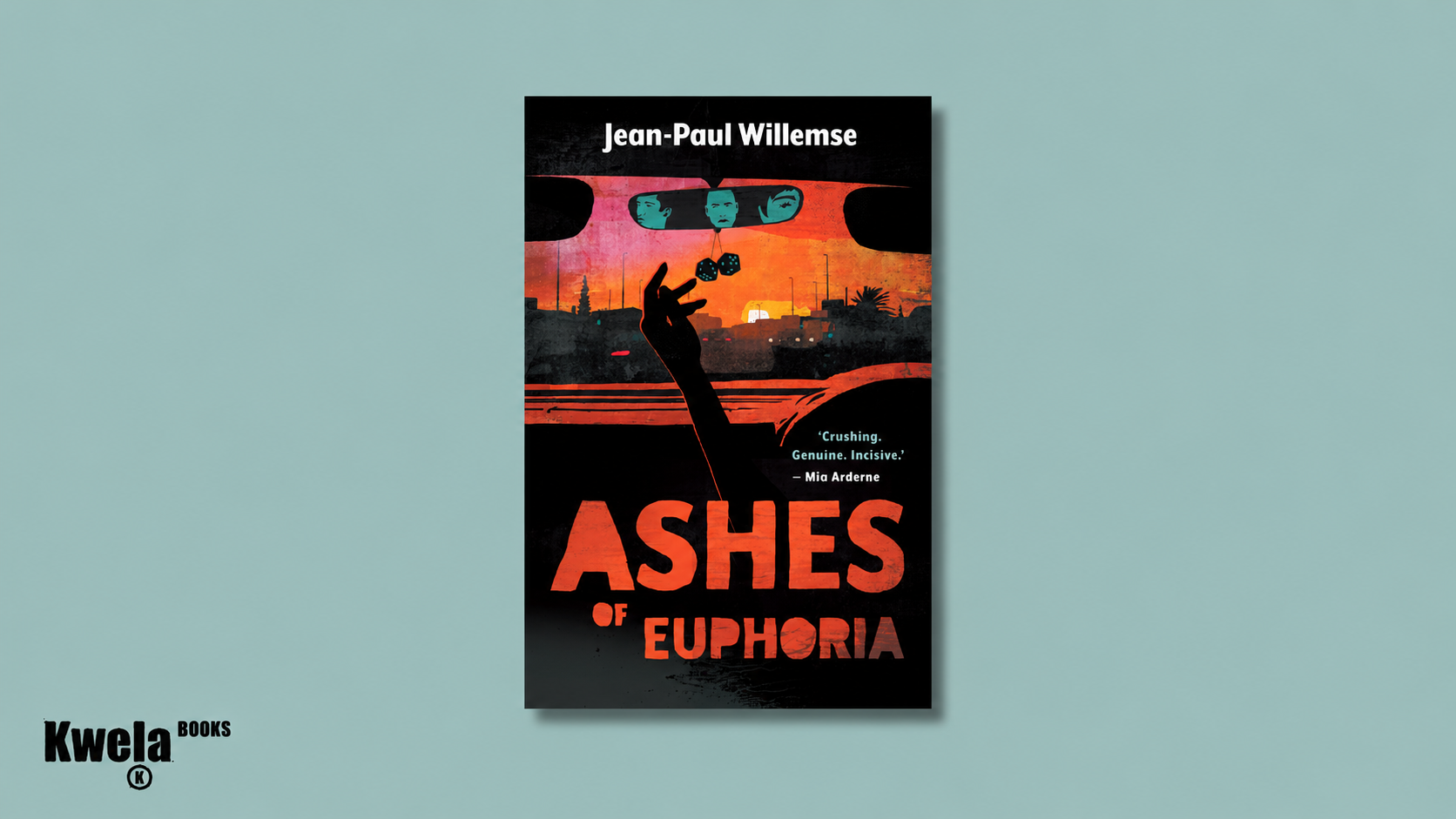
Sumaya Adams reviews 'Ashes of Euphoria' by Jean-Paul Willemse
Share this piece
Pass the story on to your people.
Publisher: Kwela (Jonathan Ball Publishers)
Type: Novel
Date Released: April 2026
Retail Price: +/- R300.00
Format: Paperback (240 pages)
Ashes of Euphoria is one of those novels that holds up a mirror to society and then refuses to let you look away.
Set in Kraaifontein, Cape Town, the story follows Jameel, a Media Studies graduate trapped in a dead-end job; his cousin Zaid, a Bolt driver with entrepreneurial ambitions; and their friend Stacey, an unemployed Geology graduate involved in Zaid’s side hustle. They are ordinary young people who want what so many people want: a better life, financial freedom and a way out of circumstances that feel increasingly limiting. But when an opportunity presents itself, what initially looks like a chance at something better draws them into a dangerous world of crime, gangsters, violence and exploitation.
At the centre of this descent is Jameel, whose path into crime is made all the more compelling by the fact that he is not driven by any obvious hunger for it. Instead, he is frustrated by the life that has taken shape around him. His qualification has failed to open the doors he expected it to, while his job offers little in the way of fulfilment or possibility.
Even the promotion he receives at work cannot quiet his sense that there must be something more. That lingering dissatisfaction makes Jameel easy to understand and, at first, easy to root for. What makes his journey increasingly disturbing, however, is that we are not watching a fully formed criminal reveal himself. We are watching the gradual dismantling of his boundaries, one compromise and one decision at a time.
What makes Jameel’s story so unsettling, however, is how firmly it is rooted in the world around him. Kraaifontein is not simply a backdrop against which the action takes place; it shapes the lives, choices, and limitations of the people who live there. Willemse captures a social landscape where education does not necessarily guarantee opportunity, where unemployment and financial pressure can narrow a person's choices, and where ambition can easily become entangled with desperation.
This is also why stories set in Cape Town, and particularly in communities such as those on the Cape Flats and neighbouring areas, matter. Too often, these communities appear in the media only through statistics, crime reports and headlines.
Storytelling can do something different: it can show people as whole human beings, with qualifications, ambitions, friendships, families, flaws, humour and dreams.
For Coloured readers especially, there is something significant about seeing a familiar world represented in literature. Not simply as a place where bad things happen, but as a place inhabited by complicated people trying to make lives for themselves.
As someone who grew up on the Cape Flats, rather than in Kraaifontein, this novel resonated with me on a deeply personal level: the violence, drugs, exploitation and fear of losing another young life too soon are not abstract concepts. These are realities that many Capetonian families know intimately. Reading Ashes of Euphoria often felt less like escaping into fiction and more like returning to stories I have heard throughout my life – that familiarity is uncomfortable, but it is also what gives the novel its power.
Willemse is particularly unflinching in his examination of the societal ills surrounding his characters. Gender-based violence, violence against children, sexual assault, human trafficking, the selling of babies, gang violence and police corruption all form part of the world he creates. But these issues are not presented simply as a collection of shocking events. They exist alongside unemployment, poverty, inequality, generational trauma and institutional failure.
The novel makes us confront a very difficult question: what happens when people are expected to build better lives while being given very few legitimate avenues through which to do so?
By asking that difficult question, the novel complicates our understanding of the terrible choices its characters make without excusing them. More importantly, it highlights a painful truth: crime does not exist in a vacuum.
One of the lines that particularly captured this reality for me is, “Trauma is just another thing to us. We cannot stop our world because of it. There is money to be made, families to care for” (Page 191).
There is something devastating about that idea.
Survival leaves little room for grief. People still have to work, children still need to be fed, bills still need to be paid. Trauma becomes something that has to be carried while life continues around you.
That survival mentality is echoed in another moment where Stacey observes white people, “Their bliss is spread out so evenly. They have exercise and book clubs… We do not need exercise. We have sex. We do not need book clubs. Traumas are our stories” (Page 194).
It is a blunt statement, but within the context of the novel it speaks to the unequal realities experienced by the characters. The dream of a better life is always present, but so are the structural barriers standing between them and that dream.
Stacey’s story affected me particularly deeply as a South African woman. She has been subjected to the male gaze and violence from a young age, and the novel shows how repeated exposure to violence can distort a person’s understanding of what is normal, safe or even humane. Another disturbing example of this comes through her relationship with her mother. Stacey is expected to forgive her brother, Kevin, despite what he did to her because her mother insists that “he didn’t know what he was doing” (Page 31). That moment speaks to something much bigger here in South Africa: the ways women can be encouraged to minimise, excuse or absorb the violence perpetrated against them in order to preserve family relationships or protect the men responsible.
This becomes even more unsettling in Stacey’s interactions with Garth, one of the gangsters she comes in contact with. His treatment of her leaves her questioning why he does not hurt her in the ways she has come to expect from men. The fact that the absence of violence can feel unfamiliar to someone who has experienced repeated abuse says more about the damage that violence causes than any statistic could. Stacey therefore becomes more than a character through whom the novel explores gender-based violence. Her experiences reveal how violence can shape a woman’s expectations of men, safety and even kindness.
The novel further explores the complicated relationship between masculinity and violence. Its gangsters have rules, codes, and ideas about how things are supposed to work, yet those rules are frequently contradicted by the violence they commit. There is a disturbing irony in men creating their own codes of conduct within a world where human life can be treated as disposable. Willemse uses this contradiction to expose the instability of these structures: violence creates its own rules, and then repeatedly breaks them.
There is another line on page 182 that stayed with me, “I am not afraid of him… He is still the same man who let me stay with him. He helped with Kevin. He is a good person.” And without giving anything away, what makes reading this uneasy is the certainty with which Stacey tries to reassure herself. The reassurance in her words slowly curdles into something far more uneasy. There is something deeply unsettling about the fact that she has to negotiate with herself over the ways in which a man might hurt her, weighing what he is capable of against what she believes he would actually do. Her sense of safety is not absolute; it is built around the boundaries she has convinced herself he will not cross.
For me, as a woman living in South Africa, the line carries a particularly painful irony. Women are often forced to assess danger while simultaneously trying to rationalise it. We tell ourselves that someone we know would never cross a certain line, that a situation cannot possibly become worse, that the person in front of us is not really a threat. The tragedy lies in how quickly that certainty can be destroyed.
Another line captures the precariousness of the world these characters inhabit, “It was a balancing act between courage and cowardice to stay alive” (pages 208–209). In Ashes of Euphoria, survival is rarely heroic or straightforward. Instead, it often requires characters to move between bravery and fear, making difficult choices simply to stay alive.
The writing itself contributes significantly to the novel’s sense of urgency. Willemse’s prose is direct yet visceral, and his dialogue feels grounded in the environment he is depicting. He does not sanitise the way his characters speak. Language is another part of what makes the novel feel so authentically Cape Town. The dialogue is blunt, colloquial and liberally peppered with South African profanity, including words like “poes”.
The profanity isn’t simply there for shock value; it gives the conversations a rawness and familiarity that feels true to the world these characters inhabit. Characters swear when they are angry, frustrated, joking or confronting one another, and that unfiltered quality makes their interactions feel lived-in rather than scripted.
For me, particularly as someone who grew up on the Cape Flats, this contributed enormously to the sense that these weren't characters speaking about my world from a distance. They belonged to it.
The dialogue also helps establish the social and class world of the novel. Conversations can shift quickly from ordinary exchanges to confrontation, sometimes with something as simple as a pointed “Djy”. That directness gives the characters individuality while grounding them in a recognisably Capetonian setting. Their language isn't decorative; it is part of who they are.
And then there is the pacing.
The chapters are short and fast-moving, and the story rarely gives you much time to settle before something else happens. Events unfold with an almost relentless momentum. The novel has a distinctly cinematic quality, not because it is heavily descriptive, but because of the speed at which its scenes unfold. I often felt as though I was watching the story rather than simply reading it. There is something visual about the way one scene leads into another, with tension continually escalating and lives changing in a matter of moments. I could genuinely see Ashes of Euphoria translating remarkably well on-screen.
That cinematic quality extends beyond the novel’s pacing and into one of its recurring objects: a camera itself. It is as if the novel is asking us to watch these characters’ lives unfold frame by frame, and the camera becomes a fitting motif through which to think about what is captured, what changes, and what can never quite be held still. The line, “It all started with a camera and now it’s ending with one” (Page 223), gives the novel a satisfying sense of circularity, allowing its beginning and ending to speak to one another through the same object.
But photographs and films can freeze only an instant; the lives around them remain precariously in motion. There is an overarching sense of instability that runs through the novel, and this precarity also reflects the characters’ circumstances. A job can disappear. A person can be alive one day and gone the next. A decision that seems manageable can have consequences far beyond what anyone anticipated. The novel captures that sense of instability without suggesting that every aspect of life on the Cape Flats is defined by chaos or violence. Instead, it shows how quickly circumstances can change for people already living with limited security.
Ashes of Euphoria is not simply a crime novel. It is a sobering portrayal of a very particular social reality, and its greatest strength lies in refusing to separate crime from the conditions surrounding it. Poverty, inequality, unemployment, masculinity, trauma, violence and survival are all tangled together.
The use of “Euphoria” in the title may suggest hope, escape and the intoxicating possibility of a better life. The use of “Ashes” , by contrast, refers to what remains when those dreams have been consumed. Together, the words capture the trajectory of the novel: the pursuit of something better, the choices made along the way, and the devastation left behind.
For me, the novel's mixture of hope within the darkness is precisely what makes it worth reading. It asks us to look beyond the headline, beyond the body count, beyond the label of “criminal”, and consider the people and circumstances behind them.
Dark, violent, fast-paced and deeply uncomfortable, Jean-Paul Willemse has written a novel that refuses to look away and asks its readers to do the same.

About the author
Sumaya Adams
Sumaya Adams is a Cape Town-based book reviewer, literary contributor, and enthusiastic collector of fictional trauma. She spends an unreasonable amount of time reading – sometimes with six books on the go, at once, because apparently one story at a time is far too sensible. She can demolish eight episodes of her favourite series in one sitting and has a particular appreciation for blood, betrayal, monsters, morally questionable characters, and spectacularly bad decisions. When she's not reading or disappearing down one of her many hobby rabbit holes, she's probably got 90s R&B playing somewhere in the background and is emotionally attached to a book that is most certainly going to ruin her life. And somewhere in all of this chaos is, a novel that she's been writing for the past three years, is on its way, one day, but she will need to stop reading, long enough, to actually finish it. Probably.
View all work by Sumaya Adams