A lesson on choices.
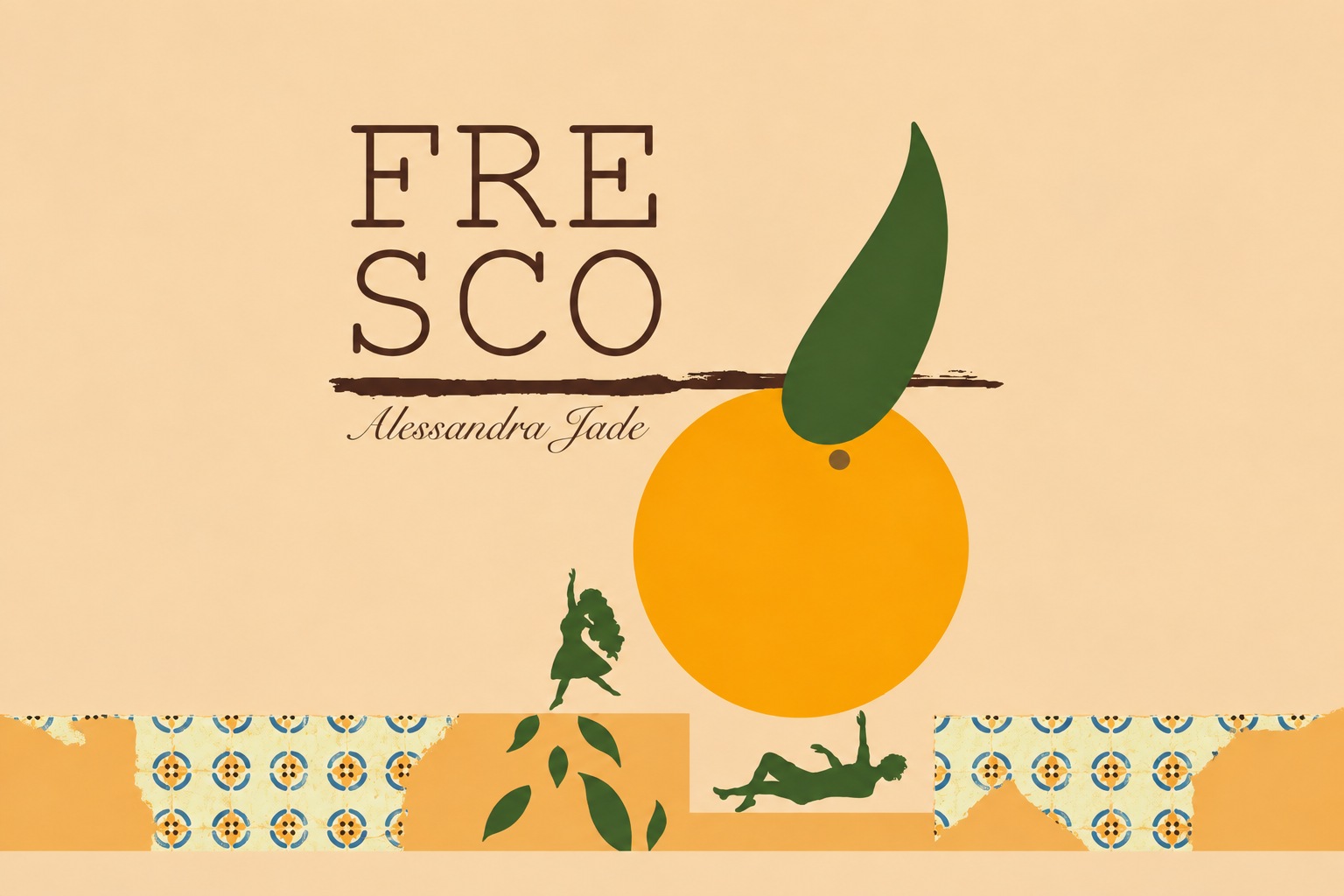
Khazimla Louw reviews 'Fresco' by Alessandra Jade
Share this piece
Pass the story on to your people.
Publisher: Alex Jade Works
Type: Novel
Date Released: October 2026
Retail Price: +/- R 355.00
Format: Paperback (338 pages)
Contrary to its definition, Fresco is nothing like a breezy watercolour painted on the high ceilings of a centuries-old cathedral. This novel is like an oil painting, rich, layered and vivid. Alessandra Jade’s 2026 debut shows incredible promise and potential as her characters, Johnny and Natalia, work through their feelings and grief in sunny Sevilla.
Set in mid-2000s Sevilla, Spain, the novel follows Johnny Neumann, a Canadian traveler, as he arrives in Sevilla to help one of his late father’s friends, Claude Stefanos, settle and plan out his estate. When he arrives, he is enamoured with the mysterious waitress and small-time singer Natalia Jain, an Indian immigrant. After he arrives at the Grand Hotel Fresco, the two toe the line in a tentative tango as Natalia pulls him into her orbit. As feelings develop and the Seville heat boils over, secrets, tensions, and tragedy threaten to shake the already vulnerable foundation of their relationship. Fresco, at its core, deals with the idea of complex human relationships, along with themes of grief.
When I first started reading this novel, I foolishly thought it would be one of those easy reads that are easily deciphered by the time you get to page fifteen. Jade is both devious and a genius for this, because by the time I got to page twenty-five, my haughty, misconstrued assumptions of the novel were royally wrecked.
Unlike Christine Féret-Fleury’s dreamy romanticism of Paris and reading in The Girl Who Reads on the Métro, Fresco sets itself apart and lives loudly as it bobs and ebbs its way along to the end.
But beneath all this glorious unpredictability lies something far more intimate: grief, and the many shapes it takes. Johnny, Natalia, and even Claude’s grief serve as one of the main plot drivers. What I loved about this book is how Jade reminds us that grief is not always rooted in death, but can also emerge from the people we once were, the lives we imagined for ourselves, and the futures that never came to be.
Grief is also tied to how each character interacts with the world around them.
Natalia is apprehensive at first, particularly when navigating unfamiliar relationships and confronting aspects of herself she has yet to reconcile.
Claude has a habit of seeking familiarity in the people he surrounds himself with, perhaps in an attempt to reclaim something he has lost.
Johnny, meanwhile, is still navigating the freshness of his grief, and many of his decisions seem less concerned with holding on or letting go than with simply finding a way forward.
Jade is a writer who has a good idea of what nuance is, and I can only see her getting better at it with more development as a writer.
And nowhere is this nuance more apparent than in the relationships she constructs, where the boundaries between love, loyalty, friendship, and self-preservation are seldom clear-cut.
The many relationships and their complexities in this novel lay the ground for the plot. Jade plays around with a multitude of relationships and how they are shaped and maintained. Johnny’s and Natalia’s relationship on its own questions multiple conventions surrounding race, religion, and privilege.
Oftentimes, relationships that mirror theirs – that deal with such stark complexities in race, religion, and privilege – are portrayed as incredibly lopsided or destined to fail because of the disparities between those involved. I appreciated how Jade was able to break away from the predictable poor girl/rich boy trope and gave us a “relationship” that had an interesting dynamic to it. I think what I appreciated more was that Johnny never sought to “save” Natalia.
A lot of stories tend to have a rich character that always “saves” the poor character, but this book strays away from that constrictive plot line.
Yet, Natalia and Johnny’s relationship with Claude also brings up questions.
I would discuss it, but you have to go read the novel, and we can talk about it together in our comments section below.
Claude is hardly the only character whose presence adds another layer of complexity to their lives. Natalia and, later on, Johnny's relationships with Maria, Carmelita, Fredrico, Guílbert, and two of the girls working at Danté’s reveal more about their personalities.
With Natalia being an immigrant, particularly in Spain, which has a difficult relationship with immigrants, I find it heartwarming that Carmelita and Maria have such a close bond with Natalia. The same goes for Johnny. It’s refreshing to see him ingratiate himself into the fabric of Sevilla without being an entitled tourist leaning heavily on harmful stereotypes.
Because Natalia is an Indian immigrant, in a city where she first knew no one, she had found refuge with a group of people. who would not necessarily fit the proverbial "good people" mould. When you consider Kiki and Ruben's line of work, the ‘good’ people wouldn't really bother befriending them. The idea of morality compels people to look down on them, and I love how Jade humanises them. I also love how Johnny doesn’t freak out during an unexpected interaction with Ruben, which could've gone very wrong, very fast.
As readers, we come to realise that Natalia herself is also someone whom society has deemed unworthy. Having left home, travelled to a far-away place, following her dreams (sort of) and working in an unstable industry, most people would see her as reckless and impulsive. Cultural expectations have weighed heavily on her, and instead of buckling under the pressure, she decided to leave. Not a lot of people have that kind of bravery, and those that do have it tend to be made outcasts.
Natalia channelled that animosity and backlash and built a life for herself, and I think that's pretty admirable. Her relationship with her pastor uncle Jean-Francis, however, is far more complicated than it initially appears. Her uncle has some very staunch and unflinching Christian convictions, often driving Natalia away. This has led to the two not really seeing eye to eye, and the atmosphere is quite frosty whenever they are around each other. I would have loved to know more about the breakdown of their relationship. There's a particular tension between them, and I don't think it's largely due to her indifference towards the church. Despite my reservations about the limited exploration of Natalia's relationship with her uncle, Jade generally does a great job of crafting and bringing her characters' relationships to life. I particularly appreciate how distinct each relationship feels. Even though many of them overlap, they retain their own identities and complexities.
And as mentioned before, Johnny and Natalia's relationship, in particular, stands out, and there’s one line in the novel that I feel perfectly captures the rather unusual nature of their connection:
“... I hate to admit that his smile was growing on me. Growing in the same way the powder blue grew on old oranges, but growing, nonetheless.”
(Page 29)
Natalia’s odd comparison of her growing feelings towards Johnny to mold was comical at first, but it makes sense. Mold doesn’t immediately engulf its host in a swoop. It starts small, spreading steadily as it overwhelms and overpowers its host.
This is a clever metaphor that feels a little backhanded to Johnny. Natalia fashions herself as the old orange. She sees herself as damaged goods that would never be seen as valuable or worth a second look. Johnny, as the mold, looks past her imperfections and slowly enters her world slowly and steadily, eventually blending himself so well into her world that he completely engulfs her senses, like mold on old fruit. I hate how I came to this conclusion. (No oranges were harmed in the making of this analysis.)
While Johnny feels that Natalia controls the nature and subsequent progression of their relationship, it becomes apparent to the reader that Natalia had, for a while, ceased to control the relationship.
But enough about what Johnny represents in Natalia’s life. Having explored the main relationship that shapes the novel, I’d like to turn my attention to the characters themselves, starting with Johnny.
Bless Johnny’s soul, but who bites into an orange, rind and all? Who? Shade aside, Johnny is… okay. He’s not overly elaborate or written as the quintessential male, but he's no jackass either. He is clumsy, though, because who wears creased shirts to the bar? There’s something very comfortable within him.
I loved how a lot of the characters could naturally be themselves without having to shrink to fit some proposed idea. Also, there's a cute scene at Natalia's apartment near the end of the book that made my heart warm. I love how devoted he is to Natalia, even though their relationship was never really labelled. (The boy would bark if she commanded.) Alessandra really did a great job writing and creating a character that was introspective and intuitive without it feeling performative or forced.
Natalia, on the other hand, is not quite as forthcoming with her emotions, although this doesn't necessarily make her any less capable of forming meaningful connections.
Although initially presented as this mysterious, evasive woman, she is actually very easy to read. She keeps a close circle, and even within that circle, she keeps everyone at arm's length. There’s this pessimistic romanticism about her – it’s an odd paradox, but walk with me. Because of her tumultuous relationship with her uncle and, by extension, her family, it is almost expected for her to be less inclined to forge meaningful and lifelong relationships as she grows older. However, her relationship with other characters such as Maria, Natasha, Kiki, Ruben, Amina, and Carmelita says otherwise. She heavily relies on them as her pillars of support, and they are her confidantes, even if she doesn't always tell them everything.
This was refreshing, in a way, as a lot of the “femme fatales” in Southern European settings tend to be written in a brutish, over-sensualised, and arrogant manner. I liked how Jade didn’t make her a pitiful character who saw no way out, but I also appreciate how she wasn't written as a total b-word.
And then there's Claude.
Claude, Claude, Claude...
This man is an enigma.
He’s as vague as fog on a cold June morning but is so incredibly detailed and obvious, it hurts my retinas. I will be honest, his story felt a little patchy, and I just wished everything had gradually been in place rather than bundled at the end in short bursts and paragraphs. Other than that, his joviality was contagious (I could actually hear his little “Ha!” every time it came up.) He did scare me, though, with how much sugar he puts in a coffee, but who am I to judge? I do admire his closeness with his employees (even if the gardeners overwater his begonias).
I do have some mixed feelings about how Maria, Carmelita, Fredrico, Ruben, and Guílbert are presented as characters.
While they are minor characters whose involvement only exists to embellish the story and to amplify the main leads’ stories, I do wish that Jade had spent more time to avoid them being generic in nature. Carmelita plays straight into the old formula of the tough-as-nails manager who’s quick with a diss. Ruben, in his flashy and unapologetic queerness, is hollow and empty without it. It feels mean to judge the character development of side characters, but if they are making frequent appearances, I would like for them to be a bit more rounded out and planned out.
Ultimately, whilst these characters are meant to add colour to the novel, their lack of depth makes them feel more like familiar archetypes than fully realised individuals, which is disappointing given how much care Jade puts into developing her main characters.
All in all, I enjoyed this novel.
I loved the dual perspectives, and it allowed the reader to fully experience both points of view. It was imaginative and emotional, and it really makes you think about the lives we live and the choices we make, and how those choices affect us in the long run.
I also love how descriptive she was when explaining the backdrop of the novel. I loved how it didn’t feel superficial.
Although Jade is South African, originally from Durban, using a setting in a novel that’s not your own in a novel is a difficult task because your ability to fully bring it to life on paper is hindered to a certain degree. Jade, however, does a good job immersing the reader. She has really done her research to give the reader the best experience. It’s a promising example of how escapism can be used to appeal to the reader’s senses, and this will be one of her strong points moving forward in her career.
Fresco by Alessandra Jade retails for +/- R355.00, and it is worth every penny.

About the author
Khazimla Louw
Just like when Queens needed a neighbourhood friendly Spiderman in Peter Parker, Cape Town found itself a neighbourhood friendly wallflower in Khazimla Louw. Always on the hunt for a great book and great coffee, she is constantly (though not so subtlety) chasing after what she believes is the next "book of her life." As a new literary blogger finding her way and standing in Cape Town's burgeoning literary landscape, she is determined to be the spark that leads many eyes and minds to South Africa's new pantheon of literary greats. When she's not snuggled up with a book and wine, Khazimla can be found either sneaking off to her nearest libraries, whisking and baking up a storm in the kitchen, or being overly passionate about sports.
View all work by Khazimla Louw