The Fear We Inherit
Rushdiyah Narker reviews ‘Kinnes Van Somers’ at Baxter Theatre
Share this piece
Pass the story on to your people.
Script: Devised and developed by the ensemble
Direction: Hanro Cloete and Tamsyn Alexander
Starring: Caitlyn Haywood, Irmah Jeleza Tiemie, Katelynne Matthews, Tameka Petersen and Tamsyn Alexander
Sound Design: Hanro Cloete and Malibongwe Bonakele
Venue: Baxter Theatre
Genre: Devised Theatre, Physical Theatre, Magical Realism
Performance Dates: 6 October 2026 – 10 October 2026
As I walk into the Baxter Studio Theatre, the room is dimly lit. Blue lights above the stage cast a cool glow across the pitch-black walls. In the middle of the stage stands a rectangular wall hung with blue and white waslappies (washcloths), many of them sewn together into something the size of a blanket.
I’m the first to enter through the right-hand door, and on my way to my seat I almost bump into someone standing off to the side.
“Oh, excuse me,” I say, only to realise she’s one of the actors, busy washing enamel plates and cups in a big enamel bakkie (bowl)!
Now, didn’t I feel dom (dumb)?!
Once I’m seated, I notice another actor in the opposite aisle doing the same thing.
The clink of enamel echoes through the room, over the gurgle of water playing in the background. With the blue light and the dark stage, I am reminded of a submarine. I clear my head to see how my body responds to the space. The longer I sit, the more I notice my breathing slowing down, even as a slight panic rises with the feeling of being confined.
The room fills up, and the excited chatter dies the moment an announcement plays over the speaker.
The actor I thought I’d initially knocked into walks to the stage like one of my teenagers when I ask them to do something they have no pluck (inclination) for. She just doesn't smaak (have the feeling) for anything. She breathes heavily, drags her feet, and once she sits down, wipes the plates, the cups, and the bakkie with the barest effort, sighing with each action. The other actor joins her on stage, and slowly the rest of the ensemble follow until there are five women on the stage – the meide.
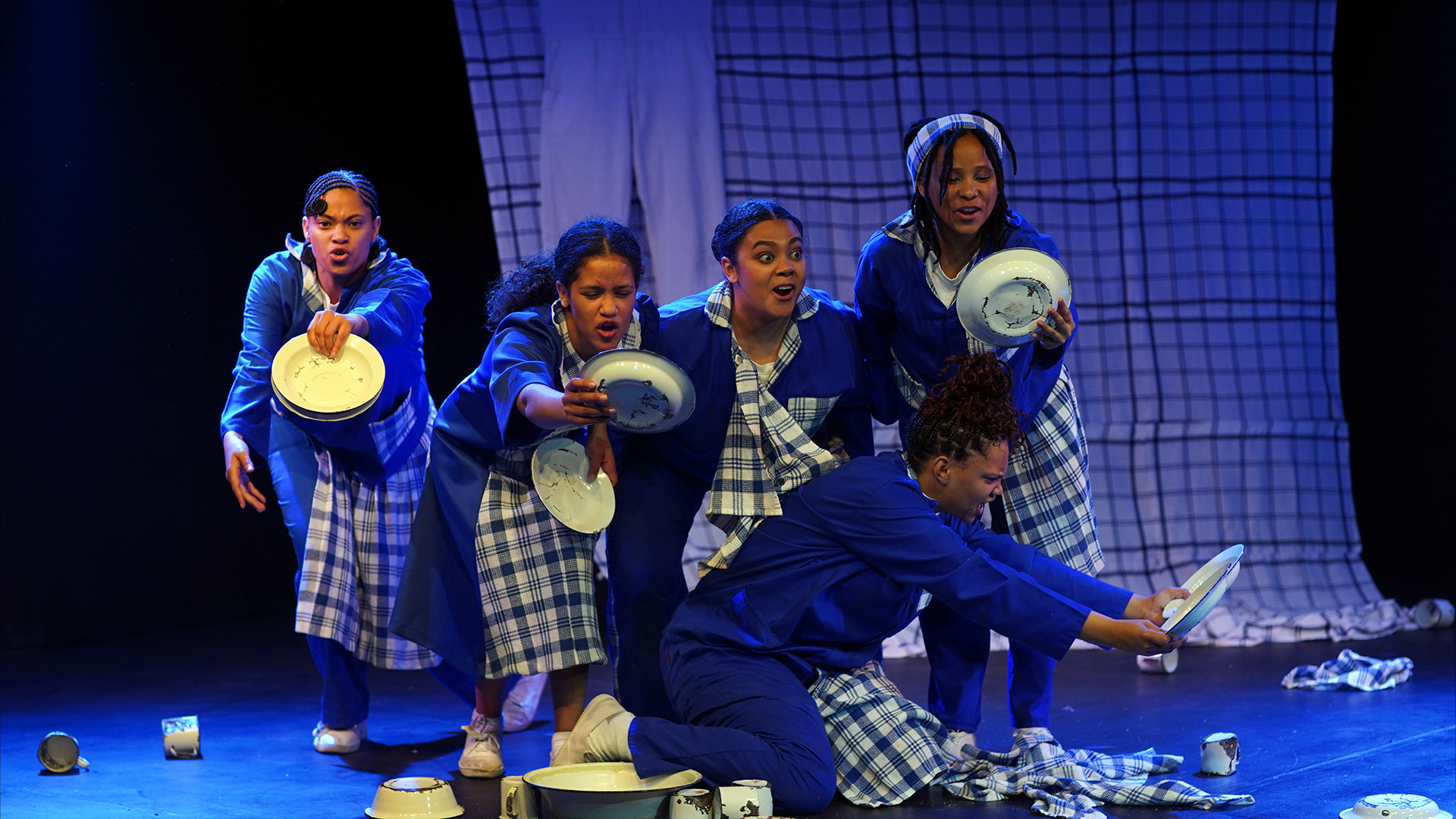
Four wear cobalt blue overalls, each with a white waslap in hand and pieces of the same blue-and-white checkedwaslap is stitched onto their clothing: across a pocket, around a collar or as a panel down the front.
The fifth, however, wears a waisted dress with the pattern in the centre panel, front and back, in the same blue colour.
Each of the five actors sits in her ow spot with her own bakkie and waslappie, cleaning.
No one speaks for what feels like seven to ten minutes.
I found myself wondering when they would start, though I soon realised that the performance had already begun. The meide were communicating through their bodies and faces, without needing dialogue. The meide interact through their bodies and faces, and that stretch of silence is what first drew me in. Already there is an established language in Kinnes van Somers.
When the dialogue finally begins, the words appear as a translation on the rectangle in the middle of the stage, in the form of surtitles, so that anyone who doesn’t speak Afrikaans can follow along. I thought that was really cool, but it’s also where the production lost me at times. I’m someone who has to read words when I see them, and even though I understood the dialogue, I found the screen distracting. In a show built on physical theatre, I had to force myself to look away from it and watch the actors. This is not a criticism on the production, but perhaps placing the text lower, or only using it for key passages, would let the physicality stay in focus?
And so begins Kinnes van Somers, a devised theatre production with elements of physical theatre and magical realism, and one of two Finest of the Fest winners at the 2026 Zabalaza Theatre Festival. Conceptualised by Tamsyn Alexander and Hanro Cloete developed collaboratively by the ensemble, the production is also directed by Alexander and Cloete; celebrated, award-winning director and theatre maker Sylvaine Strike serves as mentor to the team.
At the centre of the story is Antjie Somers, a figure drawn from Cape folklore. In the version the production engages with, she is not a supernatural creature at all, but a real person who became a legend: a bogey figure used to warn children away from the water and the mountain.
The production also nods to the children’s rhyme and game tied to her name. The actors sing songs I’ve heard before. Maybe I, too, played that game as a child, but I don’t remember the games being so dark. Perhaps that is the strange thing about folklore: we can inherit its words long before we understand the fears they carry. The production reveals how knowledge gets shared through oral tradition. But what is being passed down here is not only story; it is also history, fear and cultural memory, all of which feed into the production’s centring of the Coloured experience: from the dop system (when workers were given alcohol as part of their payment) and cheap labour on farms to the ways families used folklore and myths to keep their children safe through the invention of the bogeyman.
For those unfamiliar with South African folklore, Antjie Somers is not a securely identifiable historical person, but a figure whose identity evolved through oral tradition.
Nineteenth- and twentieth-century accounts variously portray Antjie as a ghost-like figure, a highway robber, a man disguised as a woman, a witch-like hag with masculine features, or the commonly-known child-snatching bogey who carries away disobedient children.
The earliest recoverable form of the legend appears to centre on a man dressed in women's clothing, whose disguise gave rise to the feminine name and appearance while retaining traces of a masculine identity. Over time, some storytellers preserved the man beneath the disguise, while others recast Antjie as a woman.
This ambiguity also appears in accounts of Andries Somers, rather than Antjie Somers, and he too is variously described as a fisherman, fugitive, or robber who retreated into the mountains. However, there is no archival evidence identified in this research that confirms the existence of an enslaved man named Andries Somers as the historical prototype.
Antjie and Andries are therefore better understood as alternative identities within an evolving folklore tradition, rather than as two distinct historical individuals.
That oral tradition matters because it is often all we have. For many South Africans, tracing family histories is complicated by generations of displacement, erasure and incomplete records. Oral traditions can therefore carry memories that written archives do not preserve, and most people don't realise what a privilege it is to know their family tree for generations.
What we do have are the folktales and myths we tell each other.
Underneath the production and its beauty of bringing oral tradition to The Baxter is fear, and how we’re taught it: fear of losing a job, of being unable to put food on the table, of being punished for not following an oppressor’s rules. The story of Antjie Somers is meant to incite fear and keep the meide together, and anyone who questions it is cast out of the larger group. As the production unfolds, one character keeps staring off into the distance while the other meide keep their eyes on her, afraid of what she sees.
Because Kinnes van Somers unfolds in a dreamlike or nightmarish state, some uncertainty may be intentional. However, there is a difference between an audience feeling disoriented within the world of the production and an audience being unable to understand the world itself.
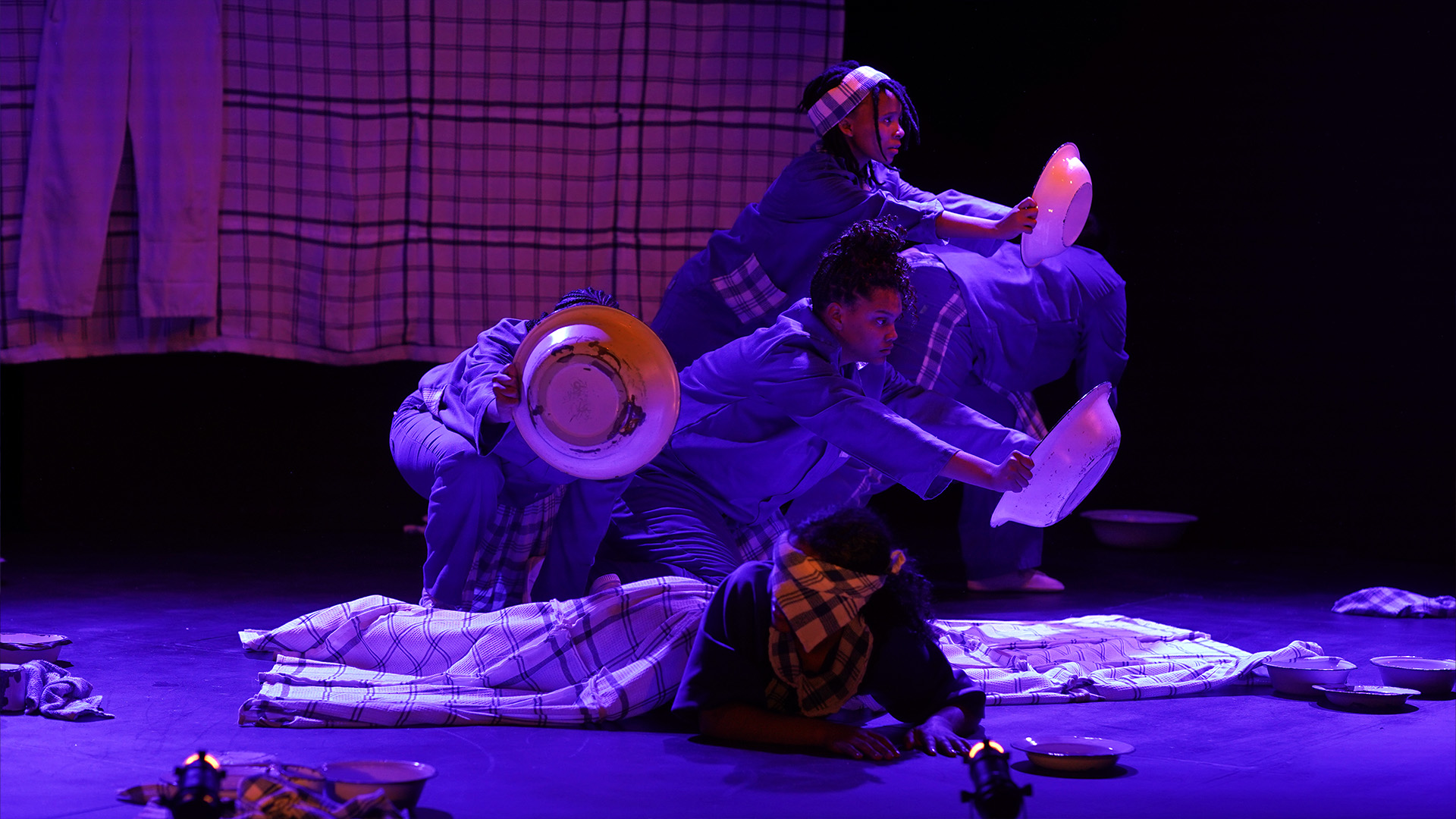
The production moves between different worlds: Dollie’s everyday life and her interactions with her Ouma; her work on a farm with the meide; the dreamlike sequences at the sea in which the meide recount the story of Antjie Somers. The changes in locations occurred in how the meide would interact with the enamel bowls, plates and cups. When on the farm they would be holding the objects, cleaning or interacting with them somehow. During the dreamlike sequences, the bowls were left alone or used to create a larger image with the characters’ bodies, and the waslappies were used as physical clues for the sea for instance.
Oumie’s shifting place in Dollie’s story also made me think more broadly about what these dreamlike sequences might represent. I read them as a form of collective memory where fear, the need to belong, and a reluctance to question inherited beliefs remain constant even as characters and settings shift.
These changes seem to suggest how, within close-knit communities, fears can become absorbed by the group and repeated long after their origins have been forgotten.
When these beliefs go unquestioned, they can become part of the community’s identity without anyone quite knowing where they began.
An important dramatic question also arises: why the audience should care about Dollie? Her conflict begins to emerge when she questions the status quo and the role assigned to her as one of the meide. Her curiosity is met with bullying and resistance, yet the sea continues to call to her, symbolising the possibility of a life beyond the farm.
Within this interpretation, Antjie/Andries Somers serves a compelling symbolic purpose: representing the fear that keeps people confined to what is known and familiar, even when that familiarity is oppressive. A thought-provoking production leaves the audience questioning…
What would it mean for Dollie to defy the expectations and limitations imposed upon her?
Could the meide themselves be caught in the very fears embodied by Antjie Somers, trapped in identities and circumstances they did not choose, unable to imagine another life?
What I kept asking myself, then, was whether the production really had a through-line, and it surely does, but did I feel it while it was happening?
The link between Dollie’s resistance, the sea, and Antjie Somers was there, but at times too faint to catch in the moment. I only pieced it together afterwards. I wanted to feel it building scene by scene, the way you sense something is wrong before you can say what. The challenge is to let that underlying conflict come through a little more clearly without losing the dream-like ambiguity that makes the production so haunting.
This raises a broader question about the production’s structure, particularly its frame narrative and overall arc. While the connections between scenes and images aren't always immediately apparent, the physical language and symbolism were, for me, the best parts of the production. But does the movement carry meaning on its own, or does the text need to do more to tie everything together? And should physical theatre have to make itself understood by every person in the audience anyway?
Does a story need a conventional plot or spoken words to be told well?
A body can show grief, conflict and memory without saying a thing, and I felt that here. So, the real question isn’t whether the production needed more explanation or a more traditional structure. Instead, it’s whether its physical and symbolic language was consistent enough for me to meet it on its own terms?
Having the audience potentially be confused isn’t the same as being failed by the story, as ambiguity in storytelling can be a strength. What I’m left wondering is where the line sits between ambiguity that is deliberate and moments when I simply couldn’t tell how the movement and the meaning were meant to connect.
And if the audience may struggle to connect every movement to the larger narrative, the physical language of the production was often powerful in its own right. The actors created eerie shapes and sounds with the props and their bodies, making the movement feel seamless.
The minimal set and props put the five meide at the centre of the story, and they carried it well.
The pace of the show forced me to slow down and pay attention.
In the same way I sometimes read too fast, skip over words, and have to go back and read more slowly, I found the
pacing of the performance a way to slow us down as an audience.
The production started at 8 pm. I’d had a full day of work, done three batches of washing, made crumbed chicken from scratch for my family’s supper, and waited to perform Maghrib (sunset prayer time) before leaving the house to get to the venue on time. It was a busy day with lots of timelines to meet. Sitting in the Studio at The Baxter tonight, watching Kinners Van Die Somers, forced me to breathe with the actors, to slow down the breath that is usually higher because of the demands of the world.
That very breath was the heart of the performance for me.
The actors work as a team, using breath to create the illusions that tell the story. They pant when they work hard, so how often do labourers, on the sea or on the farm, get to take a deep breath and reset their nervous systems?
When the meide breathed in unison, I found myself copying their pattern, and the atmosphere in the room changed with it. The act of breathing was loud and pronounced, and I wonder whether it was intentional in wanting the audience to emulate the action.
The lighting did a lot of effective work too, moving from very light to eerie while staying within that blue that kept making me think of drowning. In one section, the light projected Dollie’s body across the walls in short spurts, as though there were more than one of the meide on stage. I found that so disturbing.
The production’s score, also designed by the multi-faceted Cloete, with assistance by Bonakele, adds to this, with the music, the water in its various forms and the actors’ a cappella sounds all feeding the eeriness. That unease seems to spread through the room. A few of us would lean forward whenever something happened on stage, trying to see better. For me, that physical response from the audience was an indication of how immersive the storytelling had become. I sat in row D, and because of the tall person in front of me, I sometimes had to look between the heads of the two people ahead to see the stage. Sometimes, though, only hearing what was happening was creepier than seeing it clearly. There were heavy moments, but also moments of comic relief that gave us a few seconds to breathe. Even in the lighter moments, I stayed anxious, because I kept wondering what would happen next.
That lingering anxiety pushed the production, for me, into the territory of horror. Like a horror film that builds tension through the suggestion of something unseen, the production used light, sound and movement to make me afraid of what I couldn’t see, and sometimes of what I could only hear. That's how real the horror felt to me. I was relieved to escape the submarine-like space and breathe in some fresh air, reminding my brain that I was not, in fact, in any danger of drowning.
Perhaps that horror and uncertainty are part of what the production asks us to sit with. On my way out, I heard someone say that they didn’t understand any of it. As I have mentioned, I too had moments where I only began to understand certain connections after leaving. I hope they look up the folklore, particularly those stories rooted in Coloured identity and cultural memory that they may not have engaged with.
Should art constantly explain and over-explain for an audience that doesn’t share the lived experience being explored on stage?
Should the production be solely responsible for teaching a new audience everything?
Is there beauty in leaving some things unresolved and creating space for viewers to engage with the work on their own terms?
And perhaps that is especially important in a production so concerned with folklore, because these stories do more than preserve cultural memory: they also preserve the fears, warnings and rules carried from one generation to the next. That physical fear also speaks to what the production suggests about Antjie Somers herself.
That is why Dollie’s resistance in the production feels so important. Her willingness to look beyond what she has been told, even when the other women refuse to look with her, becomes an act of defiance.
The sea holds both danger and possibility: it is something Dollie has been taught to fear, yet it also represents a world beyond the confines of what she already knows. Her defiance against the meide therefore comes at a cost. To step away from the safety of the group is also to step away from their reassurance, encouragement, and support. Dollie must decide whether belonging is worth the price of remaining confined by the same fears she has started to question.
That tension between inheritance and resistance also sits at the heart of the Antjie Somers legend itself. There are different versions of the stories of Antjie and Andries circulating across South Africa for this very reason. The ambiguity surrounding Antjie Somers, the women and the world they inhabit may not always be easy to follow, but perhaps that uncertainty also belongs to the instability of oral tradition itself. Stories shift according to who tells them, who remembers them and what a community needs them to mean.
In the end, Antjie Somers is just a bogey figure meant to frighten. For me, she becomes a symbol of something inherited, a fear passed down through stories until it stops belonging to one person and becomes part of who a group is. The warning survives because the story continues to be told; the story is the vehicle through which that fear is first instilled. But the fear itself runs deeper than the folklore. It is bound up with questions of belonging, identity and the consequences of stepping outside the group, and would likely persist even if the story disappeared. And fear does a lot of work: it keeps people obedient, cautious, quiet and close to what they already know. Most of all, the fear stops the meide from asking what might be possible beyond the boundary they’ve been taught not to cross.
That fear becomes visible in the way the women police the boundaries of belonging among themselves. I saw that in the way the meide carry on with their lives and the way one character keeps repeating “Onse mense,” a phrase that marks a belonging that is theirs alone.
Dollie is the opposite of that.
Her willingness to question the rules shows that she is prepared to challenge the status quo, and she comes to represent the desire for a better life and the possibility of moving beyond what has already been decided for her. The production doesn’t tell us that inherited stories are simply good or bad. Instead, it shows how we use stories to protect and restrict at the same time, depending on who you are and where you stand.
What stayed with me most was how dangerous it can be to accept something without questioning it, and it made me wonder which fears of my own I’ve never thought to examine.
By the end, I realised that I had come to understand the production through breath: the women’s breathing, my own, and the way both changed as the atmosphere grew more constricting. When the meide breathed together, I found myself breathing with them; when the room tightened, my own body tightened with it.
I was relieved to leave the submarine-like confinement of the Baxter Studio Theatre after the production and breathe in the fresh air outside, signalling to my body that I was, in fact, in no danger of drowning.
Walking outside felt almost like breaking the surface of the water.
Perhaps that is what I carried most strongly from Kinnes van Somers: the sense that fear can be inherited and taught until it feels as natural as breathing, but that somewhere within that inheritance remains the possibility of questioning it, resisting it and drawing a different breath.
About the author
Rushdiyah Narker
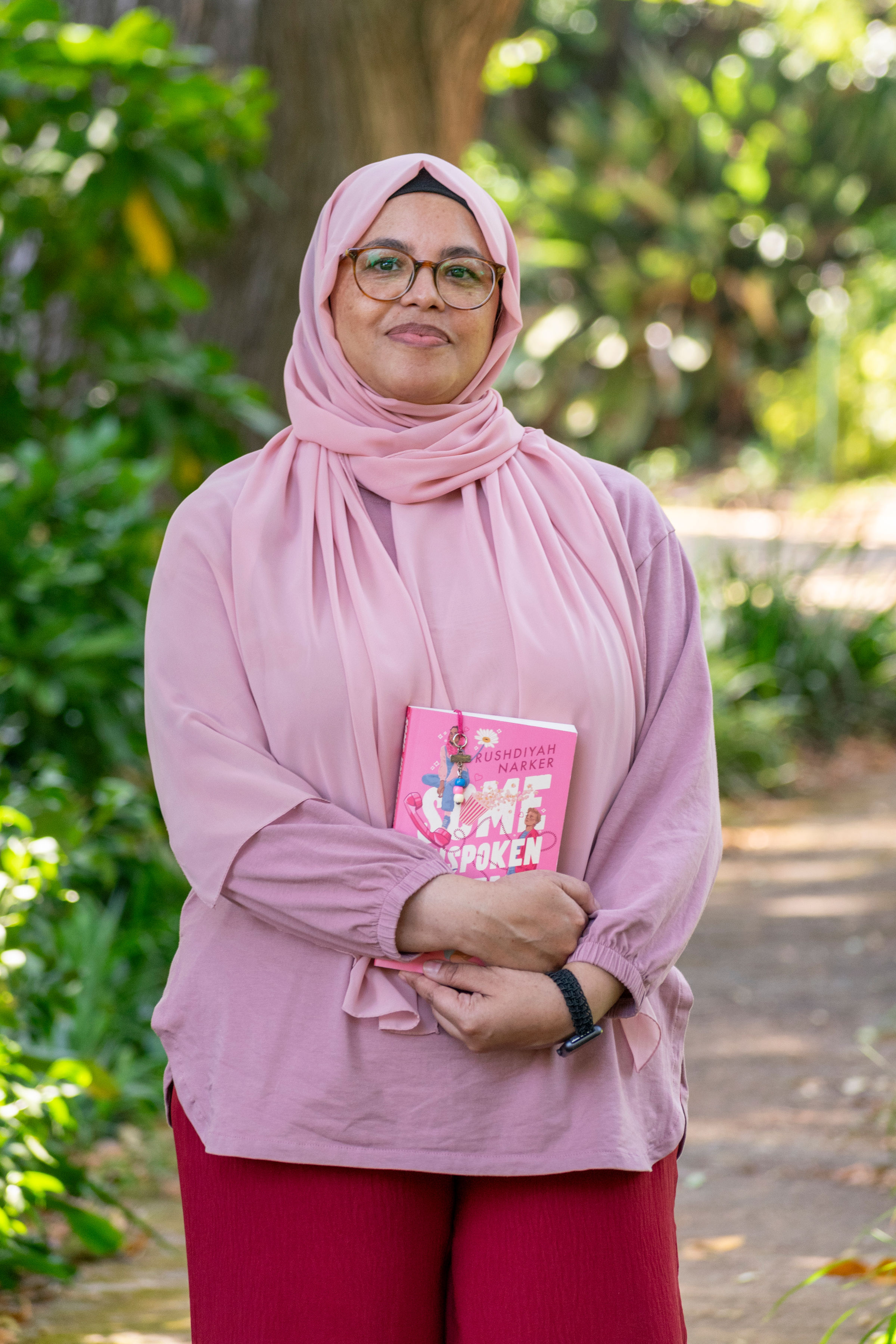
Rushdiyah Narker has moved from making up stories in her head to writing them down. She uses the skills she learnt while getting her Masters in Social Anthropology to write stories about the culture she grew up in. 'Some Unspoken Thing' is her debut young adult novel enjoyed by kids 13 to 60 years of age. For funsies, she reads a book a day and loves to go to the theatre, galleries, and movies to experience different forms of storytelling.
View all work by Rushdiyah Narker