The Weight of Power. The Burden of Proof.
Rushdiyah Narker reviews Prima Facie at Baxter Theatre
Share this piece
Pass the story on to your people.
Script: Suzie Miller
Direction: Neil Coppen
Starring: Danica De La Rey Jones
Venue: Baxter Theatre
Genre: One-woman show
Performance Dates: 4 August 2026 – 29 August 2026
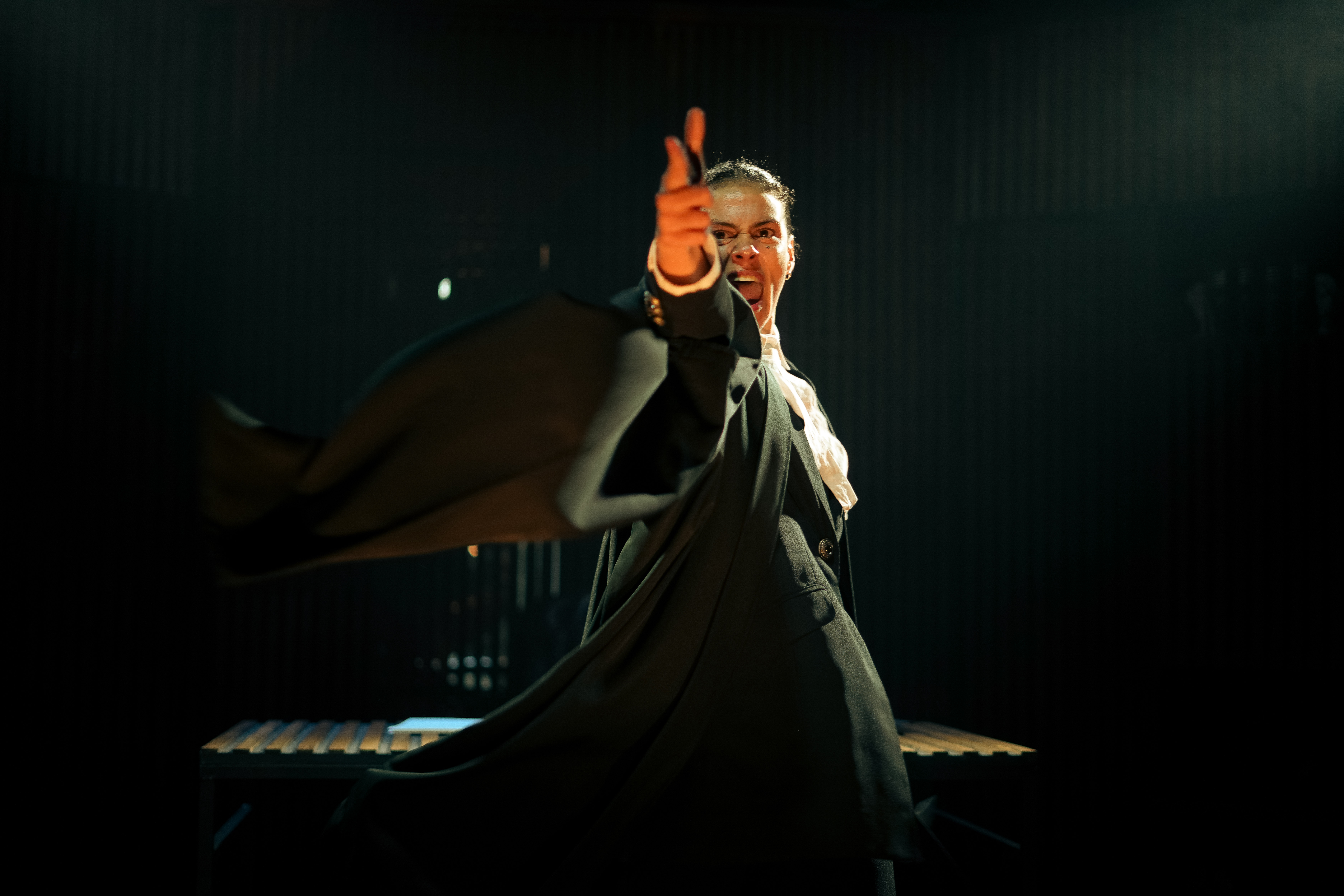
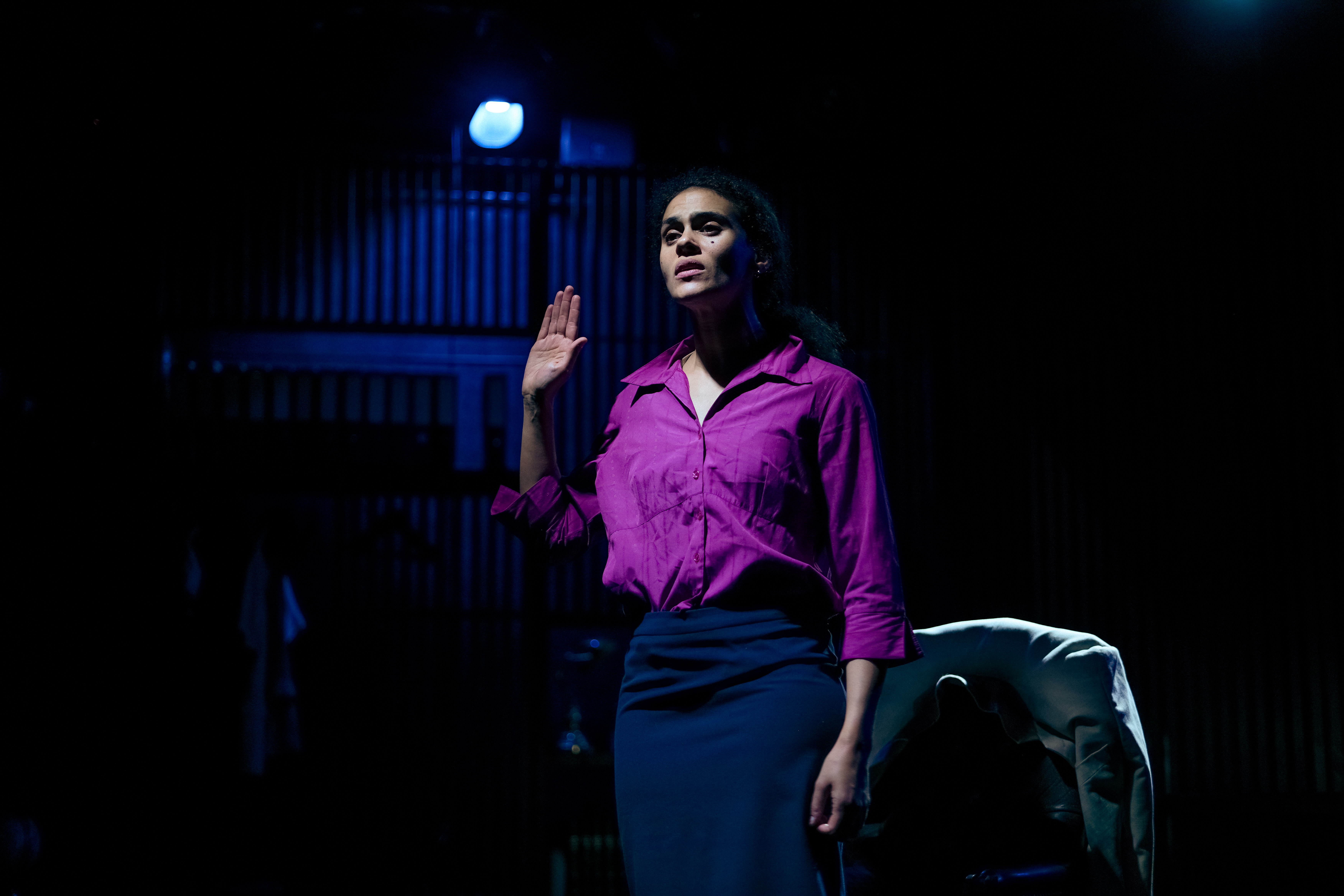
The play starts with Danica De La Rey Jones in the centre of the stage, a light beaming down on her. She is standing in her barrister cloak, black pants, white shirt, hair in a low bun, before she narrates how she is interrogating a witness on the stand, comparing her skill to a racehorse getting ready to shoot out of the starting line.
The audience watches with bated breath. The play is about to confront a heavy and sensitive subject matter, and there seems to be a moment of uncertainty around whether to laugh at the racehorse comparison. Although I had no reservations about the subject matter, the subdued response around me gave me the impression that others were less certain.
And so unfolds Prima Facie, an uncompromising one-woman play that runs for 120 minutes. From the very first beat and throughout, De La Rey Jones moves across the stage with energy, enthusiasm, and purpose. I was immediately drawn in by the play’s distinctive use of self-narration. Tessa functions as both a character and narrator in the play, directly telling the audience what she is thinking or what she is about to do before the action is physically performed on stage. In this way, the audience does not simply watch Tessa’s actions unfold; we also hear her narrate and interpret them as they happen. Although this technique could easily feel repetitive or overly explanatory, I found it engaging.
Personally, I felt that we were being introduced to a narrator who speaks through all their actions, and this is something my friends and I do too. For a psychologically intimate story such as Prima Facie, the character’s thoughts and actions cannot be disentangled, as the narrator’s voice co-exists with both; I am never without a similar presence in my own head. Through this technique, I felt privy to the main character’s innermost thoughts, as though I had been granted access to the voice inside her head.
And that intimacy becomes particularly important once we understand who Tessa is and how deeply she has invested herself in the legal system she inhabits. The play follows Tessa, a young, brilliant barrister who stems from a working-class background and who has risen to the top of her profession through her cutting skill at defending, cross-examining and winning cases. She initially has enormous faith in the legal system and in her own ability to operate within it until an unexpected and traumatic event occurs. Tessa is then placed on the other side of that system she so championed, and her experience forces her to confront the patriarchal biases embedded within the law, particularly around consent, credibility, and power.
With a demanding premise that places enormous pressure on its performer, requiring her to hold both the intellectual rigour and emotional devastation of Tessa’s journey, De La Rey Jones succeeds in sustaining the play’s intensity without allowing either aspect of the character to overwhelm the other. One of De La Rey Jones’ strengths is her ability to summon a plaintive vulnerability through her voice, which, to me, stands out as a member of the cast on its own: sometimes soft and teasing, at other times brash and loud. She moves effortlessly between these registers according to what each scene demands.
De La Rey Jones’ command of character is not limited to her voice; it is equally present in the way she uses her body. Her body language shows us when she’s confident, flirty, or scared. She is not shy about making eye contact with the audience. I sat in the front row and, in the first part of the show, she often locked eyes with me. As the play progressed, I noticed how the eye contact became less direct. Due to Tessa moving from being a fierce barrister who wins cases to a flirty yet unsure woman, revealing her hopeful connection with someone at work, to thereafter a survivor of assault who has to testify in court, the change in eye contact is an indicator of her diminishing confidence. Still, De La Rey Jones moves through these scenes with ease, with a presence that is alive on the stage. This directorial choice by Neil Coppen is highly effective as a symbolic way of portraying Tessa’s loss of confidence after being sexually assaulted.
Although Tessa is the main character on stage, other characters show up in the play. They are all separate, their own persons, and De La Rey Jones does not pretend to be them; she brings them to life with a different posture, voice, cadence, and small changes to how she moves her body. Theatre is demanding, and a one-woman show can be even more relentless. De La Rey Jones, however, invites us to stay with her and demands that we do so through the entire show.
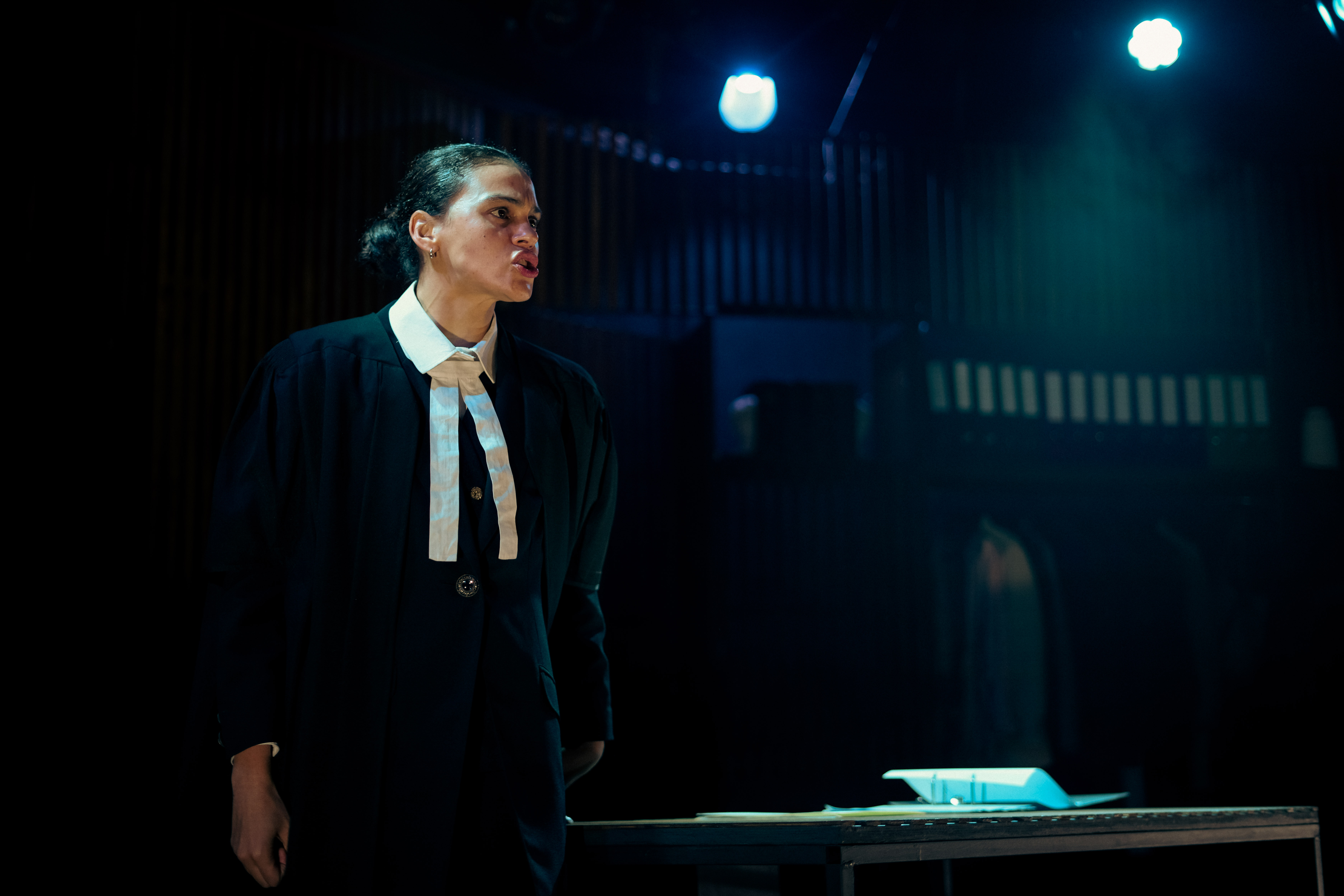
Accompanying De La Rey Jones are both great lighting and sound. Tina Le Roux, the 2026 Cape Town Theatre Awards winner for Best Lighting Design, allows the lighting to move seamlessly through the differentiation between Tessa’s apartment, the office, the court, and a bar – adding distinct depth, identity and texture to the atmosphere of each place. For a one-woman show, the lighting is of course integral to enhancing the storytelling on stage. At times, the stage is brightly lit; at others, spotlights isolate De La Rey Jones, directing the audience’s attention. As the tone of the play shifts from light-hearted to increasingly heavy, the lighting becomes even more effective. In certain moments, my attention shifted between De La Rey Jones and a space illuminated by a spotlight, creating the illusion that she was in conversation with someone who was not physically on stage. Even the timing of De La Rey Jones’ lines is perfected with the sound adding nuance, emphasis, and emotion to her line delivery. Each sound cue served a purpose in the story. It did not distract or detract from De La Rey Jones’ performance; instead, it added to it.
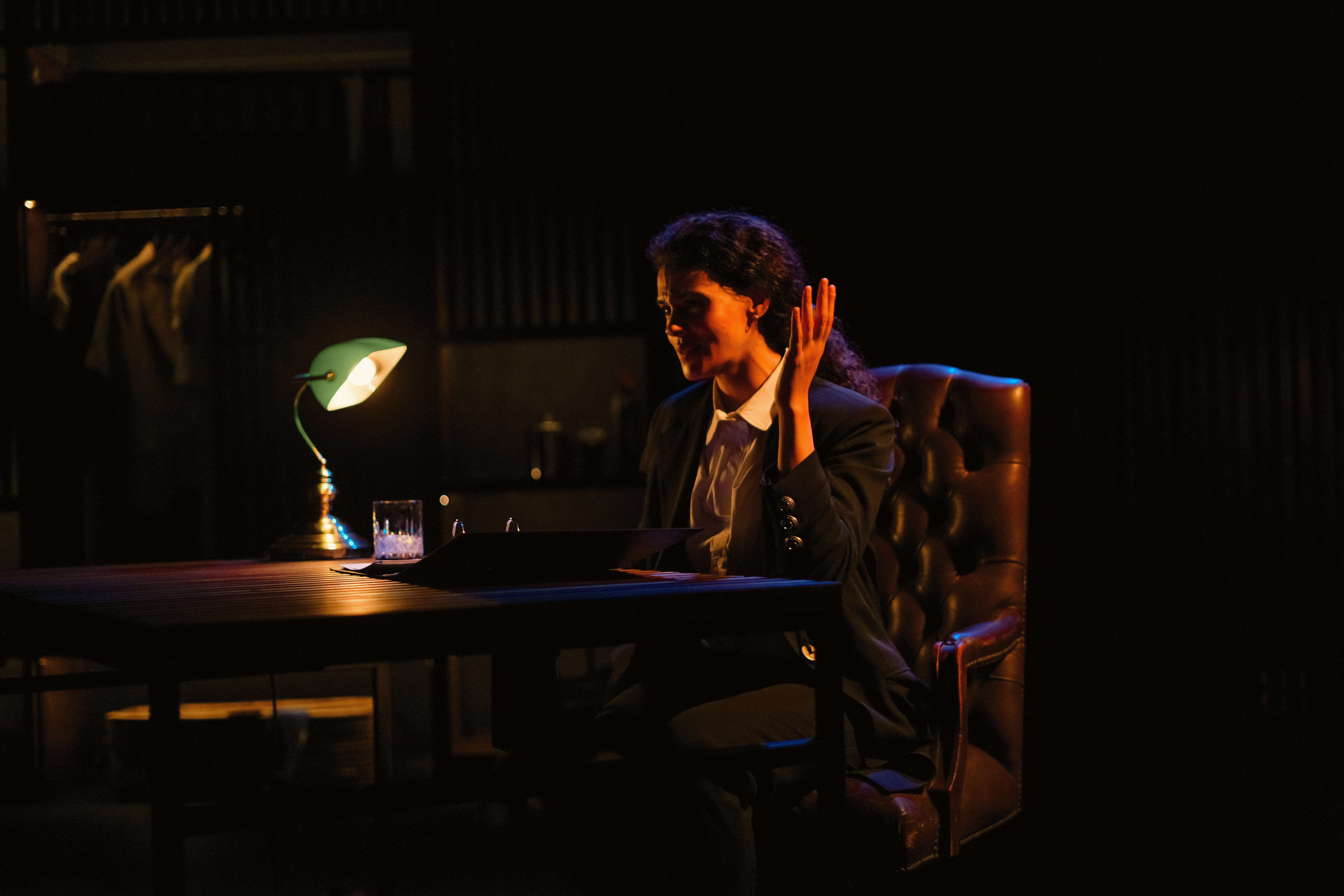
Initially, as I walked into the Baxter Theatre Studio, I noticed the set had open wardrobes against the walls with clothes on hangers, shoes in the bottom shelves, big arch lever files also stacked neatly in rows, books on display, decorative vases too, and even ornaments. There was even a section that looked like a little bar tucked on one end of the wall. A table on wheels with a wooden top the same as the cupboard with a leather office chair immediately conjured an office. Throughout the play, De La Rey Jones changes her clothes while the stage is devoid of lighting or has very little. This technique doesn't disrupt the flow or what's happening on stage. Instead, De La Rey Jones picks the clothes from the hangers and puts them on as she needs them. The clothes she does not use again, she discards in a basket at the bottom of the cupboard.
De La Rey Jones is also solely responsible for the set changes. She moves the desk on wheels, the chair, and a velvet rectangular seat as needed, but it doesn’t feel disruptive. It fits into the play seamlessly.
The original script was written by Australian-born playwright Suzie Miller. Since its 2019 premiere in Sydney, the play has become a commercial and critical success, conquering stages from Australia to London’s West End and Broadway. Now that the play has reached South African stages, the production incorporates local slang, colloquialisms and local expressions, particularly in its earlier moments. However, as we move deeper into the story, these distinct linguistic markers gradually disappear. For me, this reflects how Tessa’s ascent up the professional ladder increasingly distances her from where she comes from. Her language becomes part of the performance required to survive in the legal world, where lawyers are expected to speak, behave, and carry themselves in a particular way.
Aside from the language use, what I additionally found interesting is that the play is first told to us in a linear way.
We start at one point, where Tessa is an upcoming lawyer who responds to a colleague’s (Julian’s) flirting, and continues to a point where Julian and Tessa’s relationship develops. But when Tessa makes a case against her assaulter, she also shows us how victims don't remember things in sequence. We see how the events become jumbled because of the trauma of the event, and how a victim can't tell you where the perpetrator's hands were because all they knew was that they felt violated and trapped. Through Tessa, the audience understands how a victim will not remember things all at once. The play forces many in the audience to uncover many of their own traumas. As I sat there, I recalled the first time I made sense of remembering my own sexual assault – it’s like a colouring picture I’ve been working on for years, but it’s incomplete. This part of the play resonated with me.
Then, the act of sexual assault happens on stage. It is a harrowing scene to watch unfold. De La Rey Jones moves her body in a way that makes me believe there is someone in the room with her. She transforms from someone who was once trusting and confident in her body to someone whose boundaries are crossed and whose body is used without her consent. The hurt, confusion, and devastation are there in her face, in her body language, in her voice when she speaks.
Due to the sensitivity of the topic of sexual assault, a perhaps predictable staging choice would be to use symbolism during this scene. The narration and physicality by De La Rey Jones make it clear to the audience what is happening. And yes, Coppen perhaps could have used a more symbolic approach, but given how often the devastating effects of sexual assault are dismissed due to semantics or a lack of evidence, this scene needed to be on the nose.
No euphemisms.
No symbols.
Just a woman on the stage, portraying how a man can use their power to disregard her consent. Because sexual assault is never about the act of sex itself; it is about the power of one body over the other.
It is through this imbalance of power that the play begins to interrogate the complexities of consent. The play initially shows Tessa’s perpetrator approaching her flirtatiously, allowing her to either accept or reject his advances, thereby establishing their relationship as consensual. They have consensual sex twice. In court, however, this history is used against her, raising the question of how she could have consented before but not consented again. This highlights how we understand consent. Each sexual encounter requires consent. Yes, we can agree to be sexual with another person, but it is not a blanket consent form.
During the sexual assault and immediately after, Tessa knows exactly what’s happened. The further she gets from the incident, and with each person she encounters when she reports the incident, the further she is pushed from that certainty. We watch how the police officer's questions put doubt in her own mind. I found this part quite profound to see on stage. How the victim is made to prove their claim. I was watching how a system makes a victim doubt herself. Makes her feel like she may have misremembered. Makes her question what she knew immediately after the assault to be true.
Prima Facie leaves no space for the audience to breathe through its heavy subject matter.
We sit in discomfort.
The discomfort simmers in the air and pulses as the play unfolds. And I appreciated that.
Victims do not get to escape the effects of a sexual assault; we have to live with how it changes us.
We go from being a person who was one way before the assault to being another way after. We lose trust in our own ability to read people, to know who is safe and who isn’t.
If there is one area of the play that invites criticism, it is the monologue following Tessa’s cross-examination at the trial for the case. I found myself disconnected from the play when De La Rey Jones stands centre stage, directly addressing the audience about the consequences of a legal system rooted in patriarchy. This sudden shift from the dynamic and present storytelling from De La Rey Jones to a direct address to the audience felt at odds with the rest of the play. Up until that point, the production had allowed its social critique to emerge through character, action, and experience; however, the performance then takes on an almost motivational-speaker quality, making the overall message of the play feel more explicitly delivered than subtly revealed. As the audience, we are shown: all the ways the law fails the victims of sexual assault; how the victim is on trial instead of the perpetrator; how the prosecution only has to place some form of doubt over consent by the victim to get a verdict of not guilty. Therefore, having that particular monologue at this particular moment felt redundant.
If the monologue had been framed as Tessa realising the role she played in perpetuating a faulty system, the ending would have had more of an impact on me, and this would have highlighted how we don’t question the efficacy of a system until it fails us personally.
This is not a criticism of Coppen nor De La Rey Jones, but rather a comment directed at Miller. The writing in this moment slowed down the carefully articulated momentum of the story. However, the play picks up again when Tessa returns to the trial and finds her voice to argue her case as the victim despite the courtroom not being the space that welcomes this.
Despite my reservations about the monologue itself, one idea introduced within it becomes particularly powerful when the play returns to it later. Tessa reveals the statistic that one in three women worldwide experiences sexual violence. Earlier, when recalling her time at law school at UCT, she describes the Dean instructing the students to look at the person to their left and then the person to their right, knowing that one of the three would not make it. The play later repurposes this image to confront the audience with the prevalence of sexual assault, as one of the last lines of the play instructs us, the audience, to look at the person on our left, and then on our right, and know that one of us has been a victim, is a survivor – the person next to me repeated the words. I found the mirroring of the line from the play deeply touching.
As the saying goes, every woman knows someone who has been sexually assaulted, but no man knows another man who has sexually assaulted a woman.
And if we go by the worldwide statistic of one in three women being sexually assaulted, then the Baxter Studio was full of survivors.

About the author
Rushdiyah Narker
Rushdiyah Narker has moved from making up stories in her head to writing them down. She uses the skills she learnt while getting her Masters in Social Anthropology to write stories about the culture she grew up in. 'Some Unspoken Thing' is her debut young adult novel enjoyed by kids 13 to 60 years of age. For funsies, she reads a book a day and loves to go to the theatre, galleries, and movies to experience different forms of storytelling.
View all work by Rushdiyah Narker