Reflections on the Art of Staying Friends
Rushdiyah Narker reviews ‘Art’ at Baxter Theatre
Share this piece
Pass the story on to your people.
Script: Yasmina Reza
Direction: Marthinus Basson
Starring: Wessel Pretorius, Ludwig Binge and Wilhelm van der Walt
Venue: Baxter Theatre
Genre: Comedy of Manners / Contemporary Comedy
Performance Dates: 2 Sept 2026 – 12 September 2026
The play, Art, was a different kind of experience for me.
As I reflect on the production, what stays with me is how much I laughed – and I laughed quite a bit. From the black-and-white poster, I initially thought the play was a war drama, but when I read the write-up at the Baxter, it was listed as a comedy. Given the contradiction between my initial viewing of the poster and the genre it was listed as, I wasn’t sure what kind of humour to expect. Physical comedy usually gets me cackling, though I also enjoy clever humour that depends on references, delivery and context – Art offers a satisfying blend of the two, shifting between physical comedy and more cerebral humour throughout the show. Perhaps that is also why the experience felt so refreshing to me. I’ve recently been watching heavier plays, where the main premise centres on societal biases, prejudice and violence. This play felt different in that it was lighthearted, but not without substance.
The opening scene introduces us to Marc, played by Wessel Pretorius, as he tells us that his friend has bought a painting: a white canvas for 250 000 Francs. Marc rattles off its exact measurements and price in disbelief, making it clear he finds the purchase ridiculous.
It's not art; it's a white rectangle.
I believed him; I thought about my own purchases, the things friends have bought where I’ve been judged or have judged others for their capacity to afford something trivial. At the same time, I can acknowledge that the people in my closest circle did not have disposable income to spend on frivolous purchases. We didn’t receive an allowance from our parents every month. The only time we would get money of our own was on our birthdays, on Eid, or when we specifically asked our parents for money so that we could pay to watch a movie with our friends.
In the late 90s, I once bought a fancy glossy magazine at CNA for R80 because it had black-and-white posters of celebrities like Brad Pitt, Winona Ryder, Tom Cruise, and Salma Hayek. A friend of mine paid for a teddy bear that was made with her cat's blanket; another friend bought Hot Wheels every month and kept them sealed, hidden away in their cupboard. So, who decides if the object we spend our money on is trivial?
The object may not be needed in our lives for practical purposes, but the act of the purchase fulfils a need within us. I am of the opinion that buying something we want fulfils a need.
In my case, my friends and I experienced having our own money once we started working, and even then a portion of our salary went to our parents; buying items we did not need was not an everyday occurrence.
As Marc describes the cost of the painting Serge has bought, my initial reaction was that Serge is rich; I was therefore confused when Marc and Yvon spoke, and one of them said that Serge is comfortable, not well off. It feels privileged to be comfortable and able to purchase a painting for 200 000 francs. Perhaps the need Serge was addressing, similar to my need for purchasing the glossy magazine with the posters, was to be considered sophisticated, knowledgeable about art, and financially able to make such a purchase.
Marc’s initial reaction made me think about the privilege of being able to spend so much money on art. It wasn’t until I was older, in my late thirties, that I met someone who bought art pieces for their home and considered them an investment.
This begs the question: who decides what makes an art piece valuable?
In the play, Serge implies that the painting is valuable because of who the artist is, Antrios. He mentions that he went to a gallery or museum (this reference was lost on me) and there were few paintings by Antrios. It is implied that the scarcity denotes value. Serge’s painting is therefore valuable because he is of the select few who own it. Marc, on the other hand, considers the painting a scam. This is why he refers to the painting as white. It is unremarkable. There is nothing to make this white rectangle different to another. Anyone could replicate this white canvas with faint diagonal lines. Is it then special? Is the way we interact with art dependent on where we come from, our exposure to art, knowledge about art, and access to spaces that hold art?
While watching this play, I asked myself the same questions about the play itself.
My knowledge of art is minimal. I know the artists that are discussed in the mainstream, the ones printed on pencil bags, postcards, and notebook covers. Offhand, I couldn't name any local artists, despite having seen a few at the National Gallery.
The art references within the play went over my head.
I heard laughter from the audience, but it was only a few. Often the rest of us were left out of the joke at times. Is it because of my lack of exposure to art? Is it that the humour is lost in the translation of the play?
The play does a good job of exploring how meaning in art is often projected by the viewer rather than inherent in the work, and how taste can become a stand-in for intellectual or social status. I believe this is what Serge needed when he bought the painting: intellectual and social status.
With those initial thoughts in my mind, we're then introduced to Serge, played by Ludwig Binge. Serge is a stoic man who is quite irritated by his old friend's tone when he talks about his newly acquired white painting.
For me, Serge buys the Atrios because he wants Marc to be proud of him and wants him to recognise him as an equal in the friendship. Serge buys the Antrios partly because he wants Marc’s recognition. He wants Marc to respect his judgement and acknowledge him as an equal within their friendship. The painting therefore becomes more than an artwork: it represents Serge’s attempt to establish an identity independent of Marc whilst still craving his approval.
I imagine that Serge expects Marc, who dislikes modern and contemporary art, to say something like: I don’t understand it, but I trust your taste. Serge does not need Marc to love the Antrios; he needs Marc to respect his right to love it. What he cannot tolerate is Marc treating the purchase as a whim or, worse, as something worthy of ridicule. And why would Serge not be offended by that? If his underlying need in purchasing the painting is to be recognised as Marc’s equal, then Marc’s mockery makes him feel foolish and unworthy instead.
Marc is entitled not to like the Antrios, just as Serge is entitled to love it. Their conflict is therefore not really about a white canvas with diagonal lines on it. It is about whether their friendship can survive once Serge no longer accepts Marc as the authority whose judgement determines what is intelligent, tasteful or worthwhile.
The scene immediately establishes the central conflict of the play: the argument is not really only about the painting. Marc feels disturbed that Serge has developed tastes and interests that he no longer understands or shares. Serge, meanwhile, wants Marc to respect his independence and his judgement.
Lastly, when Marc seeks an ally in his distaste for the white painting, we meet the third member of the cast: his other old friend, Yvan, played by Wilhelm van der Walt. Through Yvan, we see an insecure, people-pleasing man who avoids conflict at all costs. Yvan is the friend who wants everyone to be happy, avoiding hard conversations and probably building resentment because he is constantly having to give in to the demands of others, including his friends.
Since every character has such a distinct, layered personality, the cast requires strong actors who can bring out all the nuances in these roles. Marc and Serge are both pretty dominant characters, but they show their confidence in different ways – Marc through criticism and control, Serge through defensiveness and intellectual arrogance. Yvan, meanwhile, is the regular guy stuck in the middle, constantly pulled back and forth as he tries to keep everyone happy. That's why you need genuinely skilled actors here – not just to nail the humour and conflict happening on the surface, but to bring out the insecurity, resentment, vulnerability, and affection simmering underneath. The whole play hinges on this emotional complexity, because the audience has to buy that these friends have a real, long-standing friendship that's worth fighting for.
It is surely a benefit to the production that Pretorius, Binge and van der Walt forged their own friendship whilst completing their postgraduate degrees at Stellenbosch University. Beyond simply sharing a campus, their tight-knit off-stage chemistry is strengthened by the fact that all three are Marthinus Basson graduates. They trained directly under Basson during their time in the Stellenbosch Drama Department, and with Basson now directing them in this production, the four share an established theatrical language and understanding that naturally feeds into the performances on stage.
That shared foundation is evident in the ease and specificity with which they inhabit their respective roles. Each actor brought his character and personality to life so distinctly that it drew me in and made me pay attention. I recognised each one of them on the stage. They were like friends I have, family members, and colleagues. Their performances made me curious to see what the characters would do and say next, and made me want to know how the show would end. Would they still be friends, or would the group dissolve?
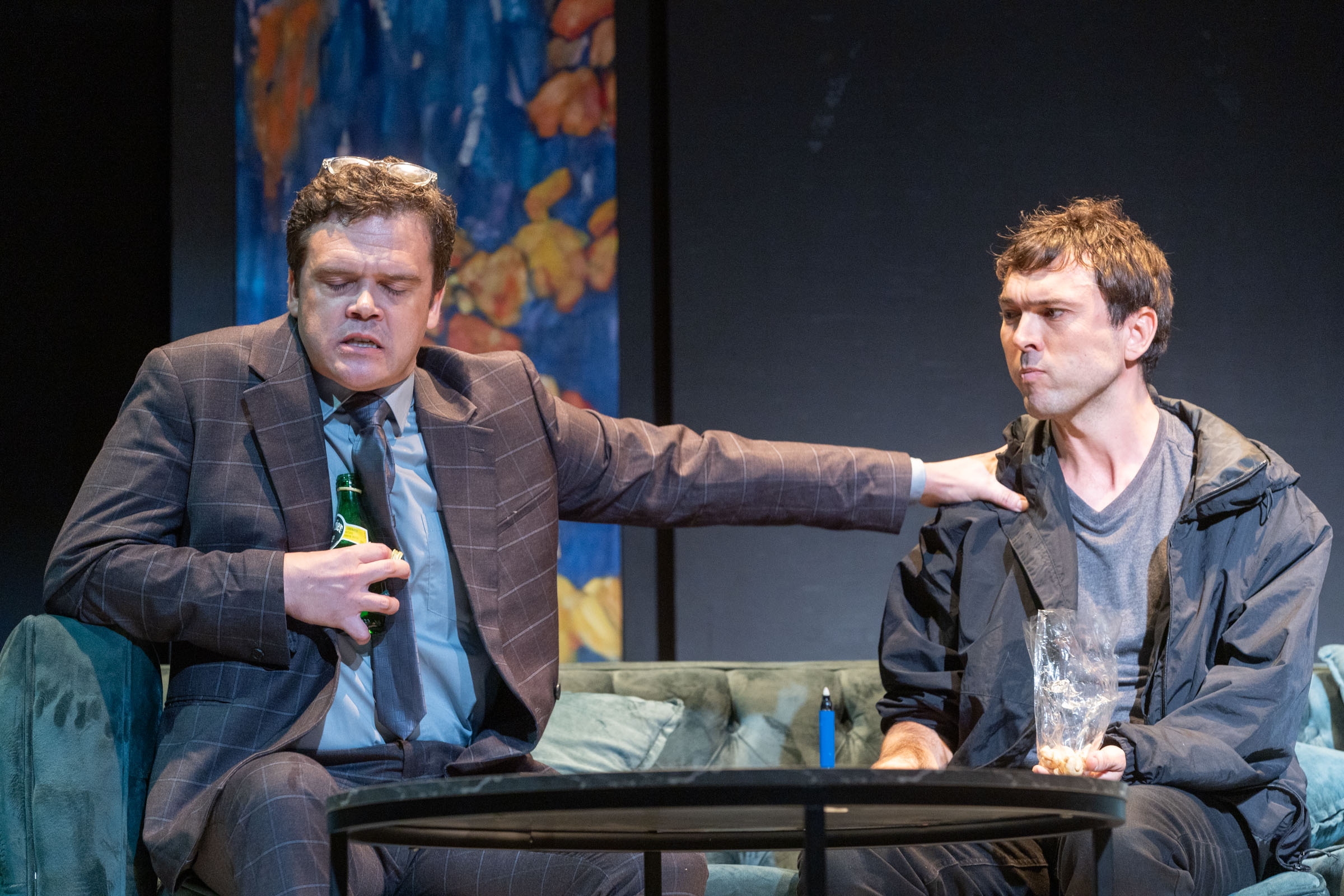
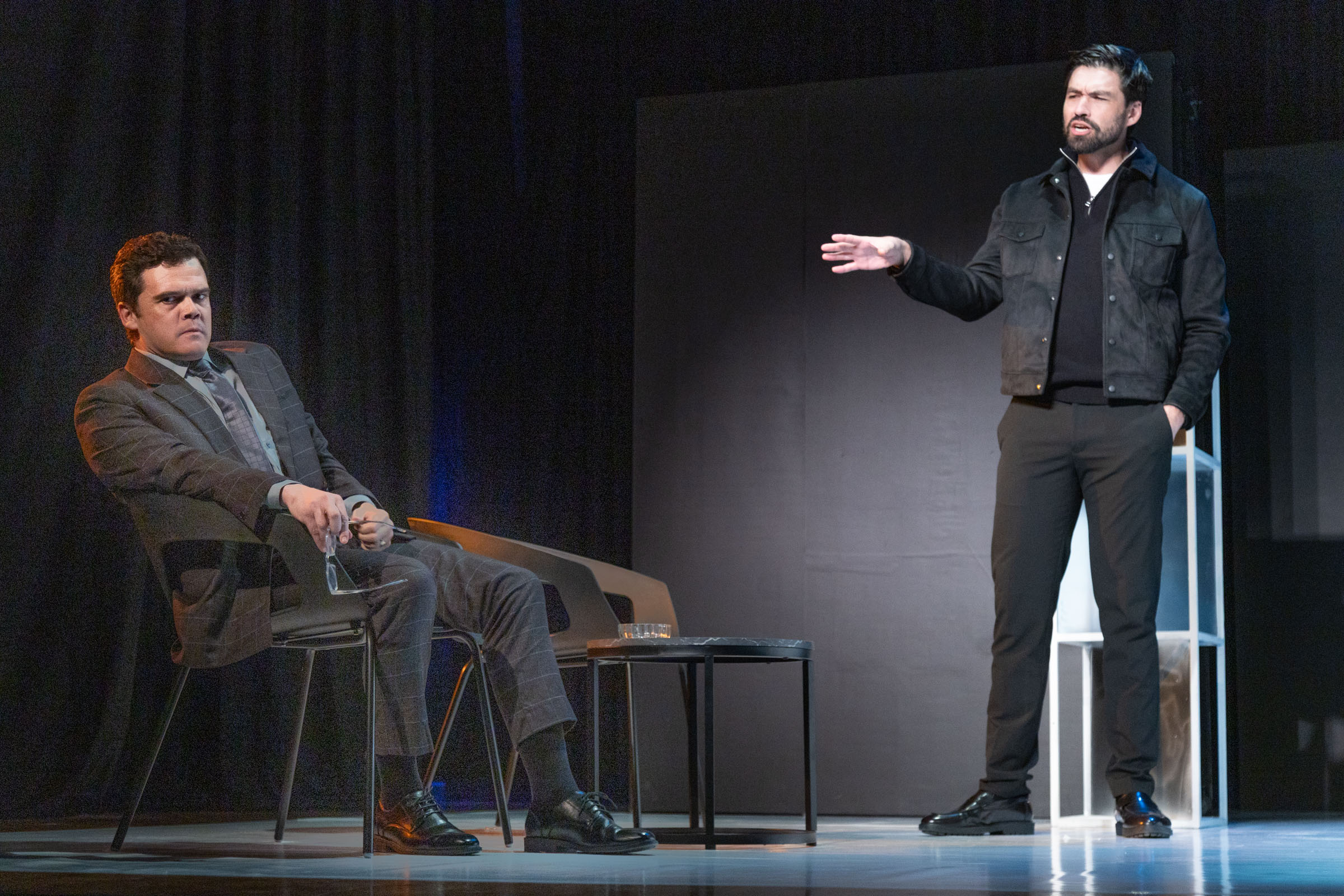
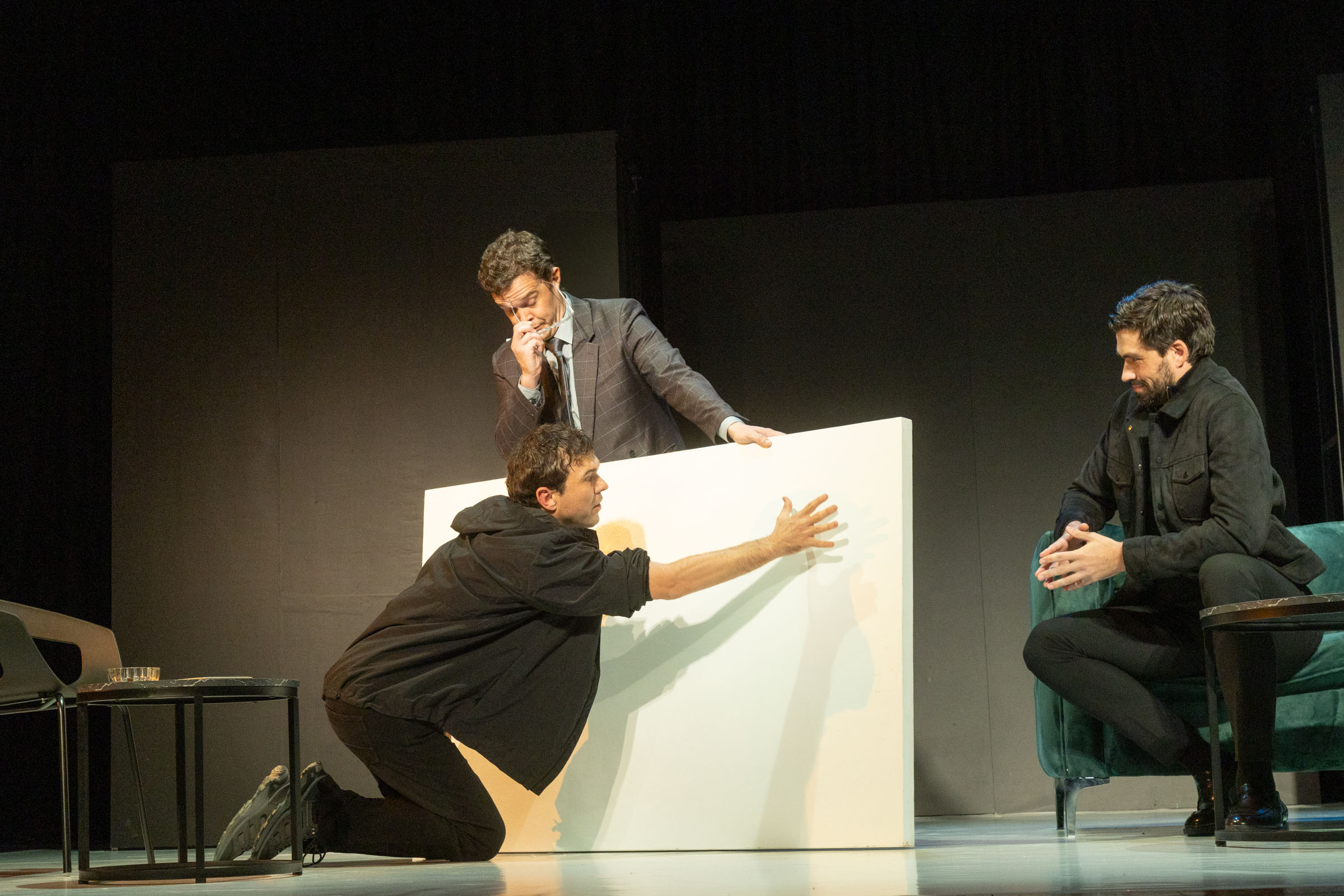
Pretorius portrays Marc as a tightly wound, self-assured, and deeply opinionated man, dressed in a grey suit and spectacles. Marc’s grey suit shows that he is serious, traditional, and controlled. Although spectacles are meant to help someone see clearly, Marc repeatedly removing them suggests his difficulty in seeing Serge’s point of view and accepting perspectives that differ from his own. It became noticeable how he put the glasses back on when he looked at the painting. I have never seen someone get so agitated! He portrays being annoyed and flabbergasted at his friend spending two hundred thousand francs on a white canvas so well that it had me cackling, and fearing he'd have a heart attack on stage. He lowered his voice when he was being conciliatory and would belt when he was not. The contrast was hilarious at the right moment.
Binge portrays Serge as polished, self-assured and quietly defensive, dressed entirely in black: plain but sophisticated trousers, a shirt, jersey and shoes that reflect his cultivated sense of taste. Serge’s all-black, minimalist costume can symbolise his cultivated sophistication, emotional restraint, and strong belief in his own aesthetic judgement. The simplicity of the plain black trousers, shirt, jersey, and shoes reflects the minimalist taste that also attracts him to the almost entirely white painting. His clothing therefore makes his interest in the artwork feel like an extension of his identity rather than simply an expensive purchase. The colour black also reinforces Serge’s stoicism and self-assurance.
Van der Walt portrays Yvan as noticeably less put-together than his friends, dressed in what could almost be called a teenager’s uniform: jeans, a T-shirt, a raincoat-style jacket reminiscent of the ones we wore to school, and a pair of takkies. His more casual appearance is done purposefully, as it immediately sets him apart from Marc and Serge, visually reinforcing his less assured and more unsettled personality. Yvan was my favourite: the joker of the friend group and of the stage, using physical comedy to show his agitation and frustration in a way the other two, being less physical, didn't.
The set is minimalist: an L-shaped green couch, two chairs off to the side, and a shelf of ornaments where Serge places a cast of a fist combined with a European-style bust. The minimalist stage allows the characters to remain the main focus, drawing our attention throughout the performance to their interpretation of the lines and the way they interact with each other. As the discussion around the painting grows when the three friends are together, the actors use the set to convey a restriction, a tightness or confinement where their insecurities, jealousy, and resentment are all laid bare. Yvon arrives at Serge's home agitated. He stands in the centre of the room, literally in the middle of his two friends who are sitting on opposite sides of the set. Marc is sitting on the couch watching, and Serge is on a chair doing the same. Their body language is tolerant, like a mother waiting for a child to be done with their tantrum.
The production further emphasises the characters’ interconnectedness by allowing the same physical space to shift between their different homes. Serge carries the white canvas in and out of frame on the stage, while the static furniture acts as each character's home depending on where the actors are in the space: when Marc visits Yvan, they sit on the couch; when they're at Serge's home, they move from the couch to the two chairs. It made me think that Serge has the bigger apartment, while Yvan's place is quite small.
This minimal use of the set is complemented equally by the strategic use of lighting, allowing the relationships between the three men to remain at the centre of the production. The lighting accompanied the story well; when a character turned inward or spoke directly to the audience, they'd be caught in a spotlight. By the end, each character gets a turn in that spotlight to tell the audience what they really feel, perhaps mirroring how the friends eventually learn to tell each other the truth too.
The structure of play itself is a simple one.
The plot isn't thick or convoluted; it's very straightforward.
Beyond differences in taste and debates about what makes art good, the play is really about the friendship of Serge, Marc, and Yvan being pushed to the breaking point when Serge buys a large, expensive white painting. What begins as a disagreement about the value of a work of art evolves into a deeper conflict, exposing tensions and truths that extend far beyond aesthetics.
The characters accuse each other of having “changed of late”, but surely one must change over a friendship spanning fifteen years. Yvan says he's tired of only ever being seen as the joker. He's settling down, has a job, is about to be married, and his oldest friends are telling him to call off the wedding because he complained to them about the wedding and his fiancé.
Marc feels he's no longer Serge's mentor because Serge bought the painting without consulting him, as if he'd left his friends unsupervised and they'd unravelled in his absence. Maybe what he really means is that he was unable to keep them the same people after fifteen years.
Serge buying the painting is the inciting incident for the friends realising they're changing and may no longer have as much in common as when they first met. But isn't that the beauty of friendship, allowing people to be different, to develop new tastes and ideas, and still letting the new versions of ourselves be friends? That's the ultimate kind of friendship: the one that lets us grow beyond who we were when we met. My own reading is that friendships change, and we disappear to become new versions of ourselves. Sometimes friends move with us, and sometimes they don't. We need the freedom to become who we are, and to be honest about those changes within our friendships, for the friendships to last. Essentially, the painting is just a white rectangle of canvas and yet it became the most controversial piece of art to ever enter this friendship.
One aspect worth noting is how I found myself wondering about whether the translation may have subtly shaped the way some of the humour landed in performance. Although I did laugh out loud, giggle, and snort at points, so the play is certainly funny; I just don't think I caught all of it.
At times, I felt slightly disconnected from jokes that had one or two other audience members guffawing. I don’t necessarily see this as a bad thing. Watching a play that isn't necessarily aimed at me as its target audience, given my lack of art knowledge, doesn't mean there isn't something for me to gain from the experience. Just because the characters’ knowledge of art exceeds my own does not make the story inaccessible.
At its core, the story is about friendship: about how, when we meet certain friends, we assume the roles we had when we were younger, and how that is inevitably unsustainable because eventually someone will change. How controlling our friends is not true friendship, but accepting them for who they are, in all the facets of their beings and what they decide to purchase; that is the truest friendship we can offer. Despite the references not landing with me because of where I come from, my exposure to art, my knowledge about art and access to spaces that hold art, I am a friend and have friends.
Yet even when certain moments felt just beyond my reach, the emotional truth at the centre of the play remained unmistakably clear. A white rectangle of canvas turned out to be the most honest thing on that stage: it didn't change at all; it simply gave three old friends somewhere to finally say what they meant.

About the author
Rushdiyah Narker
Rushdiyah Narker has moved from making up stories in her head to writing them down. She uses the skills she learnt while getting her Masters in Social Anthropology to write stories about the culture she grew up in. 'Some Unspoken Thing' is her debut young adult novel enjoyed by kids 13 to 60 years of age. For funsies, she reads a book a day and loves to go to the theatre, galleries, and movies to experience different forms of storytelling.
View all work by Rushdiyah Narker