
Parking Bay. Power Play.
Zizi Masizana reviews ‘Stacey’s Bay’ at Baxter Theatre
Share this piece
Pass the story on to your people.
Script: Pierre Malherbe
Direction: Adrian Collins
Starring: Berenice Barbier and Pierre Malherbe
Venue: Baxter Theatre
Genre: Off-Kilter Comedic Drama
Performance Dates: 8 September 2026 – 19 September 2026
As I settle into the Masambe Theatre, there are multiple empty boxes on stage; behind them is a long leather ottoman with a MacBook on it, and next to it, a crate full of vinyl records. There’s no preset sound, only the chatter of everyone gathered to enjoy the experience. Before Stacey’s Bay began, I found myself in conversation with an American woman visiting Cape Town from Washington, D.C.
What began as ordinary small talk quickly became a conversation about the state of American politics: Trump, the fractures within families, the growing difficulty of distinguishing fact from fiction on social media, Trump's tariffs (inflation across the world), and the strange experience of watching global political crises unfold through screens thousands of kilometres away.
Eventually, our conversation arrived at something closer to home: the internet’s increasingly exhausting gender wars.
Men and women now occupy trenches via the algorithm – each side accumulating and spewing dangerous rhetoric and its own grievances, evidence and explanations for the failures of the other. Social media has given us unprecedented access to other people’s lives. However, this access does not always translate into education or reliable information. We see and engage with fragments of people’s lives, then construct whole stories from them.
It was an oddly appropriate conversation to have before Pierre Malherbe’s Stacey’s Bay.
“Please don’t think that we’re all egregious,” is the last thing the American says to me as the Baxter voiceover signals the beginning of the show. We quiet down, and immediately after the lighting cue changes, a static-laced guitar riff bleeds into what sounds like a 2000s rom-com bachelor-club anthem, immediately conjuring a particular kind of masculine fantasy: slick, carefree, and faintly nostalgic.
We are in a flat.
It’s a tight fit on the Masambe stage, but it works.
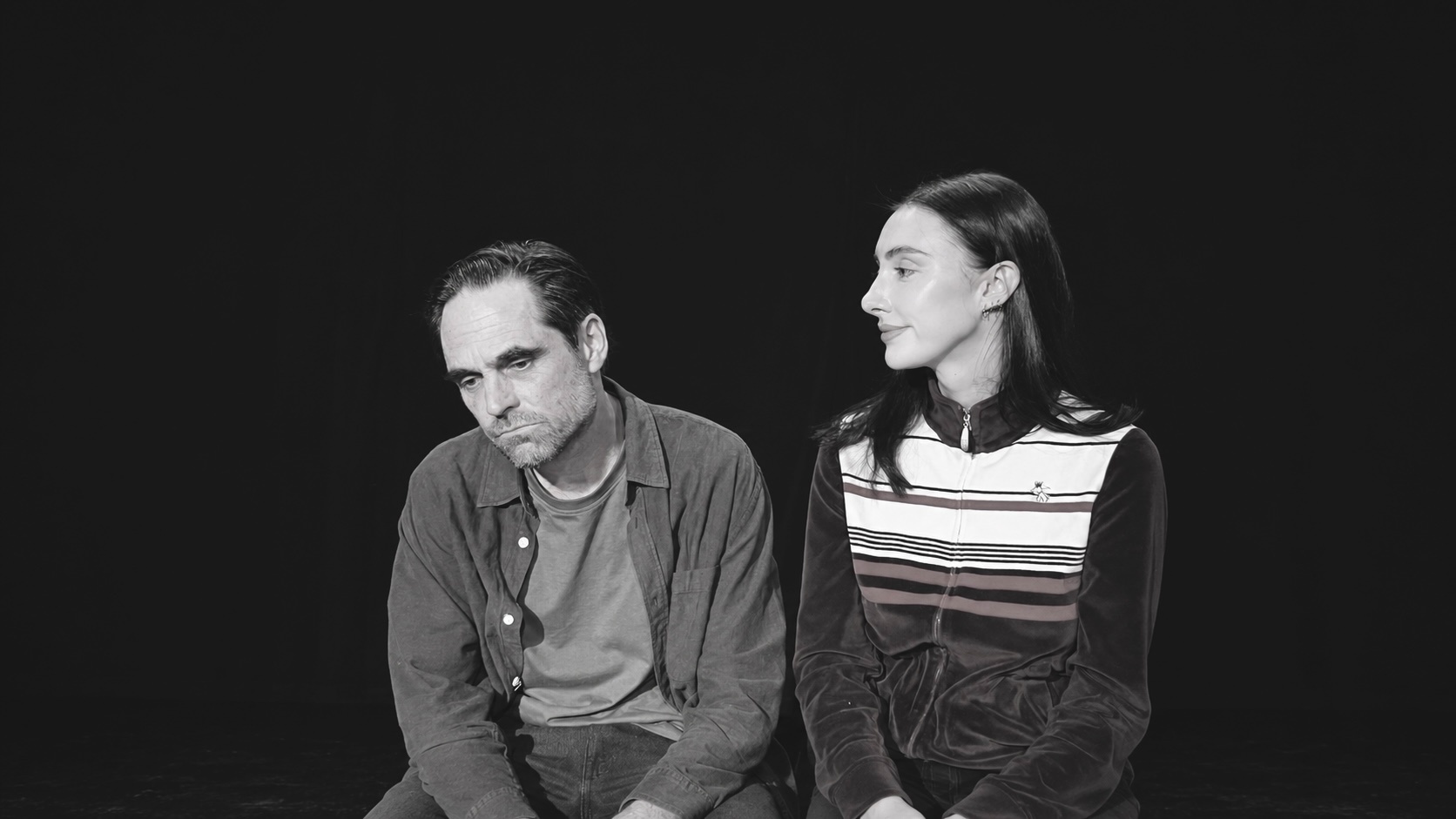
Malherbe enters, and we are introduced to Jason, who is on a work call: he seemingly works from home. The audience is then introduced to Stacey, a schoolteacher who lives in the same apartment complex as Jason and rents her parking bay to him. Jason is an advertising executive whose girlfriend is supposedly going to move in with him. What follows is a strange and increasingly intimate negotiation involving money, desire, fantasy, sex, and the stories we construct about and impose onto other people.
In South Africa, where the play is set, even something as mundane as where someone parks a car is entangled with questions of safety, money, and access; therefore, Jason needs the bay because his girlfriend needs somewhere to park.
At the beginning of the play, Jason is unpacking boxes. He had assumed that the flat came with two parking bays, only to discover after moving in that there was just one, having neither read nor enquired about the fine print of his lease. This oversight leaves his girlfriend potentially exposed to the risks of parking outside the security of the apartment complex. In contemporary internet language, his failure begins to resemble what social media has taught us is “weaponised incompetence” – the expectation, typically within heterosexual dynamics, that women will quietly absorb the consequences of men’s failure to organise, anticipate, or take responsibility for their own obligations.
After mentioning the problem to the caretaker of the apartment complex, Stacey walks into Jason’s flat without knocking. She explains that the caretaker told her he is looking to rent a parking bay and quickly sets the terms of the arrangement.
Stacey insists on being paid in cash.
No EFT.
No convenient digital transaction, forcing Jason to physically interact with her every month. What begins as a practical arrangement therefore becomes a mechanism of access. The parking bay is not merely rented; it becomes the reason these two people continue to cross each other’s boundaries. Because we, the audience, never actually see the bay itself, it also begins to symbolise the unseen attractions, chemistry, and systems of exchange that eventually govern their relationship.
That tension between access and boundaries is already present in the way Stacey conducts the arrangement. She takes control of their transaction while disregarding the boundaries of his personal space. She begins politely but remains firm: she wants to be paid in cash and insists on giving him written receipts. Her behaviour complicates any reading of Stacey as simply being an empowered woman taking control. She is both negotiating boundaries and crossing them, establishing a dynamic in which access, entitlement, and intimacy become difficult to separate.
Later on, she exerts her power, playing on the advantage of resources she has to drive forward and fulfil her own desires and fantasies. She is unexpectedly strict and calculated, never allowing herself to be manipulated or coerced out of her vision – this begins to resemble a femdom power dynamic within BDSM, with Stacey assuming control and wielding that power on her own terms.
But that control is not only written into the terms of their arrangement; it is also evident in the way Stacey occupies Jason’s space. Early on, we, the audience, understand that something is off – as mentioned before, Stacey does not knock the first few times she enters Jason’s flat. She’s imposing and simply off. There’s a persistent kind of anticipation that her character brings through well-developed mannerisms and quirks. She underplays physically, relying on decided, deliberate movements to sell her jokes.
But it all feels easy, earnest.
It lands perfectly in the gap between the seriousness and absurdity of everything she says.
Barbier’s portrayal of Stacey is thoroughly entertaining – the way in which she has paced her action and speech throughout the first 50 minutes of the production feels fragmented and effectively funny. Paired with her seemingly mundane indifference, this makes for comedic gold. For example, when she cries, she goes on and on with no tears streaming down her face, no sorrowful break in her voice or breath; this makes me feel ticklishly uncomfortable, and I physically want to lean in to observe her next move – her every move.
Amid the chaos of Jason’s move into the complex, Stacey notices a vinyl record by one of her favourite bands during her first visit to his flat. She is a “stan” (super fan) of band member Hennessy. From this single fragment of Jason’s life, Stacey begins to construct a story about who he is and what their connection might mean. The record becomes the basis upon which she projects her own assumptions and desires onto him.
As the play progresses, we learn that Jason would rather go without these monthly interactions and her relevant tangents – I describe them in this way because, to us, the audience, she is endearingly tangential. She is never simply making conversation to pass the time, but rather to observe, to piece together who he is and extend the version of him that exists in her imagination. The off-kilter quality of this play lives most distinctly in this character – she isn’t random; she tilts conversations just slightly out of alignment, and this is owed to Malherbe’s writing.
Rather than constructing jokes out of obvious punchlines, the comedy arises from conversational excess. At times, however, that same excess exposes an imbalance in the writing of the two characters. Stacey feels particularly well-defined through her text, and this is accentuated by the quirks, rhythms, and processes this detail allows Barbier to bring to the character. The character of Jason is not afforded the same definitive specificity and detailed presence through the text.
This quality in detail within the text informs how they are embodied: Barbier has a particularly precise character to inhabit, while Malherbe appears to be working with a Jason whose interior and physical life are less clearly defined. It made me wonder whether, as the playwright, Malherbe was perhaps too close to Jason to develop him from the same distance with which he had constructed Stacey.
Yet this contrast functions in varying ways throughout their performances – sometimes it’s strangely successful given the nature of the play. Between Collins’ direction and Barbier’s delivery, this contrast lands as a sometimes useful mechanism to distinguish the characters’ emotional worlds.
Malherbe’s frazzled quality often works beautifully, particularly when Jason’s awkwardness draws on the actor’s skill for comedic riffing. Jason is, after all, a man increasingly losing the familiar structure of his life as he settles into a new home. His heightened pacing, pitch and physicality sit strangely but productively beside Barbier’s more nuanced, lived-in Stacey. Even his hurried entrance in an untied nightgown, which he spends much of the scene wrapping around himself and trying to keep closed instead of simply tying between lines, adds to the picture of a man still moving at a frazzled pace, trying to hold himself together.
The friction and uncertainty, then, lie in determining where that awkwardness comes from. Are Malherbe’s choices deliberate extensions of Collins’ direction and his comic instincts, or do they occasionally expose what is less developed in the writing? This is an especially interesting question when the playwright is also the performer. At times, Barbier’s specificity makes Stacey feel more fully inhabited, while Malherbe’s performance can feel more consciously constructed – slightly incomplete. Yet it is this very mismatch that also sharpens the distinction between them, making Jason’s instability, at times, an effective counterpoint to Stacey’s assured physicality.
Despite my one reservation about certain choices in Malherbe’s performance, the play itself gathers momentum, particularly as the balance of power between Stacey and Jason begins to shift.
There is something deliciously petty about this escalation.
After Jason eventually dismisses Stacey’s fandom and tangents, she revises the parking arrangement to regain control and soothe her bruised ego – choosing to renegotiate the amount and their interactions within specific and absurd parameters. What might otherwise have remained a petty disagreement about taste and fandom is smartly spun into something more intimate. Stacey shrewdly begins drawing Jason into the fantasy she has constructed around Hennessy. Here, the negotiation over the parking bay gradually shifts into role-play, humiliation and sexual desire. In this way, the play turns an ordinary dispute over money and access into an off-kilter exploration of fantasy, power and intimacy.
In its press releases, the play is described as an “off-kilter comedy drama”, but in its staging and technical language, it more accurately embraces the lo-fi independent qualities that Collins, both director and designer, appears interested in exploring. Lo-fi independent theatre (or film) refers to an ethos and aesthetic that guides and inform the process, production, and final presentation or product of work: this includes artistic autonomy, experimentation, collaboration, and resourcefulness. In Stacey’s Bay, there exists a willingness to experiment with simple materials, visible theatrical mechanisms and unconventional design choices.
Onstage, two long white flats stand upstage on either side, providing entrances and exits for the characters. Between them, centre stage, hangs a long fluorescent tube light of the kind typically found in classrooms or kitchens. The fixture is made particularly striking by its DIY “barn doors”, metal wings ordinarily attached to theatrical lights to control and focus their beam. It is introduced only after the play’s dramatic pivot, once we enter Stacey’s flat. This object suits Stacey’s world as she is a teacher, and the most distinct time at which it is used is when she is reading. It also creates a sense that her home is specifically, spatially hers, as the other design elements remain the same when transitioning from Jason’s flat to hers. This repurposing and reimagining of a cool, clinical overhead fluorescence establishes that there is something calculated and particular about everything Stacey does in her life and on stage.
While the effect it creates is not always as dramatically distinct as it might have been – the same lighting state could arguably have been achieved through the conventional rig – the choice itself speaks to Collins’ willingness to experiment with theatrical form and design. More importantly, something is exciting about watching a long-time actor begin to test a directorial and design language of his own. Collins' attempt does not fully translate on account of the dimness of the light confined by the previously-described wings used to conceal it when in Jason’s flat; however, it clearly contributes to developing a particular visual language.
Moments such as these also remind me of the importance of spaces such as the Masambe Theatre, which function as playgrounds and laboratories where theatre-makers can experiment, redirect, and refine their practices. Collins, in his efforts and chosen style, has done well to maximise the resources, functions and liberties this space offers.
That spirit extends successfully into the production’s broader lighting design. Other lighting choices are deliberately ordinary but slightly askew, giving familiar domestic spaces a very slight unsettled quality. During transitions, the rapid shifts and flashing of light help sustain the upbeat tempo of the play, keeping the production moving without allowing the energy to settle for too long. This is reinforced by the EDM sound cues, which accompany the frenetic changes in light and contribute to the play’s sense of fragmentation.
Importantly, this fragmentation is not only a stylistic choice. It echoes the way Stacey and Jason experience one another: through partial information, fleeting encounters, and assumptions that are constantly being revised. The production’s technical language reflects its central concern – how people construct whole versions of one another from incomplete pieces. In this way, Collins’ design does more than establish the play’s off-kilter world; it gives theatrical form to the uncertainty, projection, and shifting perceptions that shape Stacey and Jason’s relationship.
By the end of Stacey’s Bay, I found myself wondering under what circumstances we allow people to become more than the versions of them we have already decided to know.
As the curtain call drew to a close, I returned to the American woman’s final words to me before the house lights went down an hour and thirteen minutes earlier: “Please don’t think that we’re all egregious.” Now, having experienced Stacey’s Bay, the American woman’s request felt almost like an introduction to the question the play spent the evening exploring. Our conversation had been built around fragments of America reaching me through disinformation – social media, political rhetoric, and screens and here was a person sitting behind me asking that I not reduce her to the version of her country I had constructed from those fragments. It made me aware of my own participation in this process: how easily I, too, can turn access to a piece of information about someone or something into the belief that I understand who or what they actually are. Perhaps the generosity the play ultimately offers us is the willingness to keep encountering people beyond our first impressions, allowing each new exchange to complicate, revise, and expand the versions of them we have already constructed.
The play left me thinking about how quickly we construct people and what becomes possible in ourselves too when we remain willing to revise them. For a culture that is increasingly shaped by algorithms, fragments, and manufactured certainty, Stacey’s Bay makes a meaningful case for real-life encounters with genuine people – for the awkwardness, absurdity, irritation, and intimacy of finding out that they are not exactly who we thought them to be.
Social media has made this impulse even more pronounced, offering us intimate access to lives we do not actually know, while parasociality allows us to feel familiarity without the reciprocity of genuine encounter. Stacey and Jason are caught in this same process. They continually project versions of one another from incomplete information, and those projections begin to determine the boundaries, negotiations, and intimacies of their relationship.
But perhaps the play’s generosity lies in what happens when those projections are disrupted. Through repeated exchange and encounter, the person in front of us inevitably becomes more complicated than the version we first imagined.
What makes encountering this play worthwhile and effective is the collaborative relationship between Malherbe’s writing, Collins’ direction, Barbier’s skilful character work and Malherbe’s particular delivery. Together, they never allow the subject matter and questions that arise to overcome the play with earnestness. They instead allow the questions and subject matter to emerge through humour, awkwardness and the strange intimacy between two people learning to see one another differently.
Stacey’s Bay does not suggest that misunderstanding can simply be avoided; rather, it reminds us that our understanding of another person is always partial, provisional and capable of changing.
There is something tender in allowing someone to expand beyond the story we have made of them, and something generous in meeting that expansion with curiosity rather than judgement.

About the author
Zizi Masizana
Zizi is an emerging performance artist, theatre maker and technician from Cape Town. She can be found at the theatre doing any and everything; honing her craft, learning and exploring. Her practice right now is about remaining curious, observant and cultivating rituals that’ll aid her craft. Her eventual aim is to create overwhelming sensory experiences as live art, theatre and storytelling.
View all work by Zizi Masizana