A gardener. A dog. A country still waiting for uhuru.
Zizi Masizana reviews 'Scott' at Baxter Theatre
Share this piece
Pass the story on to your people.
Script: Morapeleng Molekoa
Direction: Morapeleng Molekoa
Starring: Sibuyiselo Dywili
Venue: Baxter Theatre
Genre: One-man show
Performance Dates: 22 August 2026 – 29 August 2026
On my way to Baxter Theatre tonight, I encounter the same women I do in the mornings and afternoons on their way home from work, on the MyCiti bus. Exhausted by a full day of care-taking.
The bus is full. There is only standing space left.
We stop on Adderley Street, loading more black women from Elokshini (townships) on their way back home, after a long day of cooking, cleaning, and doing any domestic or service work that sustains the homes, businesses, and lives of the wealthy here in Cape Town. A lady waddles to stand at the back of the bus. Another already seated woman shouts out to her to ask her how she is; reaching the standing space at the back, she responds, “iyhoo (wow)! I’m miserable,” imitating a white woman with the latter part of the response. The women on the bus, myself included, burst out in laughter. Yes, the moment may be funny, but everyone recognises themselves in the immediacy of that laughter. It is obvious that most of us here on the bus are miserable too; that there are, in fact, more urgent and important things in our lives, but our circumstances confine us to a life spent travelling to and from work, managing other people’s homes, and tending to the lives of others.
I leave the bus and walk from Salt River to the Baxter Theatre, still caught in the continuation of the commute: waiting to arrive somewhere so that I might resume my life. If you use public transport, you know this in-between well. It is the seemingly insignificant stretch of going-going – waiting, moving, transferring – so that you might eventually arrive somewhere and finally do, or simply be. As I step into the foyer of the Masambe Theatre, I mentally prepare myself for what awaits me, to finally be and experience Scott, written and directed by Morapeleng Molekoa. I have seen it before, in my first year at university as a theatre-making student; it was big then, to me at least. There were these cool students, years ahead of me, who were so committed to our shared passion for theatre that they had created and staged a play that was both gripping and inspiring. I remember how in awe I was of the storytelling. Awaiting the doors to open, I am excited and nervous to see both what has changed and how the play has grown, as it was first staged at the Theatre Arts in Observatory, Cape Town, in September 2019. A finalist for the 2019 Distell National Playwright Award, the production later earned three Fleur du Cap Theatre Awards: Best New South African Script and Best New Director for Molekoa, and Best Performance in a Revue, Cabaret or One-Person Show for Nyatsanza. In this iteration, the role is taken on by Sbuja Dywili.
The story itself emerged from an unsettling real-life account. In July 2018, inspired by a post that read, “An Afrikaans lady and her dog survived a head-on collision. You would think this is a happy ending until you read the story further and realise that her black employee was sitting at the back of the bakkie and unfortunately did not survive.” This story is about Sizwe, a gardener from Nyanga who cares for his white employer’s beloved dog, Scott. When tragedy strikes in Constantia, the ever-present current of racial, economic and emotional inequalities that have always shaped the relationship between him and his employer beam beyond observation and constant considerations on his part. And he bears his burdens so far as his resources will allow.
I think about that origin story which sharpens the significance of what we are about to witness. We step into the theatre after our tickets are scanned, and the preset marks the first of only two instances in which audio is played throughout the performance. As we settle into our seats, ahead of this achingly real story Mam’ Letta Mbulu’s Not Yet Uhuru is playing – a clear and informed choice, like so many of Molekoa’s directorial decisions throughout the production.
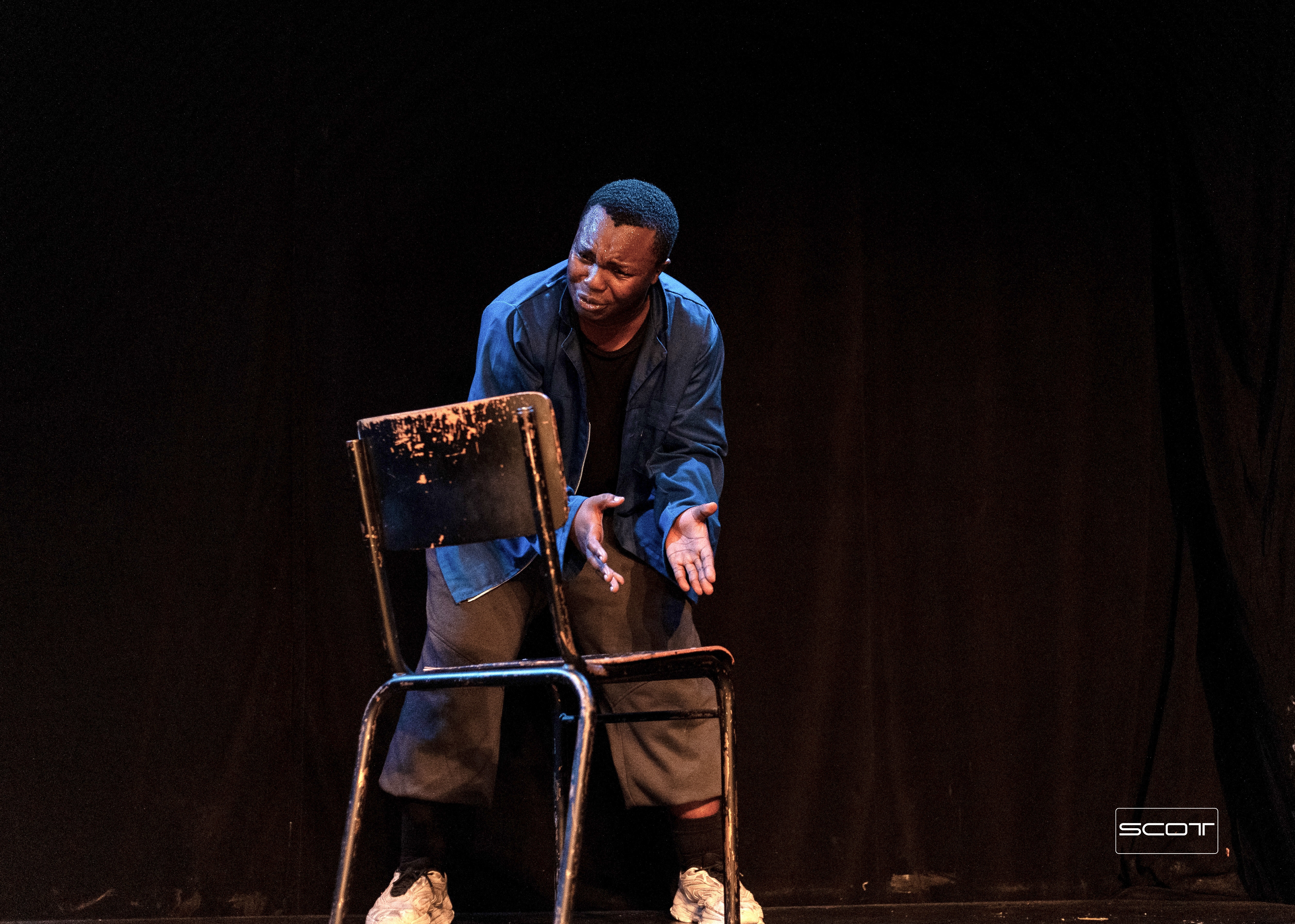
There’s a single wooden chair on stage, facing the wall. I notice that the chair was at some point painted black and now it is worn. The chair has been used and re-used. The chair has worked. It’s chipped and scratched, and the wood is exposed in some parts.
On the chair is a blue conti suit jacket – we all know it and recognise it, easily spotted all over the city, townships, farms and in the village. Again, the choice is clear, and so is the image; a particular man is about to enter this space. We know why he wears that “attire”. He is a labourer; a man who works his body tirelessly to maybe earn minimum wage. He is one of those men who are herded into bakkies before sunrise and back again at sunset – Black and Coloured men wear this jacket on street corners, busking, waiting outside shopping centres or hardware stores for piece work, or labouring on the infrastructure that builds and sustains our cities. We know this man, perhaps not socially but certainly economically and perhaps politically.
The preset lights and music fade. We are introduced to a dog and Sizwe, a man in his family home – ehokini (in a shack), to be exact - that his mother built with her own two hands, and this is the reality of most Black townships. In many Black townships homes are often built and maintained by women whose husbands, like Sizwe, had left the Eastern Cape to labour in the city. Sizwe is home in eNyanga township, where he is preparing for work. Quickly we are introduced to themes of spirituality, ubudoda (masculinity) and abject poverty, as well as to the radically different values assigned to material things.
Sizwe exists between two worlds, both equally real to him: the aforementioned Nyanga township and the ultra-wealthy suburb of Constantia, where he works. What allows Sizwe to move between them is itexi (a taxi), the road, the daily commute that carries him from one reality into the other. In this in-between, he doesn’t matter either, because he is a Black man. His story, and his recollections of life before and after his grief, are achingly actual in their portrayal of the seemingly menial and mundane.
As a poor man, he prepares for work, goes to work, does his work, then returns home to wake up and do the same the next day.
Whilst in transit and at work, he is subject to the social hierarchies of near-pauperism, oonoteksi (taxi owners and drivers) and township entrepreneurs sit at the very top of this pyramid, followed by nurses – still service professionals – government workers and security guards. Below them are young women, and even teenage girls, whose perceived social currency lies in youth, beauty and proximity to men with access to resources, both within and beyond their communities. Then come schoolchildren and mothers, and finally the Black men holding it all together, piece by piece, job by job. Below him are the obvious: prostitutes, starving artists, drug addicts and drunkards, finally the criminals – a common reality with which many black South Africans or anyone who commutes using public transport or government services, is aware of.
In addition to this, the weight of his responsibilities is felt in the constant considerations one generally makes when there’s not enough of anything, particularly money and resources. He is constantly calculating, although not numerically, what is short: basic needs like access to transport and health care. This constant counting and considering is one of the great tragedies of the Black condition in our neo-colonial, post-apartheid-yet-still-apartheid reality.
Through a series of recollections leading up to and following the death of someone significant in his life, Sizwe re-enacts encounters with the various characters who populate his world, including Scott, the dog he is expected to care for alongside his duties as a gardener. Rather than morphing into these characters entirely, Dywili portrays them as he experienced and understood them, allowing each interaction to remain filtered through his own memory and perspective. Dywili does this impeccably, toeing the line between characters effectively and demonstrating Sizwe’s inner understanding and perception/experience of the outside whilst conveying earnestly the emotion, circumstance, and mindframe of each. From the taxi driver to Bruce the dog, Bruce ekoneni (on the corner), Madam, and others, each character is presented through Sizwe’s particular understanding of them. In this way, we gain greater insight into Sizwe himself: his emotional well-being, his inner conflicts, and the constant negotiation of his own worth within Cape Town, South Africa. He is not merely recounting what happened; he is recounting his experience of what happened.
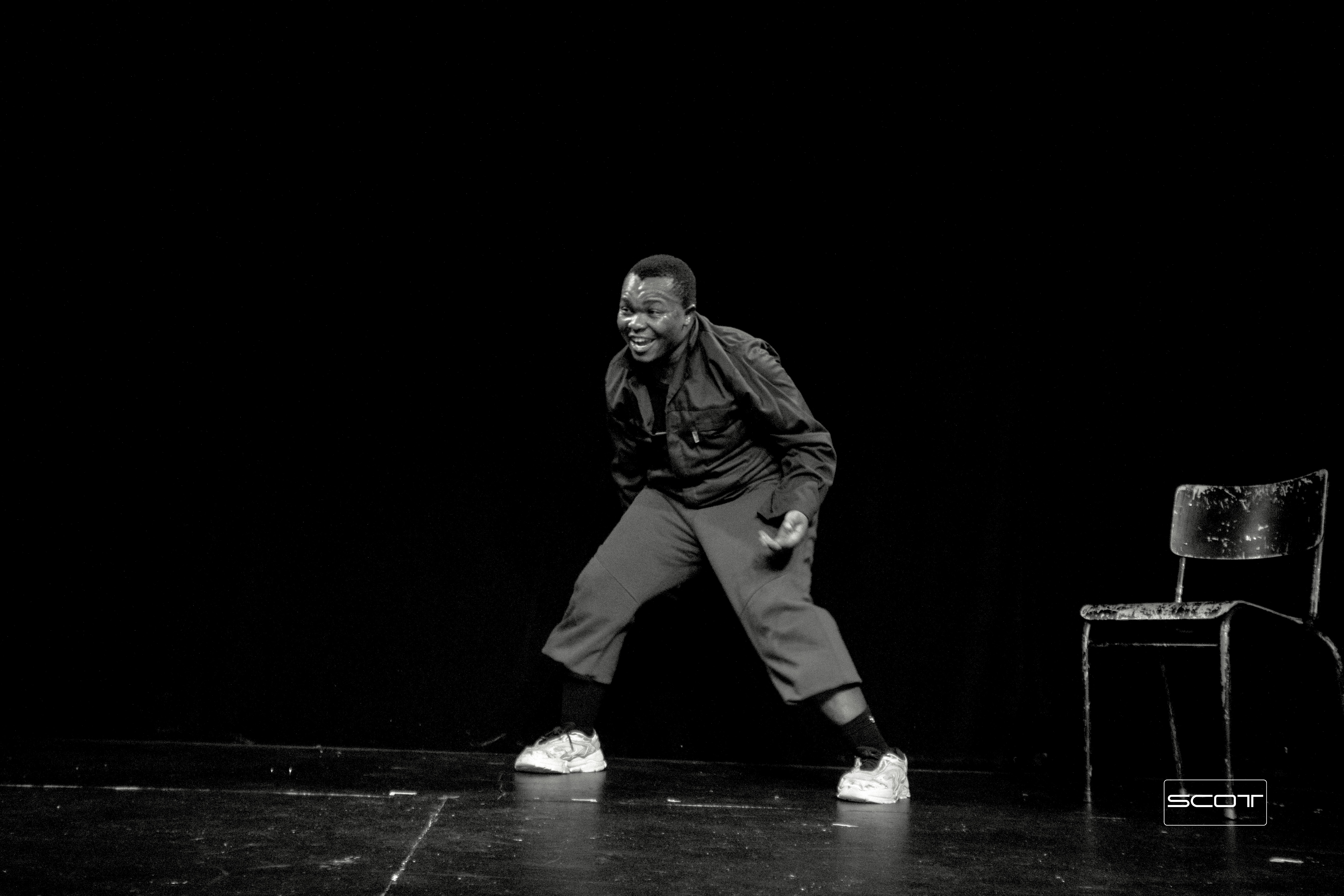
Usually, in a one-person show, a single actor performs several different characters through a convention known as multi-rolling. Because there are no other actors on stage to distinguish between the characters, the performer needs to make each one recognisably different through changes in voice, posture, facial expression, movement, physicality, costume, or props, which Dywili occasionally implements. However, what becomes clearer to me as the show progresses is that when Sizwe performs with the other characters, he is not necessarily trying to portray them objectively for the audience. Instead, he seems to perform them as he remembers or experienced them. We are therefore seeing these characters through Sizwe’s recollection of them rather than encountering them as fully independent characters.
There was a moment, for example, when Madam begs him to stay and he reveals how she uses the word “Please!” My immediate reaction is that the gesture or mannerism accompanying her request does not feel like something she herself would necessarily do. That makes me realise that Dywili’s performances of the other characters are not intended to be completely realistic representations. Rather, it is how Sizwe remembers seeing her in that particular moment. The other characters are therefore filtered through his perspective.
I also notice something interesting about the character transitions. The first character Sizwe transitions into is his younger brother. To mark that transition, he turns the chair around so that it faces the audience in the conventional way a chair would normally be positioned. When he returns to Sizwe, he turns the chair back around. Initially, this seems to establish the chair as a character signifier or transition device: the movement of the chair visually tells us that he has moved from Sizwe into another character. But it does more than this; it does practically everything, a wonderful demonstration of how to really stretch and maximise a resource, albeit worn-out, tired and simple. Like people working to survive typically stretch their minimum wage and still manage to thrive in spirit. Sizwe is exactly like this, moving between worlds; when he is home, he amusingly shares the absurdity of his work-life with his family.
However, this convention does not continue consistently when he transitions into the other characters.
This raises an interesting question about why the production establishes that theatrical language and then seems to abandon it. If the chair initially teaches us how to recognise the movement between Sizwe and another character, why is that same device not used again? Is this deliberate? Does the distinction between Sizwe and the other characters become less rigid as his memories unfold? Or is the chair specifically connected to the younger brother rather than functioning as a general signifier for multi-rolling? Rather than weakening the production, this ambiguity invites the audience to think more closely about how memory, character and theatrical convention operate within Sizwe’s recollection.
The physicality within the play is also worth examining.
Under Molekoa’s direction, Dywili’s portrayal of Sizwe frequently involves bending or leaning forward, and this physical characteristic carries over into some of the other characters he portrays. For example, when he becomes Madam and she goes to confront a worker at the Doggy Daycare, elements of Sizwe’s own physicality remain visible in the performance. Rather than necessarily being a flaw in the characterisation, this cleverly reinforces the idea that these characters are never entirely separate from Sizwe. He is not disappearing into them completely; he remains physically present underneath each portrayal, as they are, after all, versions of these people reconstructed through his memory. The overlap in physicality therefore reflects the fact that what we are witnessing is not an objective reenactment of the past, but Sizwe performing his own recollection of it. This subjectivity extends beyond the way Sizwe remembers people; it also shapes the way he remembers, experiences and performs loss. Nowhere is this more apparent than in two of the play’s major emotional turning points. Grief is one of its central themes, yet these moments are given markedly different dramatic weight.
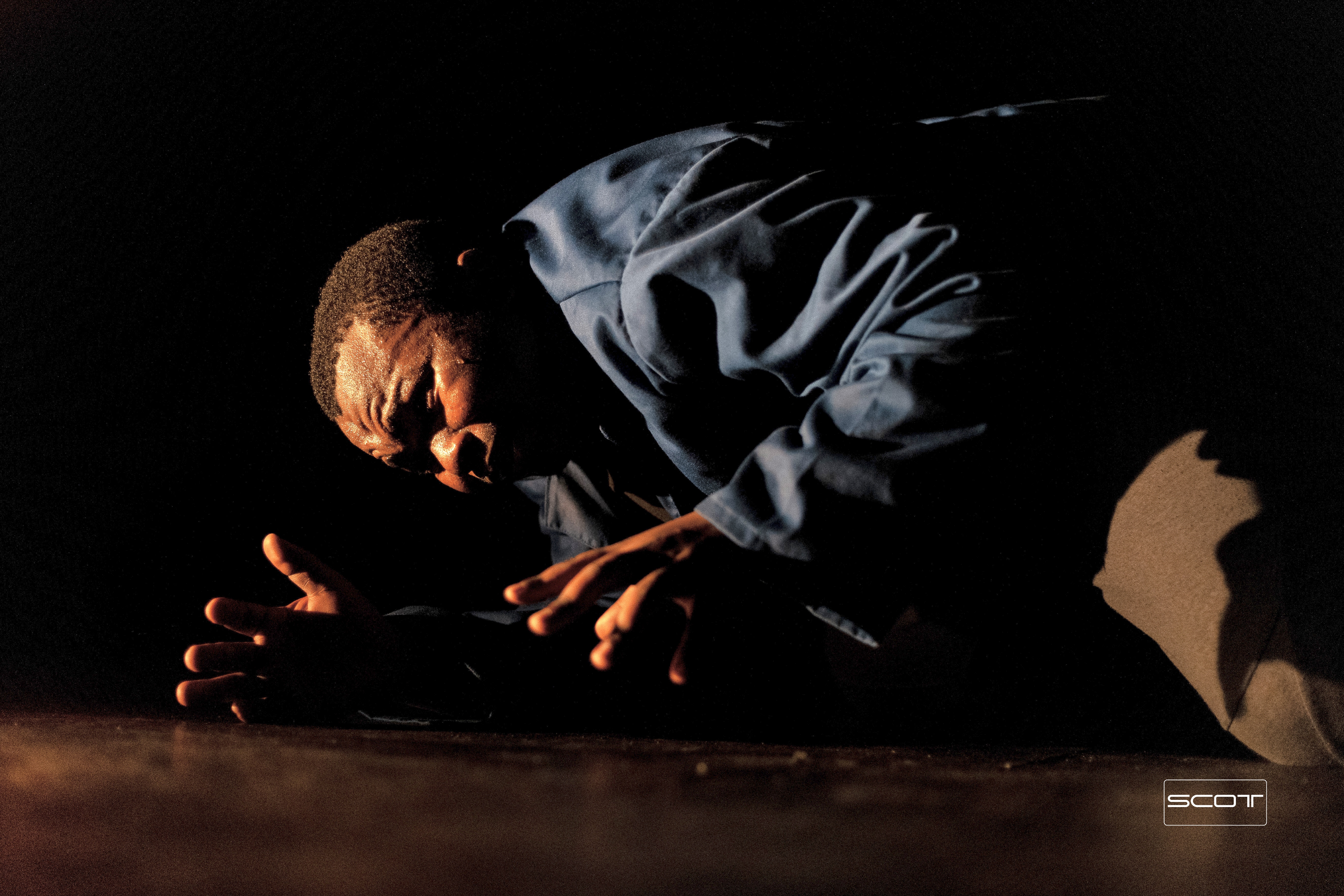
Then the play tackles the crisis involving Scott and is presented as a major dramatic event. This is where the second and final sound cue is heard. It is a large scene in which Sizwe is forced to process, both mentally and physically, what has happened and what it might mean for his own circumstances- his livelihood is contingent upon something which is arguably replaceable. As an audience member, I feel extremely sorry for Sizwe, but I am also afraid for him. There is an immediate practical anxiety attached to the moment: what will happen to Sizwe now? Is his job secure? What might this mean for his livelihood, the mouths and bodies dependent on him? His future?
By contrast, the storyline involving Sizwe’s mother feels much more emotionally affecting to me because the play builds towards it through a constant anticipation of grief. From the moment we meet her, the possibility of loss seems to hover over both her and Sizwe. Her relationship with sugar captures something particularly tragic about this. Her severe intake of sugar is a symbol for the only luxury available to her, which explains why she refuses to let it go, even though it is also contributing to her deteriorating health. There is something deeply sad about the fact that one of the few things that brings her pleasure is simultaneously harming her.
Because of this, there is a growing sense that something inevitable is approaching. And that the magnitude of loss and grief is shrouded again in the constant considerations that have to be made. Living as a poor black person is expensive, but dying is a hefty charge too. Most black people in Cape Town understand this; something which Madam is so offensively inconsiderate of. Transport to the Eastern Cape, travel times, and the price of a casket alone could easily set someone in this situation back significantly. Fortunately, he is able to rely on the community and a remaining single cow belonging to his long-gone father. The audience senses where the story is heading before Sizwe confronts it, sharing in his anticipation as what he fears becomes unavoidable.
Once these parallel crises unfold, the energy of the performance shifts. The crisis involving Scott creates a heightened dramatic moment, whilst Sizwe’s family storyline is treated with a quieter, more devastating weight. The anticipation settles, and both Sizwe and the audience are forced into a new emotional reality. It feels as though Sizwe’s state of mind changes once the grief he has spent so long anticipating becomes tangible. For me, this is where the play enters a different emotional phase, almost like the beginning of a second half, even if it does not literally occur halfway through the performance.
There is also an uncomfortable sense of relief embedded within this shift. Some of the responsibilities and considerations that have weighed heavily on him are altered, perhaps alleviated, but this immediately produces another form of anxiety: what about work and showing up for Madam? What happens to his younger siblings? The community extends their assistance, yes, but even then the constant considerations are a choice between a rock and a hard place.
As an audience member, I continuously think about the logistics of Sizwe’s life and the fragile support structures available to him. The possible consequences of his only option but he has to work, tend to Madam. He has to rely on neighbours, whilst a drunken uncle seems to be one of the few other options. An uncle who we learn once sat in the social hierarchy just as Sizwe does but dropped into addiction and idleness. It is hard to judge this character even though in my real life I do. When encountering someone like this, this particular uncle, who presently, in a social assumption, has no consideration for anyone or anything but bobbing along the waters of immortality (alcohol, typically Black Label), I wonder as many do, “What happened in the life that calcified you in this state and mode of existing and relationing; inconsiderately, callously and selfishly?” This portrayal of Sizwe’s impending and eventual grief answers that question.
This is why the storyline involving Sizwe’s mother affects me more deeply than the crisis surrounding Scott – the latter is theatrically larger and more immediately dramatic, but the former carries the accumulated weight of everything the play has been anticipating: one is staged as an immediate crisis; the other carries the quieter weight of anticipated loss. Through that contrast, grief becomes not simply an emotion Sizwe experiences, but something capable of reorganising his responsibilities, relationships and understanding of what his life might look like moving forward.
It is through these deeply personal experiences that the production reveals something much larger about the world Sizwe occupies. It does so with remarkable clarity, and that clarity is part of what makes this production important. I always knew where I was and who I was with. That is the clarity with which each character has been written and transferred onto stage. Madam herself earns my sympathy, but I cannot unsee and unfeel the rage that the unawareness of her disposition and those beyond her own stirs in me. I wonder if this is what the freedom of not constantly having to make considerations as a result of financial constraints is like? That it breeds inconsideration and blindness toward that which does not matter to you, even when it is right before you.
Faith and spirituality are important throughout the play and important to surviving Blackness in South Africa. For without it, there is nothing beyond the current circumstance. Little to nothing other than the near-impossible-to-reach realities and privileges of whiteness and wealth. Sizwe is very conscious of all that he encounters and surrounds him. He notes ominous signs and references Luke 6:29 in the Bible, using these things to teeter onto survival. So, as God instructs him, when slapped in life on the one cheek turns to the other, effectively bracing for things to get even worse, demonstrating the grace and forgiveness of the Lord. A standard by which Madam certainly is not held to. And perhaps this is where the production finds its deepest truth: survival is not presented as heroic or uncomplicated, but as something pieced together through faith, endurance, humour and the small consolations that make life bearable.
This story is valuable and important in so many ways. And yes, it was funny – not funny-silly, but funny in that genuine way Black joy always seems to overcome what feels, and often is, devastating. It is funny in the way that the women and I all find ourselves uplifted by the confession of misery on the MyCiTi bus. It is in the inhales and exhales that punctuate our laughter that we find some solace in life and, as an audience, in experiencing Sizwe’s. We know exactly who he is. We recognise the ridiculousness of poverty and its T&Cs.
It is after 9pm. I am on the bus again. Only a few seats are occupied. Many of us are back from a night out. We can’t afford even an inDriver. I know the last few taxis are leaving the rank within the hour. There are no more trains either. The women are not here. The city feels quieter, stripped of the bodies that carried it through the day, yet my mind is loud as I am transported as close to home as possible. I am hoping everyone made it home safe, and that come Monday, although dreadful, everyone will make it through the weekend with a little less dread for the trek, but I know that is probably unrealistic; this struggle of poverty tends to compound, unless, of course, you happen upon a glass slipper on your walk home from the station. I’m thinking again of Sizwe, of labour, survival and the constant calculations that shape ordinary life.
I get off at my final station and tap out. The bus moves on, and so do we all have to in life. And with the same faith as Sizwe’s mother when she is described to be gripping her bible, I pray my twenty-minute walk home will be peaceful and safe.
At every beat of the show, I know exactly where I am. The landscape is clear. Erankini (at the taxi rank), I can smell the braai stand next to Sizwe’s vegetable stand. I can see la sisi oneshori (the woman with an attitude) side-eyeing him. I can see uMama, whom he serves with grace. I know all these places. In Constantia, I can see how big the house is; I can feel the luxury and freedom of Sizwe arriving and finding Madam is not in. In the Eastern Cape, I see exactly where in the tent umalume (maternal uncle) stands as he addresses family and friends, and I know their reactions too. I am everyone, everywhere.
And it is from this feeling that I find myself wondering: who exactly does this city belong to? Those who own it, or those who build it, sustain it and maintain it? Do those who ‘own’ it know all its parts as I do? Like Sizwe does? What does Scott know about this place?
For a bracing dose of contemporary reality – and the familiar spiritedness and grace with which the working class carries itself through it – watch Scott at the Baxter’s Masambe Theatre.

About the author
Zizi Masizana
Zizi is an emerging performance artist, theatre maker and technician from Cape Town. She can be found at the theatre doing any and everything; honing her craft, learning and exploring. Her practice right now is about remaining curious, observant and cultivating rituals that’ll aid her craft. Her eventual aim is to create overwhelming sensory experiences as live art, theatre and storytelling.
View all work by Zizi Masizana