When The Truth Is Not Enough
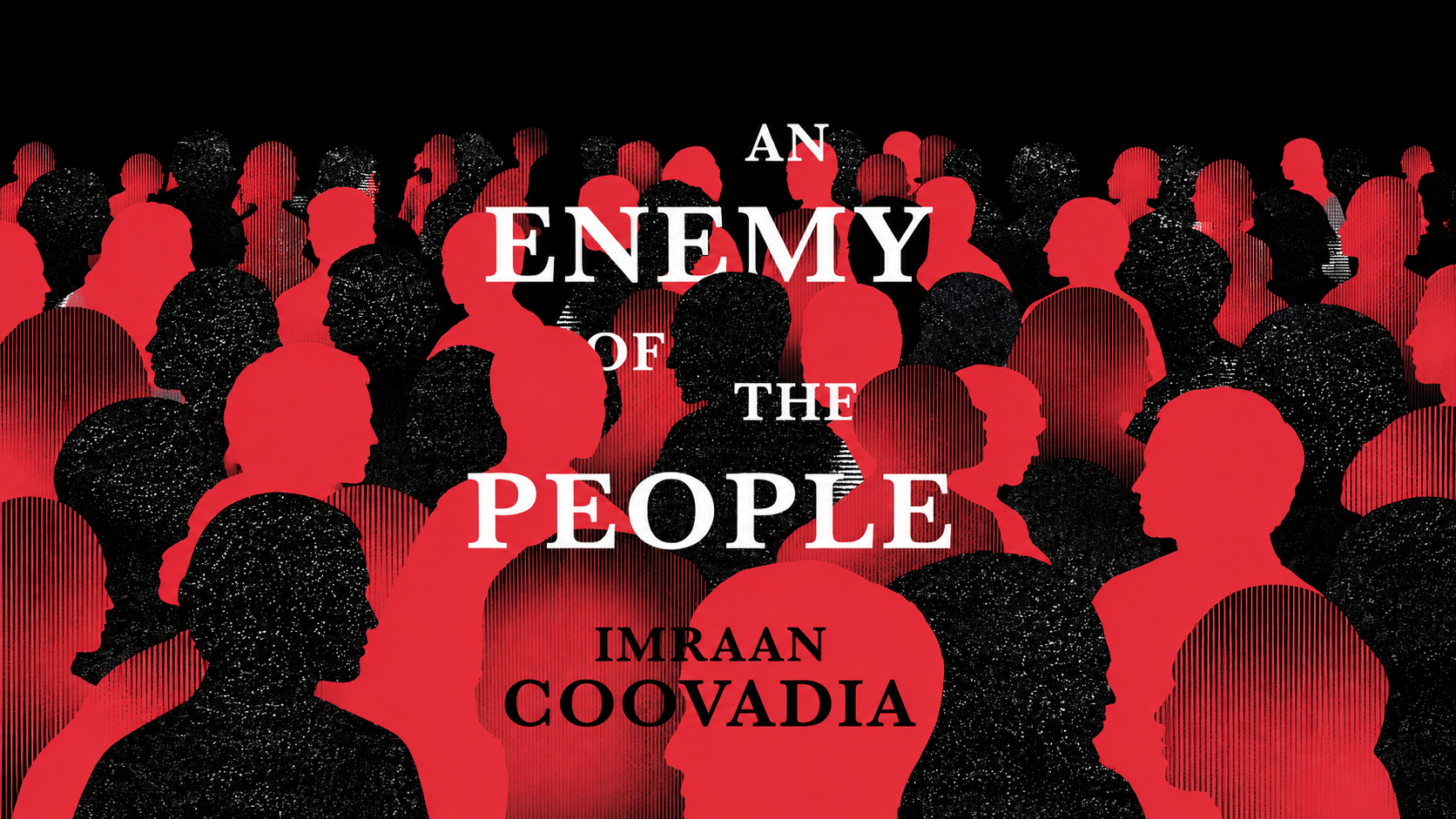
Shaheena Links reviews 'An Enemy of the People' by Imraan Coovadia
Share this piece
Pass the story on to your people.
Publisher: Penguin Random House South Africa
Type: Novel
Date Released: February 2026
Retail Price: +/- R350
Format: Paperback (256 pages)
“In da clerb, we all fam,” as the cool kids mime to the viral TikTok sound – the line is from the TV series Broad City and has now seeped its way into our everyday vernacular. In South Africa, though, the sentiment feels especially familiar. Whenever our president appears on television, basically, “In the living room, we all family” — and Uncle Cyril is everybody’s uncle, reminding us about our civic duties and, of course, the importance of paying our taxes.
You may be wondering what the correlation is between Uncle Cyril and tax collection, and what any of this has to do with the review. Well, quite a lot, actually.
Enter Imraan Coovadia’s An Enemy of the People and its protagonist, Mac Mackenjee, a tax collector in South Africa, where corruption is rife and dodging tax is a point of pride amongst some.
Mac is adept at uncovering money hidden in the most unlikely places, and that skill soon draws him into a high-level government conspiracy. What was meant to be a simple job of checks and balances goes sideways fast, and when the police call Mac and his boss in for questioning and tell them to stop investigating, the official line is that they are obstructing justice.
Mac knows this means that he and his boss are digging a little too close to the truth, and he refuses to be deterred.
Mac is meticulous about his job, and he is the kind of colleague who would want to “circle back” to things in Zoom meetings.
So, as a reader, you know he will not let corruption and fraud simply slide.
The only problem is that Mac is like a bloodhound with a scent, and this whole thing stinks to high heaven. He is meticulous, stubborn, and very much the kind of colleague who would want to “circle back” in a Zoom meeting; he cannot resist pulling at a loose thread until the whole thing is unravelled – even when it might be safer to leave it alone. If the thought of accounting and tax collection doesn’t sound like it would be your thing, then perhaps the promise of political scandal, fraud and government paranoia will do the trick.
The first thing I noticed about Coovadia’s writing was how easily it flowed.
His prose is almost lyrical, yet never feels pretentious or like a Poetry 101 lecture; the writing always feels natural.
The scenic descriptions in An Enemy of the People are evocative, and when Coovadia drops the reader into a scene, I can practically see and feel myself there: zooming by on Nelson Mandela Drive past Table Mountain and Devil’s Peak, or even on the M3 on my way to the seaside neighbourhood of Muizenberg with its colourful wooden huts. The world Coovadia creates feels lived in, all the more so because I also live in this same world.
Beyond this vivid sense of place, Coovadia gradually draws us deeper into the other threads of Mac’s world. Meanwhile, his wife, Tejal, a lawyer, is defending an activist accused of burning buses and destroying statues. Tejal has a steadfast belief in the law and that everybody has a right to a defence. Mac is not entirely convinced that his wife should be defending the young activist, because it is in direct conflict with his own moral compass. Mac is very black-and-white in his belief system, whereas Tejal leaves some room for the grey areas of life.
Pretty soon, Mac and Tejal’s worlds collide, and they both become entangled in a web of tax fraud, forensic investigators, shell corporations, corrupt police officers. and politicians. It is a sprawling, powerful network for Mac to take on – perhaps a modern-day David facing a very well-connected Goliath. Both husband and wife are constantly questioning each other’s work and work ethic. Mac and Tejal often disagree on what the other person should be doing, and Coovadia uses these professional disagreements masterfully to test their intimacy. There is a magnetic push and pull between the pair, but they always find their way back to each other. However, despite all of this, it is clear that they do love each other. This is shown in subtleties: the way Mac looks at his wife, or when Mac is injured and Tejal insists they go to the hospital immediately.
Mac is not only grappling with political corruption, but also with the threat it poses to his family. On top of all of this, he is constantly questioning his place as an Indian South African man in post-apartheid South Africa. Despite all that he has achieved, he still feels as though he stands on unequal footing with white South Africans. He has a loving wife, two precocious sons, a well-paying job, and a home in an affluent neighbourhood.
From the outside looking in, he would be considered successful, but from his vantage point, none of this provides him the sense of comfort or belonging he seeks or desires.
Instead, Mac navigates the world with the sense that he lacks a place to put his feet, as if he has nothing stable to hold onto. Everything he has achieved professionally and financially does not automatically guarantee him protection from the racial and social class hierarchies that are still deeply embedded in South African life. This insecurity plays on his mind as he fears losing it all: his job, his home, and the life he built, and the doubts that it will never be enough, no matter how much he does or has achieved. Coovadia unflinchingly reveals that success does not equate to an escape from inequality but is something that can be so easily wrenched out of our grasp with one wrong move.
Mac and Tejal are firmly middle-class, and one of their challenges is finding the right school for their sons. Coovadia also gives us small slices of domestic life, with Mac spending time with his boys. It’s tender and heartwarming. Mac’s sons Shiv and Rogan both struggle at school in their own ways, and Mac does his best to support them. Mac advocates fiercely on behalf of both of his sons: Rogan, the youngest, who is on the spectrum and who is regularly bullied, ridiculed, and struggles to fit in; and Shiv, the oldest, who gets into a nasty school fight that leads to a broken nose. It is always Mac who goes to sort out any school issues for his boys and provides the necessary comfort, whether it’s taking them to fly kites, a walk in the park, or reading them bedtime stories. He is doing everything in his power to not only get his boys into better schools but to give them the best chance at excelling in life. These scenes provide much-needed relief from all the tension and political intrigue.
In between the everyday family and life moments, the real world keeps closing in on Mac.
Is his phone tapped?
What is that parked car doing opposite their house all day?
Is he going to lose his job?
What will he and Tejal do then?
These are the questions that plague Mac as he delves deeper down the rabbit hole.
For me, one of the novel’s greatest strengths is the way an ordinary man tries to stick it to the man. Coovadia places an average citizen at the centre of corruption, surveillance, and political power, and we get to watch him stumble around and figure everything out alongside him.
Mac is a multi-faceted character.
He is more than his work. He is a devoted father and a husband who is deeply in love with his wife, and he would do anything to protect them from the danger surrounding them. The novel is set in Muizenberg, where Mac lives, and the rest around Cape Town, and this gives it a distinctly South African feel, especially when we consider that these spaces were historically shaped by race, privilege, and exclusion.
The novel covers a wide array of themes, from racial inequality to wealth disparity and political corruption, that readers from anywhere can resonate with, but it is Mac’s deep distrust of the government that I feel most South Africans will immediately recognise. Mac’s fear of losing his job, his financial insecurity, and that nagging feeling that he will never be able to catch up is one that many South Africans can relate to. These are everyday anxieties, regardless of our tax bracket.
The novel feels more like a conventional spy thriller and less like a political thriller, with moments of subterfuge, and Mac is woefully ill-equipped for the world he is thrust into. His courage in the face of all this vulnerability is what makes him a complex character. There were moments when the book feels almost too realistic to offer any real form of escapism, but this is when Coovadia shines because he shows us something the news cannot: the ordinary people behind the political scandals, the “little people” who, despite the odds, will try to do the right thing, knowing that it may never make the news cycle.
Below the murky surface, the mystery and intrigue, the novel is simplistic in its message: do the right thing, no matter the difficulties we face or what it costs.
I enjoyed the mystery and intrigue of this book.
The pacing and reveals were good and kept my interest. The fast-moving pace of the book mirrors the speed of modern life in South Africa.
That sense of place also comes through in the language. Coovadia weaves South African colloquialisms and idioms into the novel in a way that feels natural and relatable. It does not feel heavy-handed or overdone. Coovadia does not pepper it in every single sentence and every single paragraph. He uses it sparingly, and where it will hold the most weight and will have the most dramatic effect.
For a novel that is all about law, taxation, and government bureaucracy, it never feels bogged down by too much technical jargon. Coovadia keeps the language simple enough for anyone to be able to follow along, even for the most numerically challenged amongst us. So, despite the fact that the novel deals with complicated institutions and systems, I never once felt lost in “sauce”, as they say. I also did not feel the simplicity was dumbed down for readers. It was simple enough to follow along, but complicated enough to be intriguing.
That same attention to language carries into the dialogue, where Coovadia uses the way his characters speak to reveal who they are. For instance, it’s clear from Mac’s dialogue that who he is at work is also who he is at home. Here, Coovadia’s language shifts from establishing a distinctly South African setting to revealing character through voice. Mac’s morals and values carry through every aspect of his life, with little separation between his professional identity and who he is as a person. Tejal, by contrast, has a much clearer separation between her professional and personal selves. As a litigator, she is capable, calculating, and formidable, but around Mac and her sons, she is softer, warmer, and more nurturing.
Then, there is also Coovadia’s use of humour, particularly in the way most South African’s use humour as a coping mechanism: it’s either laugh or cry, and South Africans, when our backs are pushed up against a wall, tend to laugh. We see the lightness in grim situations, no matter how bleak they may seem. It makes the novel almost feel hopeful in a way. It demonstrates the resilient nature of South Africans, and I think most South Africans can agree that we can be extremely unserious people.
Coovadia strikes the perfect balance between simple yet lyrical prose and colloquial, everyday language. His dialogue is realistic, and I could definitely imagine hearing these types of conversations taking place in the real world. It is not hard for me to think that somewhere at a braai or in a dorpie, someone could be waxing lyrical. I truly believe most South Africans are natural storytellers and that storytelling is in our DNA. This combination is effective because if it were too lyrical, it would feel overly crafted, whereas if there was too much colloquial language, it could lose emotional depth.
The ending may feel rushed to some readers, but I believe this is intentional. When the conflict in a narrative involves something as large and diffuse as government corruption, there is no single “big bad” to defeat; instead, the abruptness of the resolution makes it feel less conventionally satisfying. Everything is not tied up in a neat, clichéd bow, and perhaps that is the point.
Coovadia ends the final pages on a philosophical note. An Enemy of the People is poignant and touching, leaving me hopeful that, even in the face of corruption, there are still “the beautiful souls of this world.”

About the author
Shaheena Links
Shaheena Links comes from a long line of storytellers. From a young age, she used to count her Oumie's teeth, and hung onto every syllable. And with a degree in Communication Science, she's gotten pretty darn good at communicating! She is a published author of the short story 'Woodstock Wonderwall', a poetry collection, 'Lost and Found (Again)', and a holiday novella, 'Mistletoe and Mayhem'. She regularly genre-hops between romance, science fiction, dystopia, speculative fiction, fantasy, mystery and poetry. When not writing, Shaheena can be found taking long afternoon naps or talking about life and love on her podcast, 'The Skinne Bekke'.
View all work by Shaheena Links