When Becoming Yourself Is More Than a Comedy
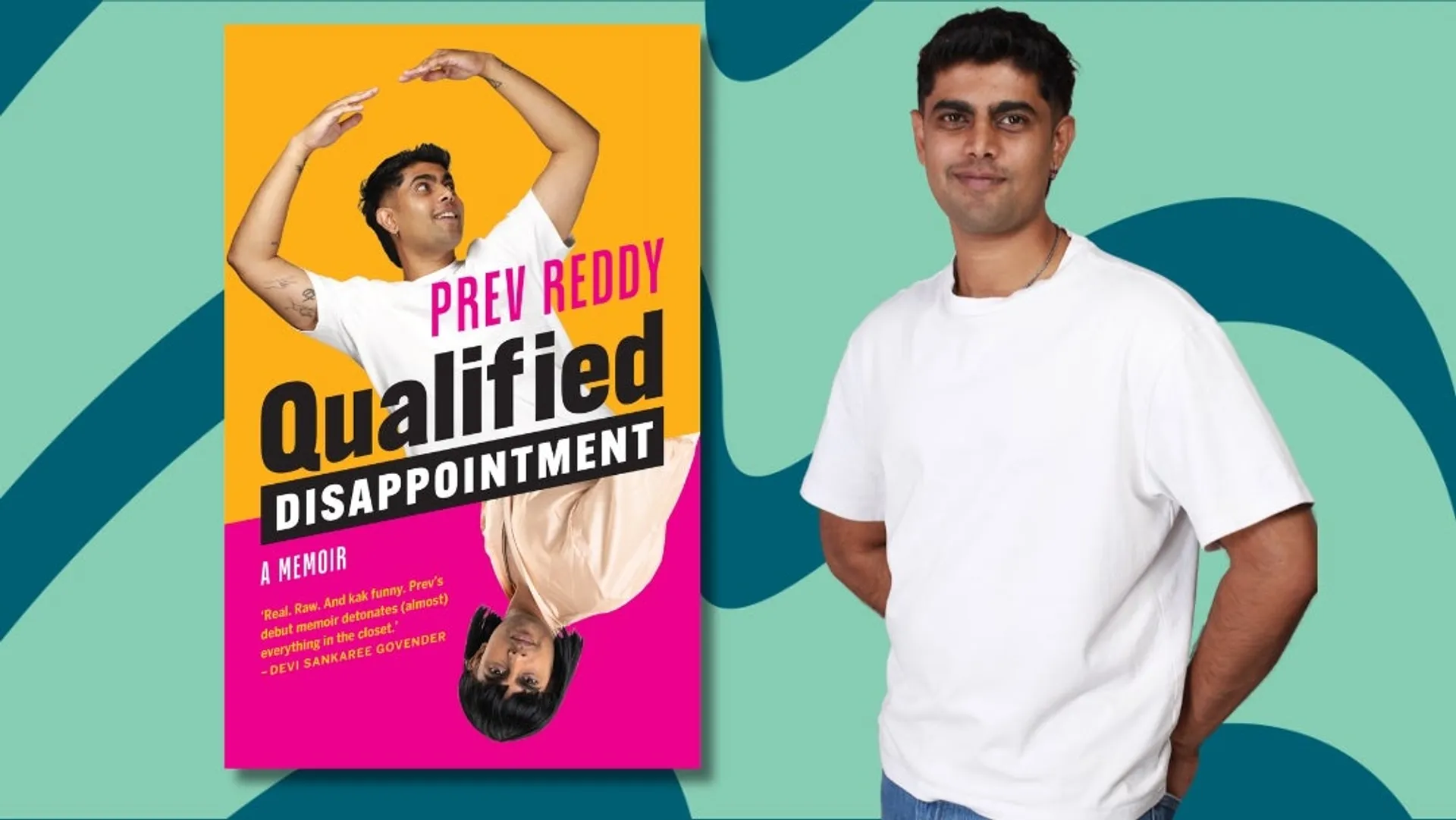
Sumaya Adams reviews 'Qualified Disappointment' by Prev Reddy
Share this piece
Pass the story on to your people.
Publisher: Pan Macmillan South Africa
Type: Novel
Date Released: July 2026
Retail Price: +/- R360.00
Format: Paperback (194 pages)
I don't quite know how to put this book into words.
I could start by mentioning that I picked up Qualified Disappointment expecting Prev Reddy's trademark humour. And yes, I laughed. But somewhere between the jokes, the childhood memories, the family stories and the uncomfortable truths, this memoir found places in me I wasn't expecting it to reach.
Published as Reddy's debut memoir and adapted from his one-man show Prev Reddy Is a Triple Threat, the book carries the DNA of a performance in written form. And yet, Qualified Disappointment is not simply a stand-up comedy show transferred into a book – the humour provides a narrative framework that allows Reddy to write about themes such as apartheid’s legacy, colourism, shame, sexuality, family conflict, generational expectations, heartbreak, and the realities of being a brown person trying to make a place for himself in the entertainment industry, without allowing those experiences to have the final say.
It is in these moments, when the humour gives way to vulnerability, that Reddy’s story feels most intimate and recognisable. One such moment comes when he writes about the silent treatment he experienced as a child, which took me back to my own childhood – that particular silence where nothing is said and yet so much is said. This is particularly significant in a memoir concerned with queerness: the “What will people say?” that hangs over so many like a silent threat; the understanding that sometimes our parents' behaviour comes from wounds, fears and histories we didn't live through ourselves.
The threat is not always explicit.
Sometimes it exists in a look, a withdrawal, a change in tone, a television programme no longer being watched because the performer is queer.
Reddy understands that children are very perceptive readers of these silences. As kids, we learn very early on what is acceptable not only from what adults say, but from what adults refuse to say. In this way, silence becomes a form of instruction.
The result is an interesting paradox.
Silence protects a family from uncomfortable conversations while simultaneously teaching a child exactly what he is supposed to hide.
The memoir thus becomes an excavation of things that were once left unsaid. What makes this excavation particularly effective, however, is the way Reddy uses humour to approach experiences that may have once been difficult to name.
Reddy's comedy is not incidental to the memoir; his humour guides the reader effortlessly between the ordinary and the painful. As readers, we are invited to laugh before being confronted with the seriousness underneath the joke. I found myself constantly moving between “this is so funny” and “oh wow, that hurts.”
As South Africans, we know this language.
We give our politicians nicknames, create memes about devastating news within minutes, and laugh at the things that feel too heavy to hold directly. And that is exactly how Prev's humour becomes a bridge between discomfort and dialogue.
Humour, of course, doesn't mean we don't understand the seriousness. Sometimes it’s how we as South Africans survive it. A trait that I recognised in myself.
I, too, have used humour to navigate difficult experiences and trauma.
There is something disarming about being able to laugh at a situation that has hurt you. The laughter does not erase the pain. Instead, it softens the initial blow and creates an opening through which a more difficult conversation can begin.
The point is not to make the trauma disappear. The laughter says: this happened to me, but it does not own me anymore.
Through humour, Reddy transforms memories of judgement, exclusion and misunderstanding into something he can revisit on his own terms. In doing so, the memoir moves beyond his story and becomes an invitation for the reader to reflect on their own. The check-ins at the end of each chapter became my favourite part. They felt like Reddy quietly turning to me and saying, “Now, what does this mean for you?"
One piece of advice about heartbreak had me crying because, although written for a very specific experience, its truth reached somewhere much broader: You have to leave the light on for yourself (Page 103).
Because when everything falls apart, you are still the person who has to carry the love, the grief, and whatever remains of you. This is where Qualified Disappointment moves beyond autobiography and becomes participatory by inviting the reader in for some self-reflection.
As a reader, you do not need to share Reddy's sexuality, cultural background, family circumstances or career to recognise the emotional truths contained in his experiences. Advice directed toward queer readers can have a wider meaning when it addresses universal questions of self-preservation, heartbreak, identity and self-worth.
One of the memoir's most compelling threads is the way in which it handles the generational gaps between Reddy and his parents. His parents' lives were shaped by apartheid and by the material and psychological realities of growing up within that system.
Reddy, as part of the born-free generation, enters adulthood in a formally different South Africa, but political change does not automatically erase inherited attitudes.
The differences between generations extend beyond political and social experience. Reddy reflects on a time when his parents’ generation could, by their mid-twenties, have a home, a car, a job and a family – the markers of adulthood and stability that were considered attainable milestones.
For many young South Africans today, that same trajectory feels increasingly out of reach. In the current economic climate, home ownership, financial security and stable employment can remain elusive well into your thirties and forties, making the expectations inherited from previous generations feel increasingly disconnected from our current reality. Reddy's reflections show how easily parents can carry the expectations of their own upbringing into the way they raise their children. What begins as love and protection can sometimes become limiting when the world their children grow up in looks so different to the one they knew.
And as much as the older generation's hardships were real, so too, are the economic realities facing the generations that followed. The familiar comparison of “when I was your age…” becomes misleading when the circumstances are no longer comparable. Reddy, however, does not have to flatten his parents into villains to acknowledge the ways their fears affected him. Instead, his reflections open up the conversation to understanding our parents without necessarily agreeing with them.
And then there is Aunty Shamilla.
I found her presence in this story incredibly moving. In Reddy's story, Aunty Shamilla exists simultaneously as a character, alter ego, comic creation, and embodiment of social expectation. She represents so much of that familiar voice of community.
The expectations.
The judgement.
The aforementioned, “What will people say?”
What begins as a character who represents the gaze of the community that once policed him becomes material through which he
creates. But she ultimately becomes something much more significant in Reddy's journey.
She is a shield.
A space between Reddy and a world that wasn't always ready to accept him fully. Aunty Shamilla helped create a version of Reddy that he could inhabit – one in which he could perform, exist freely, and eventually grow comfortable with being seen. What makes her story so beautiful is that, in time, Reddy no longer needed that shield. He had grown into himself and was ready to face the world on his own terms.
Yet, learning to take up space does not mean becoming immune to judgement. Reddy finds himself navigating several layers of expectation shaped not only by his sexuality, but also by his identity and the community he comes from. Reddy's exploration of colourism within the Indian community extends beyond the immediate question of sexuality. His story reveals how identity is rarely singular. To be brown, Indian, queer, and ambitious is to encounter multiple systems of expectation simultaneously.
The memoir also touches on visibility.
Seeing queer people represented on television does not necessarily mean that queerness is accepted within one's home or community. Representation shows a person that another life exists while simultaneously reminding them how far away that life may be.
In this sense, Qualified Disappointment distinguishes between seeing and being seen.
The child can see possibilities before he is necessarily permitted to inhabit them. This becomes especially significant later, when Reddy enters the entertainment industry and encounters stereotypes about brown performers.
The entertainment industry chapters were equally difficult to read.
The stereotypes.
The auditions.
The rejection.
The gatekeeping.
The exhaustion of being told, in so many ways, where a brown person belongs.
Reddy describes an environment in which success feels competitive rather than communal.
Where one person's advancement may be perceived as a threat rather than an opening for others. The resulting atmosphere resembles a cultural version of the Hunger Games: competition, cliques, gatekeeping, and scarcity.
And yet, he kept going. He understood that sometimes you have to crawl so the people who come after you can walk, and eventually run.
His success is not simply a personal triumph. It becomes a form of representation. The boy who once needed to search for evidence that someone like him could succeed eventually becomes that evidence for someone else, and watching those doors finally open was incredibly emotional.
The sold-out shows.
His disbelief at seeing the crowds.
Trevor Noah's team reaching out – the same Trevor Noah who showed Reddy, and so many of us, what might be possible for a
brown South African child.
The Nickelodeon nomination.
The full-circle moments.
His relationship with his mother changing.
And finally, the on-screen roles; not the stereotypical roles, but roles that are significant.
And yet, for all these moments of recognition and success, the title Qualified Disappointment initially suggests failure.
To disappoint is to fall short of expectation, but Reddy gradually destabilises that very definition.
What his family or community may have interpreted as failure becomes the very thing that enabled him to build an unconventional life. The career path that might once have been considered disappointing becomes a source of recognition. The characteristics that could have made him feel like an outsider become central to his artistic identity.
This is why the title is so satisfyingly ironic.
Reddy’s “disappointment” is qualified because the judgement depended upon a particular definition of success. The memoir forces us to ask a very important question: Who gets to decide what a successful life looks like?
Reddy's answer is not that family expectations are inherently malicious. Rather, he suggests that inherited definitions of success become diluted when imposed on people whose lives no longer resemble those of previous generations.
Success, ultimately, becomes authenticity.
One of the memoir's greatest strengths comes from its ability to connect the child with the adult.
The glitter-loving boy who dreams of a creative life eventually becomes a performer whose audiences fill venues. The child who watched people such as Trevor Noah and saw possibilities beyond his immediate world eventually creates spaces that once seemed inaccessible.
These moments are not simply career milestones; they are acts of validation.
The child could not always know that the things making him different would one day become part of what made him successful.
That alone is one of the memoir's most satisfying reversals.
The qualities that once threatened to make him a disappointment become the qualities through which he builds a life.
Perhaps the most profound movement in Qualified Disappointment is from performance as protection to performance as a means of expression. From trying not to disappoint others to refusing to disappoint himself. I was so moved by this boy, who spent so much of his life navigating other people's judgment of him and eventually grew up to understand that he didn't have to disappear into someone else's expectations to be loved.
Reddy could simply be himself.
Qualified Disappointment is funny, yes. But it is also tender, painful, hopeful, and deeply reflective. It reminded me that sometimes someone else's story can unlock pieces of your own. I laughed with Reddy, cried with Reddy, and somewhere between the two, I found bits and pieces of myself.

About the author
Sumaya Adams
Sumaya Adams is a Cape Town-based book reviewer, literary contributor, and enthusiastic collector of fictional trauma. She spends an unreasonable amount of time reading – sometimes with six books on the go, at once, because apparently one story at a time is far too sensible. She can demolish eight episodes of her favourite series in one sitting and has a particular appreciation for blood, betrayal, monsters, morally questionable characters, and spectacularly bad decisions. When she's not reading or disappearing down one of her many hobby rabbit holes, she's probably got 90s R&B playing somewhere in the background and is emotionally attached to a book that is most certainly going to ruin her life. And somewhere in all of this chaos is, a novel that she's been writing for the past three years, is on its way, one day, but she will need to stop reading, long enough, to actually finish it. Probably.
View all work by Sumaya Adams