What We Inherit When We Are Xhosa in an English World
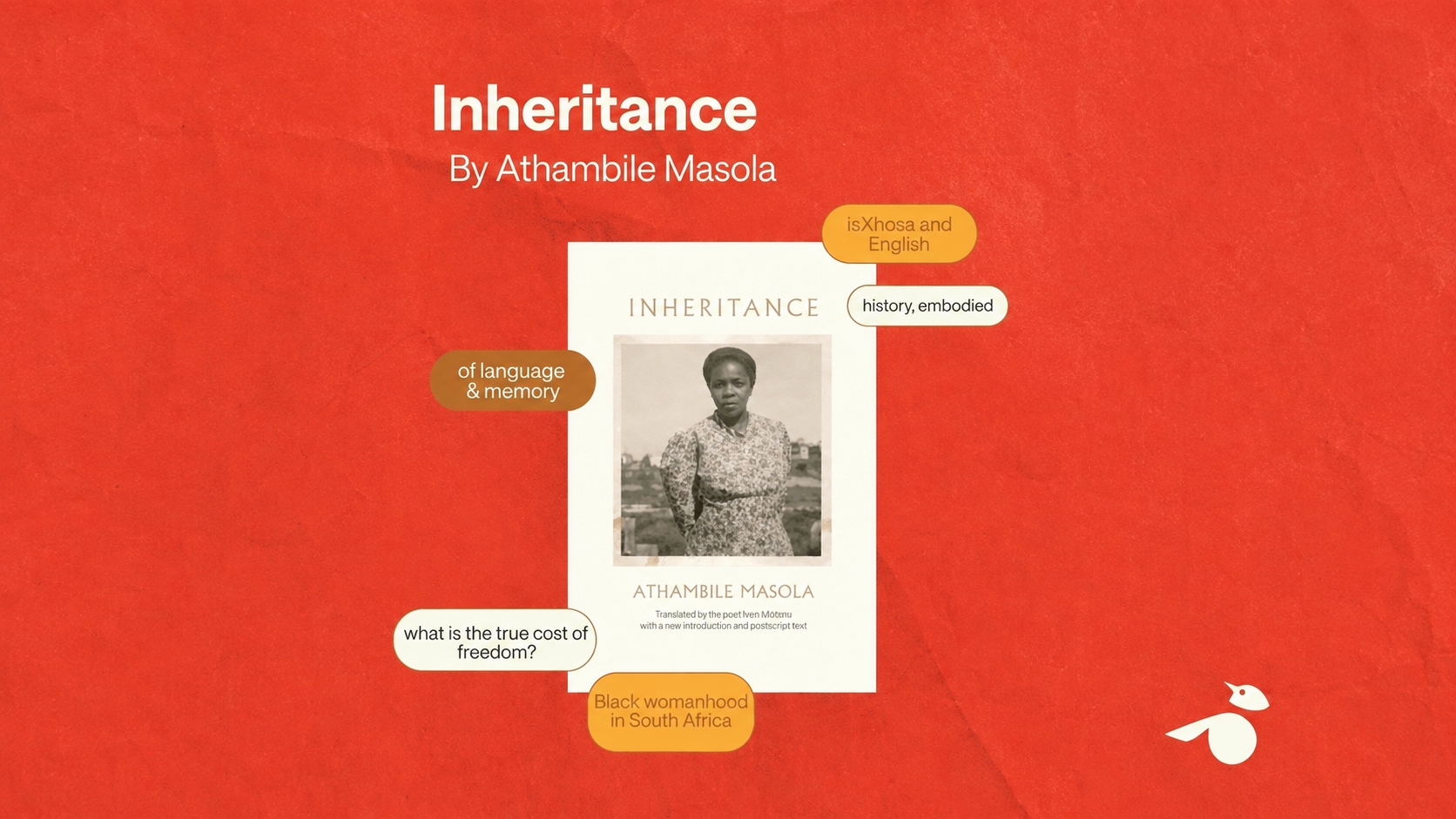
Brick Mbekwa reviews 'Inheritance' by Athambile Masola
Share this piece
Pass the story on to your people.
Publisher: Batis Books
Type: Poetry collection
Date Released: April 2026
Retail Price: +/- R330.00
Format: Paperback (152 pages)
I started reading this collection on a cool Saturday afternoon, and I thought about this funny saying my mother would say, “English comes from Xhosa.”
For a long time, I just saw my mother’s words as a funny joke for when she would pronounce an English word in a Xhosa accent, or we would find an English word that has similar spelling or pronunciation to an isiXhosa word. However, while reading Inheritance, my mother’s funny saying felt more concrete.
To put it simply, I do not mean that the English language originated from isiXhosa or Nguni languages but rather that these Xhosa poems that have been translated into English still carry on the nuance and meaning in isiXhosa that the English language may not have.
In 2021, Athambile Masola made a striking entrance onto the South African poetry scene with her celebrated debut collection, Ilifa, written in her home language of isiXhosa. In 2026, the collection returns as Inheritance, with Masola’s English translations presented alongside the original poems.
In Inheritance, Masola explores love, morality and pleasure in a world shaped by danger and inequality. Unabashedly modern in style and contemporary in outlook, she examines the ways in which poverty, patriarchy and widespread violence against women continue to restrict South Africans’ freedoms. Yet the collection also celebrates the possibility of healing through self-reflection, care and learning to listen to oneself.
Writing within a rich literary tradition, Masola captures an isiXhosa that feels urban, vibrant and alive – a language shaped by the time and place in which it is spoken. Her breezy love poems and bold historical reimaginings question what freedom means in a society where apartheid’s legacy persists through new and equally oppressive systems.
Bold, original and deeply contemporary, Inheritance offers a moment to be immersed in the lives of Black women in South Africa today. The collection moves masterfully between self-care and self-recrimination, desire and social safety, and the shadows of the past and the uncertain light of an equally complicated present.
It is this tension between the burdens of the past and the realities of the present that initially struck me. Masola’s poems interrogate the lived experiences of women and the systems of oppression that have persisted beyond apartheid, including sexism, patriarchy and the fracturing of identity. The title Inheritance therefore establishes the collection’s central concern: the histories, emotions and injustices passed down through individuals, families and the nation. Masola explores not only what we inherit from previous generations, but also how we carry, confront and attempt to heal from those legacies.
Translation is a complex process where many elements of language clash and mesh together. It is a process that is known intimately by the South African audience as we all translate our mother tongue into all the different languages spoken in our country. With the territory of language translation comes the possibility of losing the essence of language through translation due to the differences that all languages have. Athambile Masola encountered this dilemma as she did not want to lose the essence of the isiXhosa language while translating these poems for non-isiXhosa readers. Through Masola’s translation, we are able to view stories through different lenses. For example, the poem “Wakrazulwa” is a poem that heavily borrows from an isiXhosa hymn that depicts the crucifixion of Jesus Christ. In the poem, Masola uses the crucifixion as a metaphor for the violence women face in South Africa. The English translation of this poem is able to convey the same powerful message while still keeping the initial hymn essence that was in “Wakrazulwa”. The isiXhosa and English translation both stray away from the source of the crucifixion of Jesus while still maintaining the integrity of the message that women are made into martyrs in South Africa.
Through translation, these poems can be seen as a wrest of the English language, as these poems being translated from Xhosa to English steer the non-Xhosa reader to experience a Xhosa narrative in English. Masola speaks on common Black South African experiences and features such as Mzansi Magic and the use of clan names in conversation, making accessible experiences to non-isiXhosa readers that still resonate with others no matter their background.
For me, this collection feels like the embodiment of being Xhosa in an English world without the tension that comes with it. Rather than living within the tension, I am able to view this tension on paper and watch how the interactions and translations of English and isiXhosa words create a new language for myself. I am fully Xhosa, but I do not fully know isiXhosa due to the nature of growing up in predominantly white areas in a new South Africa. Inheritance creates a space to be able to both learn and question the dual existence of being an English-speaking Xhosa person as well as create this space for non-isiXhosa-speaking readers to engage with a language.
Furthermore, Inheritance has the ability to resonate with people living in dual existence and for people that live in the in-betweens. The poems question the lived realities of women and the systems of oppression that have replaced apartheid, such as sexism, patriarchy, and the overall disjunction in identity.
In Part 1 of this collection, titled Advice for Women, Masola invites the reader to reflect on the lived experience of women as well as the standards and expectations that Black women are held. Masola tackles topics of purity culture, rape culture, women empowerment and the importance of shared womanhood within Advice for Women in a seamless manner. While reading this first part of the collection, I resonated with the messages and symbolism the poems as well as the delivery of these experiences. A few of the poems in Part 1 are written in a conversational manner. An example of this would be the poem “Coconut”. In the South African context, a coconut in colloquial language is typically a Black person that is Westernized to the point of being perceived as “being white” and being more immersed in white Westernized culture rather than their own culture.
“Who are your people?
Pardon?
What is your lineage?
I don’t know what that means.” (lines 1-4, page 47)
In these four lines, Masola is able to already position the reader as a listener of this conversation. The fourth line that states “I don’t know what the means” is in English in both the original isiXhosa and the translated poem. By keeping this phrase in English, Masola is able to convey how Black South Africans can become disconnected in a conversation due to a lack of common language or understanding. Masola presents this in a way where both speakers in the poem are not wrong however tension is created through not knowing how to recite your clan names and tell people your lineage.
“Coconut” is portraying the reality of Black South Africans raised in multicultural or predominantly English-speaking spaces of living in the in-betweens where they are not fully able to connect to their culture and heritage. In this poem, Masola does not portray being a Coconut as something inherently bad but rather is portraying the tensions that happen within conversation as well as the possible tension within one's self. This message can be felt by many South Africans as we all live in the same post-apartheid society.
Honourable mentions from Advice for Women are the poems “Public Service Announcements” and “Erasure”.
After I finished reading Advice for Women, I felt quite empowered after seeing experiences that I have gone through be portrayed in my mother tongue. Part 1 is raw and unapologetic in its language whichI believe is necessary for the topics Masola is writing about in these poems. The conversational poems stay true to the theme of Advice for Women, making the poems feel more like a conversation between the reader and Masola or the reader and the speaker in the poem.
In Part 2 of this collection, titled Love, Masola portrays love in its many forms from love of self, to romantic love to the love of ones spirituality. This part deviates slightly from the main focus of Black women’s issues and rather focuses on the intimacies that happen in Black women's lives. Things such as wanting better for ourselves, praising our ancestors, yearning for our lover and other personal aspects of someone's life are all portrayed and explored in this part. A poem that stood out to me in Part 2 was “Bodyland” as it is one out of two poems in the entire collection that has no capitalization except for the pronoun “I”. The isiXhosa title of this poem is “iXhanti Lam”. iXhanti can be many things but in this context it's a spiritual essence or anchor. Masola equivocating her body to a spiritual anchor in the title portrays how she views spirituality as an integral part of who she is. This sentiment is carried on through this poem. Masola solidifies the sentiment of her body being a spiritual anchor when she writes
“bodyland
the story of all I have been
the person I am becoming.” (lines 10-12, page 79)
As mentioned previously, this poem has no capitalization except for the pronoun “I”. The lack of capitalization in the poem portrays the abundance of spirituality that Masola sees within her body and within herself. The lack of capitalization allows for the poem to flow seamlessly from one line to the next which can be viewed as being mimetic for how spirituality and the essence of Masola are one and the same. There is no separation between who she is and what her spiritual self is, these two concepts are intertwined and live peacefully within her.
Honourable mentions from Love are the poems “Ancestor” and “The Olive Tree and The Mountain”
After I finished reading Love, I felt the gravity of all the forms of love Athambile Masola portrayed. Love gives a diverse telling of how it feels to love, be loved and embody love in all its different forms. It is a softer and more vulnerable part in this collection that portrays the emotional inner world in an elequent way. This part of the collection made me realize the many ways in which the people in my life have loved me and how I have loved them and how the essence of this love still stays the same even within translation.
In Part 3 of this collection, titled Here, Masola situates the reader back into the realities of a new South Africa. Masola invites the reader to sit with the discomfort and frustration that is in our daily lives as South Africans. Here forces the reader to be present in what is happening around them as well as see the issues in government and in our society through a factual and realistic lens. Masola takes the issues that are minimized or normalized and makes them glaringly obvious to the reader. This is made clear in the first poem of Part 3 titled “Shit”. “Shit” is a poem that reflects some of the feelings of Black South Africans on the brink of freedom in 1994. The poem is framed as a retelling of a story by Masola’s mother, and it discusses the issues of the lack in the government's ability to provide citizens with something as integral as the dignity of sanitation. Masola states that
“...when blacks get their freedom, they will have a
shitty freedom.
When children drown in shit,
So does our freedom.” (lines 45-48 , page 121 ).
These last two lines of the poem send a strong message stating that freedom cannot be achieved when basic sanitary needs are not being meet for all South Africans. Masola plays with the common phrase of saying a country has gone or will go to shit as the vessel to highlight how basic needs are not being meet for all South Africans showing that true freedom has not been achieved. This message being said 32 years after democracy speaks volumes to how we as a country have been stagnant in the betterment of the country for every individual that lives in it. This sentiment is echoed throughout the rest of Part 3 being a constant reminder that after three decades of democracy, we remain as Verwoerd intended as stated in the poem “Here”.
Honourable mentions from Here are the poems “In the City” and “Mr President”.
After I finished reading Here, I felt enraged about the state of our country and the blatant issues that are not being addressed within our nation. I also felt heard. Reading the poems in Here made me realize that my frustrations are shared by others and these frustrations are heard and are voiced.
By the time I had closed Inheritance, I understood my mother’s joke differently. English does not come from Xhosa in any literal sense, but is Masola’s hands, English is made to carry isiXhosa within it. This is the quiet argument that the collection makes: that translation is not loss of meaning but a negotiation, a place where two languages can hold the same ache without either one having to give it up entirely.
Advice for Women, Love and Here move through distinct registers, from inherited womanhood to many forms of love, to the unflinching realities of democracy that has not delivered on its promises. Yet all three return to the collections title: the coconut’s dilemma, the body as a spiritual anchor, the sanitation that still fails children decades after freedom are all a part of what has been passed down and what mighty, through poems like these, be finally set down.
For me, reading Inheritance was personal as it was literary. As someone who is fully Xhosa without fully knowing isiXhosa, Masola’s bilingual pages gave me a space to both learn and understand in both isiXhosa and English. The collection does not resolve the tension between a painful past and an uncertain future but rather it insists that this tension be held, and even healed. That is Masola’s gift: not an answer, but a place to sit with the question alongside her.

About the author
Brick Mbekwa
Graphics Designer
Brick Mbekwa is a freelance photographer and self-taught graphic designer who lives life in full technicolor. Raised in Johannesburg, Brick draws from the richness of multiculturalism to create visuals rooted in community and lived experience. Currently a third-year UCT student, when he's not behind the lens (or a desk), they are out with friends, drinking copious amounts of matcha, or deep in an anime binge. (He/She/They)
View all work by Brick Mbekwa