No Crumbs Left Behind …
Fatima Bheekoo-Shah reviews 'Curry and Bread' by Pravasan Pillay
Share this piece
Pass the story on to your people.
Publisher: Dye Hard Press
Type: Memoir
Date Released: June 2025
Retail Price: +/- R285.00
Format: Paperback (136 pages)
Books often announce themselves to have grand ambitions; Curry and Bread does the opposite.
The memoir arrives like its namesake meal: unpretentious, made from what's on hand, and somehow exactly what you didn't know you were hungry for.
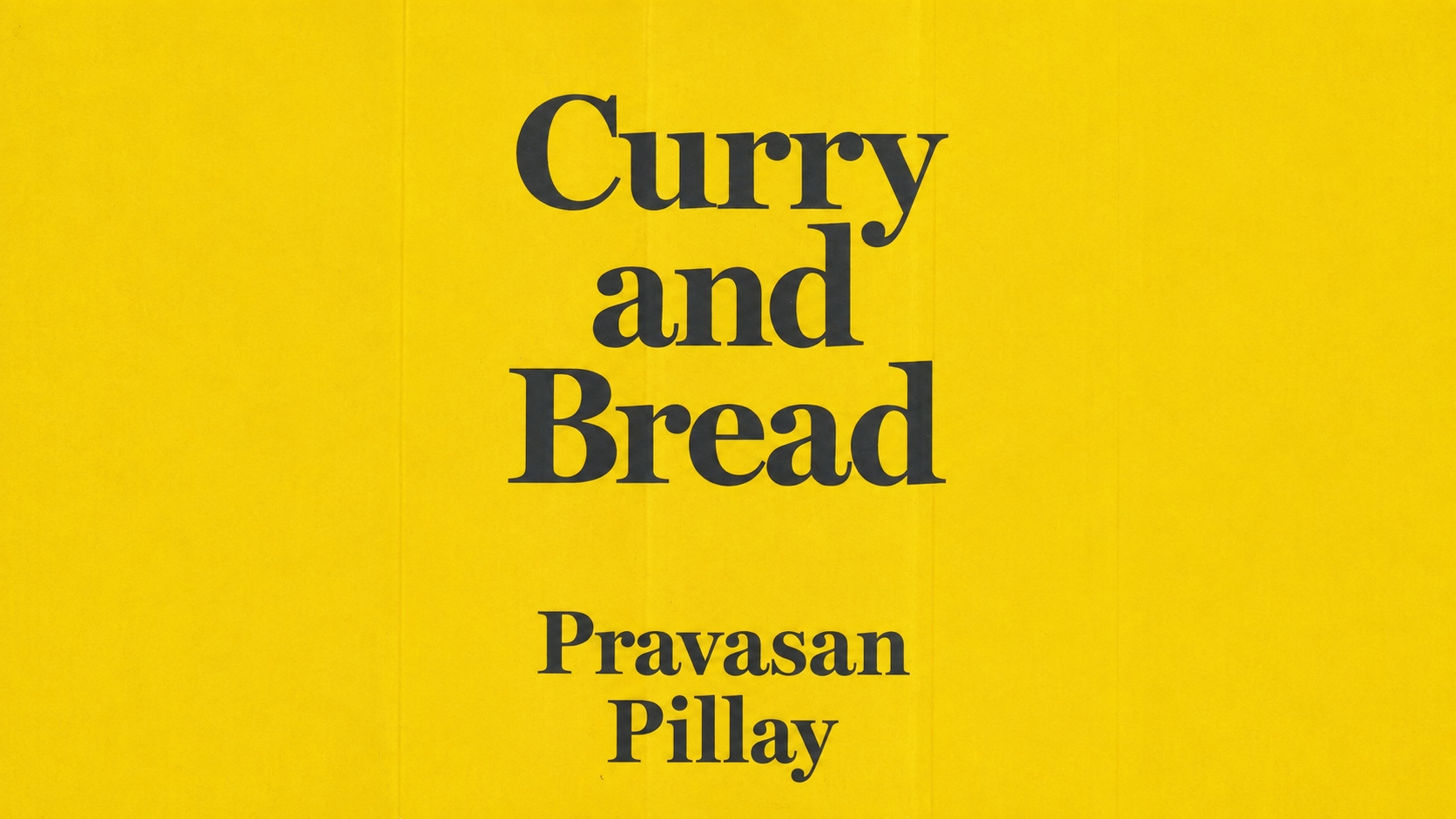
Even the minimalist cover conveys this before you have read a single word. I loved it on first sight: the deep yellow recalls turmeric, the most essential spice in any curry worthy of the name, whilst the bold, unflinching font refuses to whisper. There is no clutter or noise, only a quiet confidence that the contents will speak for themselves.
Pillay was born in Durban and grew up in Chatsworth, though these days his curries are made in Sweden, where he has had to work out how to get home onto a plate using whatever a Scandinavian supermarket will allow, while slowly making peace with the tastes of his adopted country. Part memoir and part scrapbook, the book that emerges from this life resists tidy categorisation. Through short pieces, lists and remembered meals, it builds a vivid picture of how ordinary Indian families in this country ate, cooked, saved, stretched what they had and celebrated.
Blending memoir, humour, lists, slices of life and vignettes into a layered collage, Curry and Bread is Pravasan Pillay’s offbeat exploration of the food and foodways of working-class South African Indians, as well as his own memories of eating and belonging. Memoirs like this matter deeply in our literary landscape because food is never merely food. It is culture made edible, passed from hand to hand, pot to pot and generation to generation. When Pillay records the proper way to eat a bunny chow or the sacred bond between Indian aunties and repurposed ice-cream containers, he preserves details of everyday life that could otherwise so easily disappear.
What the memoir understands so well is the intersection between food and lived experience.
A meal in these pages is never only a meal. It is a marker of who cooked it and who could afford it, of what was celebrated and what was survived, of which memories a single taste can summon decades later.
Pillay reads his life through what was on the plate, and in doing so shows us how our own plates have been quietly telling our stories all along.
Where the memoir touched me most is in its handling of identity.
I can only speak for myself here, not for every Indian South African, but I have often felt caught in a peculiar in-between, made to feel I belong fully to neither South Africa nor India, too Indian for one, too South African for the other.
Pillay somehow bridges that gap, not by resolving the tension but by writing from inside it so honestly that the in-between becomes a home of its own. Reading him, I felt permission to identify simply as who I am. That is no small gift.
The brilliance of Pillay's writing lies in its simplicity.
There are no literary fireworks here, no straining for effect – just clean, unhurried sentences that seem to be doing very little until you realise how much they've done. Beneath that plainness runs a real depth, and a melancholy that surfaces when you least expect it, as he waxes lyrical about experiences so ordinary that all of us can find ourselves in them. It takes enormous skill to write this simply about things that matter this much, and Pillay makes it look effortless.
Then there is the nostalgia.
For anyone who grew up in the 1990s, Curry and Bread offers a sweet reminder of what felt like a simpler time. Pillay captures the textures of the era with warmth and affection, without allowing the memoir to become overly sentimental.
My favourite vignette is the last one, in which he recounts a rare visit to Wimpy. Raised by a single mother, these outings were not a regular treat, and the young Pillay finds himself wrestling with knife and fork when his hands had always known better. It is a small scene, almost nothing, and yet it holds so much: class, aspiration, the quiet codes of belonging, and a mother's love stretched to afford a burger. I closed the book on that note and sat with it for a while.
If I have one caution, it's this: the memoir lives and breathes food, and it assumes you care about food too. Every memory, every observation, every joke comes plated. If you're the kind of reader for whom a meal is just fuel, some of these vignettes may feel like being stuck at a dinner party where everyone is discussing a dish you didn't taste. But if you understand that food carries memory, family, and identity, and I'd argue it always does, whether we notice or not, then this book will feed you well.
At 136 pages, you could finish Curry and Bread in an afternoon, but I'd recommend against it.
Read it the way you'd eat a good curry: slowly, with bread to soak up every last bit. It made me hungry, it made me laugh, and it reminded me that our tables, our kitchens, and our in-between lives deserve the page.
Pillay has given us all of that, and left no crumbs.

About the author
Fatima Bheekoo-Shah
Fatima Bheekoo-Shah is proof that one woman can wear a ridiculous number of creative hats and still somehow find time for a decent cup of tea. She's the founder of 'The Book Doula', where she ghostwrites, coaches, and midwifes other people's manuscripts into the world. Under the pen name BF Queen, she writes award-winning romance that has readers reaching for the tissues (or the fan, depending on the chapter). She's currently working on launching Write & Sip, her women's writing workshop for women who’ve always been interested in creative writing, but when she's not doing that, Fatima can be found colouring in like it's a competitive sport, deep-diving into true crime rabbit holes, or experimenting in the kitchen with whatever's left in the fridge. Contemporary romance is her home turf, but really, she just loves a good story, especially if it ends with a happily ever after.
View all work by Fatima Bheekoo-Shah