Fear Not Monsters in the Dark... Fear The Ones in your Psyche.
Khazimla Louw reviews 'The Enumerations' by Máire Fisher
Share this piece
Pass the story on to your people.
Publisher: Catalyst Press
Type: Novel
Date Released: February 2025
Retail Price: +/- R350.00
Format: Paperback (368 pages)
“There are very few monsters who warrant the fear we have of them.”
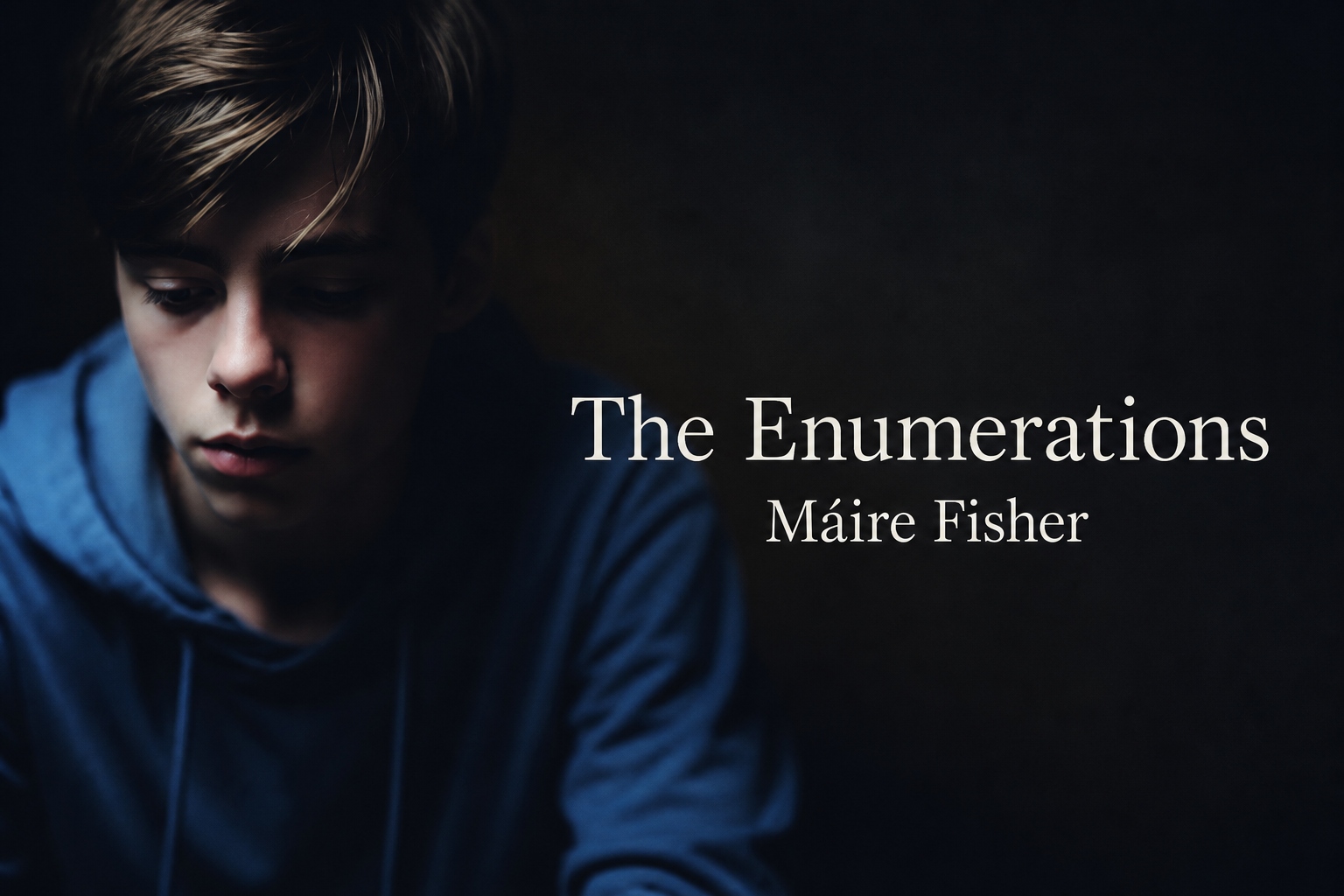
Borrowed from André Gide's Autumn Leaves, Máire Fisher's sophomore release starts on a grim note, a foreshadowing of what's to come. A haunting prologue follows, inviting the reader for an immersive and thought-provoking novel that points out real and lived experiences of a youth battling an invisible war and the cruel ironies and epiphanies of it.
Set in 2010s Cape Town in the fictional town of pristine and airy Harbiton, the gritty and not-so-clean-cut The Enumerations follows OCD-affected teenager Noah Groome. After a brawl with a bully turns brutal, he is sent to Greenhills, a luxury rehabilitation centre. In the mandated weeks he spends at the centre, his world unravels and evolves as secrets come tumbling faster than his five-step wake-up routine.
Going into this story, I really had no idea what to expect. With a book heavily rooted in discussions and depictions of mental illness, there’s a lot that could go wrong: one-sided iterations and biased writing could easily make a promising book fall apart. At the same time, a lot of things could go very well: diverse ideas and perspectives could be equally balanced and defended and that could really turn a good book into a great work of literature.
The Enumerations felt very new to me: new author, new subgenre, new ideas to mull on...
Fisher's novel sees her tackle a variety of themes and concepts, such as the nuanced interpretations and ideas surrounding mental health, the perpetuated idea that wealth and success equate to happiness and soundness, complex family dynamics, the effects trauma has on children and adults alike and the often difficult act of growing up. Fisher would make Noah proud, as her often sharp and unflinching take brings together a novel that pushes the reader to really think.
Now, depending on who you are, this book might be a cliche bitter pill to swallow. Mental illness, through the South African lens, is often a subject not many communities address still in 2026. Through my perspective as a Black woman, the intersectionality of race and illness is a concept that I rarely ever think about. Often, mental illness is always seen as a "White people problem", which is very dismissive and quite frankly rude. You could never be “Black and depressed," as that's laziness. You could never be Black and be anorexic, as you’d simply be labelled a “picky eater”. The idea of being “Black and having PTSD?” There's usually two conclusions: you're seeking attention or you need to see a sangoma – pretty archaic, I know, but that's how it is around here...
However, this novel also made me think about the ways mental illness is understood within some Black South African families and communities. I found myself wondering how Noah’s experiences might be interpreted in spaces where mental health is still sometimes dismissed, misunderstood, or treated as something that should be dealt with privately. Would his behaviour be recognised as a sign that he needed help, or would it be explained away, judged or stigmatised? I also wondered whether those responses might differ for a Black girl, particularly given the expectations often placed on young women to remain resilient and composed. These questions stayed with me as I read and made me reflect on the broader conversations we still need to have about mental health, stigma and access to support in South Africa. Perhaps part of challenging that stigma is also recognising that mental illness does not always present itself in the ways we have been taught to expect.
Fisher does something in this book that I personally loved reading: she didn't give mental illness a look. She didn't play into stereotypes surrounding illnesses. Noah, with his OCD, was not always tick-ridden and "borderline manic". Sadie, with her PTSD and depression, was not a hollow shell floating through her stay. Vuyo, with her anorexia, had more substance and depth.
Noah's OCD doesn't define who he is as a person. It might dictate large aspects of his life, but it does little to alter who he is at his core. I really enjoyed Fisher's interpretations and visualisations of mental illness. I also love how she let the reader into his thought processes. The style of writing reflects this as much of the dialogue is written in second-person, which is a style of writing I personally loved the most.
Another major theme discussed are the many complex family dynamics represented in the novel. These are directly tied to another theme: the perpetuated idea that wealth and success equate to happiness and soundness. The Groomes, along with the Ryans, and the families of the patients at Greenhills, are core examples of these.
The Groomes represent what the "perfect family" looks like: affluent father, pretty mother, smart son, talented daughter... there's nothing that could possibly be wrong... until Fisher decides it's not.
Affluence or not, we are all pretending to be okay, and honey, that's not okay. Okay?
I guess I had, for a while, been unconsciously conditioned to view people like the Groome family as happy and healthy people. I was so caught up in the allure of their lives that I didn't see the scratches and cracks behind their facades. I loved how Fisher zoomed into these families.
With the Groomes, rather than pick and choose who to rally behind, I feel that Fisher tried to make the reader understand how each Groome dealt and lived with Noah's OCD.
Kate's helicopter parenting doesn't aim to ridicule her, nor does Dominic's indifference and subsequent coldness to his son seek to make him a villain.
Maddie's own complicated feelings didn't make her weak. I believe one of Fisher's strongest traits as a writer is her ability to write tense scenes and reflections with incredible ease.
The car rides to see Noah are so expertly detailed and I like how she didn't try to sensationalise these moments.
There's an odd normalcy in these scenes, but it doesn't take away from the emotional energy of the characters. There's a natural progression in how the Groome family is at the start of the book and at the end and honestly, she's goated for that. (Not Audrey thirsting over Dominic... like ma'am no. Just no.)
With the Ryans, however, the main conflict is narrowed down to Juliet's father, Bart. Not to say Leonie is not at fault. Whatever problems Bart and Leonie have had never got resolved and as a result, they take their frustrations out on Juliet. Bart's disappointment is not entirely on Juliet, but on himself. Her "almost tryst" with Mr Wright had confirmed one thing: men like himself would eventually wind up on his door step preying on his daughters the same way he preys on other younger women. His tough love doesn't seek to galvanise his daughters, rather it seeks to absolve him of the guilt that eats at him.
Leonie, though I am sympathetic to the woman, irks me as she does not seem concerned with the blatant character assassination of her daughter. I may even go as far as to say Juliet does not have a sex addiction. I'm really tempted to believe that Juliet is rebelling against the facade her father desperately wants them to partake in.
Trauma is a core component to the making of this book. Every character has gone through trauma, minor or major, and I want to commend Fisher for including this. Again, the Venn diagram of race and crime is a major talking point. Every character deals with trauma in their own way.
Mental illnesses on their own bring a certain trauma, for both patients and those around them.
The Groome family's own trauma manifests in various ways, some more drastic (Noah) and others mild (Maddie).
Vuyo's own trauma can be found in her unbalanced battle between her own ambitions and her filial piety. As Black girls, we're taught that the greatest achievement can be found in raising and maintaining a good family. Black girls have been shackled by these heavy traditionalists ideals that it is nearly impossible to break free from them. Vuyo has dreams of being a doctor (a very noble profession), but her mother is more concerned with her ability to bear children. (Side-eyeing Vuyo's mom). I really relate with Vuyo on this, and I feel a lot of Black women can also attest to the tiring constraints we are often put under. I wouldn't be surprised if this constant pestering hadn't triggered her anorexia...
This complexity in Fisher’s characterisation is not limited to Vuyo, however, and becomes especially apparent in the way she writes Noah.
Noah is pretty standoffish and peculiar. I can't decide whether this is a result of his OCD or if he naturally is like this. While most might consider him cold, Noah is surprisingly warm. For instance, him accommodating Juliet in his space even though he counts the seconds until she leaves is proof that he's better than me, because I would have kicked her out so quickly. Noah is also dependable, contrary to what he might say. As an older brother, he often feels bad that he can't always be there for Maddie like he used to be, but in his sometimes limited capacity he really tries his hardest and I find this to be an admirable trait in him.
Juliet, in her snark and quip, is actually a soft sweetheart. She genuinely has good intentions and her kindness knows no bounds. Her readiness to help Noah without wanting anything in return would easily make her a reader's favourite. There's a scene when she defends Willa and effectively everyone in their support group and this showcases her maturity and ability to empathise with others. I would actually smile every time she appeared.
Sadie and Morné? I really want to be mad at Sadie and her misconstrued views, but considering the environment she grew up in, I feel more sorry. She's young. She still has a lot of time to unlearn and question all the things she was taught. Morné is quite the mystery. He effectively only appears as Sadie's shield. There's a story behind Morné's quick remarks and I wish Fisher could have given me a brief history.
Willa is a rockstar and I also want their boots. Though their appearance is brief, their story is such an important conversation that I feel still needs to be had. I can't imagine what living as trans would be like today, let alone 2013. I would like to see more dialogue on this from multiple angles and perspectives. I wish I could say more about Vuyo, Wandile and Simon but there wasn't anything that stuck out to me (besides Vuyo's speaking about her mother asking whether her menstrual cycle has begun.)
Kate and Dominic are chaotic in their own way and that is both okay and not. Besides Kate having “thoughts” (wink wink) about Mr Bill, there's a certain melancholy about her. I feel that Kate has ultimately wrapped her worth and personality around her family. Outside of her role as a mother and wife, there's not much to her as a person. I think this tends to affect a lot of mothers who've been trained to abolish who they are after they give birth. Dominic is... I really can't decide how to describe Dominic? He annoys me, yet I feel so sorry for him. Then he angers me, but suddenly I want to give him a hug. Who knew men could be this frustrating, right? Maddie, bless her soul, needs a hug. I admire her strong will and persistence. She's much more intelligent than most of her peers and I love how she's prepared to put a shoe in someone's face should they speak badly about her brother. I love her.
What I found really innovative was how you could easily tell which character's perspective we're reading from. Rather than chapters, the book is divided into parts. Chapters are broken up by times, I assume. Alternating between Noah, Juliet, Kate, Dominic and Maddie, Fisher shows her genius by making the chapters feel more like mental monologues.
Fisher really made me feel as if I was with each character as the book progressed. For instance, I stopped breathing when Maddie went into her father's study. I was worried that the changing writing style would be a hindrance as one reads further but there's a charm to it. The reader could go as far as to say her changing writing patterns reflect how the character thinks and even speaks. I expected it to become wonky and old but with each turn, a certain maturity arises with each character. Rather than simply explain the changes, she changes their dialogue and the writing of their perspectives to match their shifting stories and I find that to be the book's biggest highlight.
The word “enumerations”, by definition, is the act of naming things one by one, counting items, or listing a set of named values. As such, there are many reasons to pick up this novel. It honestly astounds me the talent that lies in Máire Fisher's writing. As a first time reader of her work, I'm a little mad her name is not brought up more in reader circles. She has a clean way of writing, not too stuffy and I like how she isn't overly elaborate.
The Enumerationsis one of those novels you don't really feel guilty splurging on; I would even be brave enough to say that this book is the kind of book that needs to be taught in schools. The novel discusses what a lot of teenagers go through and many young readers might even relate to one or some of the characters.
I definitely would recommend this book as a must read, not because of the subject matter, but it truly shows the potential South African literature has and all its diverse storytelling.
About the author
Khazimla Louw
Just like when Queens needed a neighbourhood friendly Spiderman in Peter Parker, Cape Town found itself a neighbourhood friendly wallflower in Khazimla Louw. Always on the hunt for a great book and great coffee, she is constantly (though not so subtlety) chasing after what she believes is the next "book of her life." As a new literary blogger finding her way and standing in Cape Town's burgeoning literary landscape, she is determined to be the spark that leads many eyes and minds to South Africa's new pantheon of literary greats. When she's not snuggled up with a book and wine, Khazimla can be found either sneaking off to her nearest libraries, whisking and baking up a storm in the kitchen, or being overly passionate about sports.
View all work by Khazimla Louw