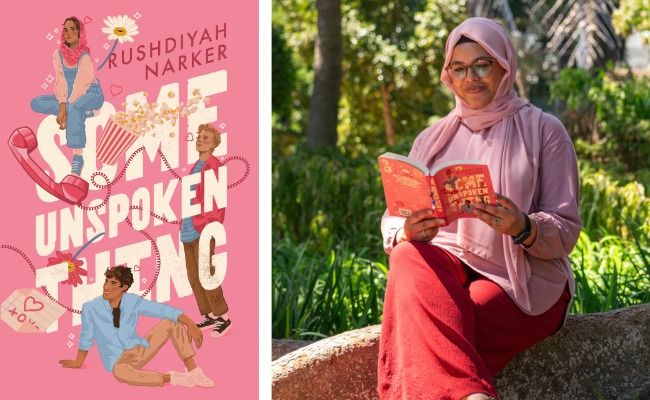
All The Things They Left Unsaid
Shaheena Links reviews 'Some Unspoken Thing' by Rushdiyah Narker
Share this piece
Pass the story on to your people.
Publisher: Penguin Books South Africa
Type: Novel
Date Released: August 2025
Retail Price: +/- R290
Format: Paperback (280 pages)
Do you remember what growing up in the 90s was like in Cape Town?
Are you old enough to remember recording your favourite songs from the radio on cassette tapes?
Did you also spend hours writing lyrics in your glitter-covered notebooks?
Or do you remember your first love? That feeling of waiting by the phone for your crush to call and running to make sure your Daddy doesn’t get to the phone first?
Don’t get me started on getting picked up in a souped-up Toyota Tazz with subs so loud the windows vibrate?
Now imagine this nuanced experience encapsulated perfectly in a young adult romance novel.
Some Unspoken Thing, written by local author Rushdiyah Narker, is a novel set in Cape Town – even better, we get to hop into a DeLorean – straight into the 1990s.
All my core memories live in the 90s. As a Cape Malay and Coloured woman born in the 80s, this story was a nostalgic trip down memory lane. When I read this sweet coming-of-age novel, it was more than a teenage love story; I was reminded of myself at that age – an awkward age when one minute we were playing nickies in the street, and the next minute one of those guy friends looked at me differently, and I experienced an explosion of butterflies in my stomach.
Told through first-person narration, the main character is Maryam – a shy and awkwardly introverted sixteen-year-old. As someone who was an awkward teenager myself, I found myself relating to her so much. Maryam is the type of girl who is more likely to have her head stuck in a book than checking out boys at the mall.
This novel is relevant today because teenagers' struggles largely remain the same.
In today’s society, there are still many shy and awkwardly introverted teenagers navigating life, love, and friendships, all while trying to figure out who they want to be as people. Except now they are doing it in a digital age. I know I would not have survived high school if smartphones and social media were around – my experimentation with fashion and hairstyles alone would have caused a viral moment or led to cyberbullying!
It’s important to note that this novel is not only meant for teenagers. There is a scene when Maryam’s parents want to pursue a field of study that would give her sensible career options – a field that would get her out of a life of poverty, and this echoed my own life.
My mother wanted me to study Finance, and a part of me knew back then that I wanted to be a writer. It would take me years to find the courage to pursue that dream. Therefore, I had a visceral reaction to Maryam’s disappointment with her parents’ casual dismissal of her desire to pursue her dreams beyond high school, but it also made me feel less alone; someone else understood me and what I felt.
Despite its 90s nostalgia and its appeal across different age groups, the novel remains an unconventional romance story. I cannot say with certainty whether it is the first romance novel of its kind, or even the first traditionally published Coloured, Muslim, Cape Malay love story, but this novel is certainly the first time I encountered this kind of representation in mainstream South African fiction.
That, in itself, feels momentous.
The novel further entices readers when the popular boy Fuad takes an interest in Maryam; she becomes all flustered – borderline clueless – “As if!”
Luckily, her best friend Tauhier is there to give her tips. However, Maryam’s introverted nature is only half the problem; due to her age and religious upbringing, she is not supposed to be dating anyone, ever! Well, not while she is still in high school.
Despite Tauhier being Maryam's emotional support system, Maryam does have strong female friendships in the form of Gadija and Amierah. This is an interesting dynamic, as most stories centre around girl meets boy, girl falls for boy, and boy eventually falls for girl, don’t usually incorporate strong female friendships. Some Unspoken Thing does something unspeakable – it gives us depth and layered friendships.
Gadija and Amierah aren't just filler characters for when Fuad and Tauhier are not on the pages.
Gadija and Amierah feel real. Each with their own unique and distinct personality. They fill out Maryam’s interior world.
As the storyline unravels, Fuad shows interest in Maryam. He has the whole cool boy starter pack: handsome, popular, confident, and loads of girls drooling after him while scribbling his surname in their notebooks. Yet, Fuad has his sights set on Maryam, and he is not the type to back down from a challenge. Narker subverts the “cool guy” archetype by making Fuad fall for the quiet beauty that is Maryam. Maryam, who is blissfully unaware of the power she holds over Fuad, grows in confidence as their relationship deepens.
Throughout the story, we get a front-row seat to Maryam exploring the curiosity and excitement she feels about experiencing her first love. As Tauhier helps Maryam navigate the strange ways of teenage boys and how to charm Fuad while still playing it cool, Maryam and Fuad grow closer, and this makes Tauhier behave strangely and become distant towards Maryam.
Although the nature of Tauhier’s feelings for Maryam isn’t immediately revealed, for a while, I was sceptical whether the narrative would fall into the traditional v-shaped love triangle. This plot device can so easily become a hot mess or lead to what I dislike even more – miscommunication.
I am also no geometry whiz, but I was worried that the whole v-shaped love triangle business would be giving isosceles – wink, wink – for all those who paid attention in Maths. However, Narker deftly sidesteps any cliches, because the novel tackles more than just romance; it is also about yearning, identity, choice, and Maryam figuring out her place in this chaotic world.
Although it was not her intention, as Narker has previously stated in interviews that she does not write with archetypes in mind, it is interesting to note that she has somehow written Fuad to fall into the “bad boy” archetype and for Tauhier to fall into the “manic pixie dream boy” archetype. Archetypes are not to be confused with stereotypes; the former are important literary devices that readers can instantly recognise because they have easily identifiable traits.
What makes this observation even more magical is that Narker achieves this within a Coloured, Cape Malay setting. She gives these age-old archetypes a local flavour, shaped by Cape Malay identity, culture, and experience. Although the only v-shaped triangles I usually prefer are spicy samosas, this was one exception I was happy to make, because representation in literature is important.
Through Maryam’s blossoming from uncertainty into agency, Narker comments on the importance of allowing young girls the space to make mistakes in a society that judges them for their choices in relationships while, simultaneously, praising boys for being charming, desirable, or having player-like mentalities.
Despite its romantic tensions, questions surrounding identity and belonging, and Maryam’s coming-of-age journey, the novel is underpinned by the context of a country inhaling its first ragged post-apartheid breaths. It also deals with interracial relations within South African communities. There is a particular gut-wrenching moment in the novel where Maryam deals with the consequences of inequality.
Maryam also has to navigate the effects of poverty and upward mobility. She does not have wealthy parents like some of the other students at the school, and soon after getting into university, she experiences more struggles. And without giving too much away, Narker captures the difficult tension between following one’s heart and carrying the weight of family responsibility.
I found the book to be fast-paced and easy to read. It took me less than a week to finish. I practically inhaled it, which speaks volumes to Narker’s writing ability, as we are living in an age of constant distractions where our phones are glued to our hands. It’s so easy to lose three hours of doomscrolling on TikTok, but I am telling you, those three hours can be better spent by picking up this novel today and reading it.
Another aspect that stood out to me immediately was the use of Kaaps and colloquialisms of Cape Coloured people being integrated in this story – the language of my people; the language I grew up learning, hearing and speaking. It was a breath of fresh air and somehow healing to read the words: “tjaise”, “mos”, “oraait”, “aweh”, “joh”, “sieker” and the usage of plural you with the s at the end. Then there is also the inclusion of Cape Muslim Vernacular. Words like “batcha”, “Salaam”, “kanallah’ and “kassam” were woven in casually, as if those words were waiting for their rightful place in South African mainstream literature, and it was surely a validating experience for me as the reader. I even got triggered at the mention of having to be home before Maghrib!
I should also give an honourable mention to the names of some of the places mentioned in the novels: Lansdowne Road, Adderley Street, Long Street Baths, Company Gardens, Fish Hoek, and Maynard Mall.
Places I have been to.
Places I know like the back of my hand.
And finally, places that are now immortalised in South African romance fiction.
For years, growing up, I read books from far-flung places: London, New York and Paris – and as fun as it was to imagine myself in those places, it’s a different kind of feeling reading a novel and instantly recognising the place because you have been there.
I am not the biggest fan of v-shaped love triangles or the will-they-won’t-they storyline, but Some Unspoken Thing managed to handle it well while still making me want to keep reading.
This novel is about love.
This novel is about friendship.
These universal themes are equally important in everyday life, and are still important in literature.
Narker has threaded the representation of the Coloured, Muslim, Cape Malay community in such a way that I felt this could easily have been me and my friend group, my family, my community. In some ways, it was, and this is why I can once again, and honestly, say that I felt seen on the pages.
This book is, as Narker mentions on the inside of the copyright verso page, dedicated “to the Muslim girlies”, but I would extend this to young Muslim boys too, because Tauhier is such a great example of healthy masculinity. Note: I did not say perfect. He is still just a boy, also trying to figure out this thing called life, but Narker handles his character with great sensitivity and vulnerability that I rarely saw from the men in previous generations.
If you enjoy sweet romances and character-driven stories with more layers than your mom’s Sunday breyani, then this book is surely for you!
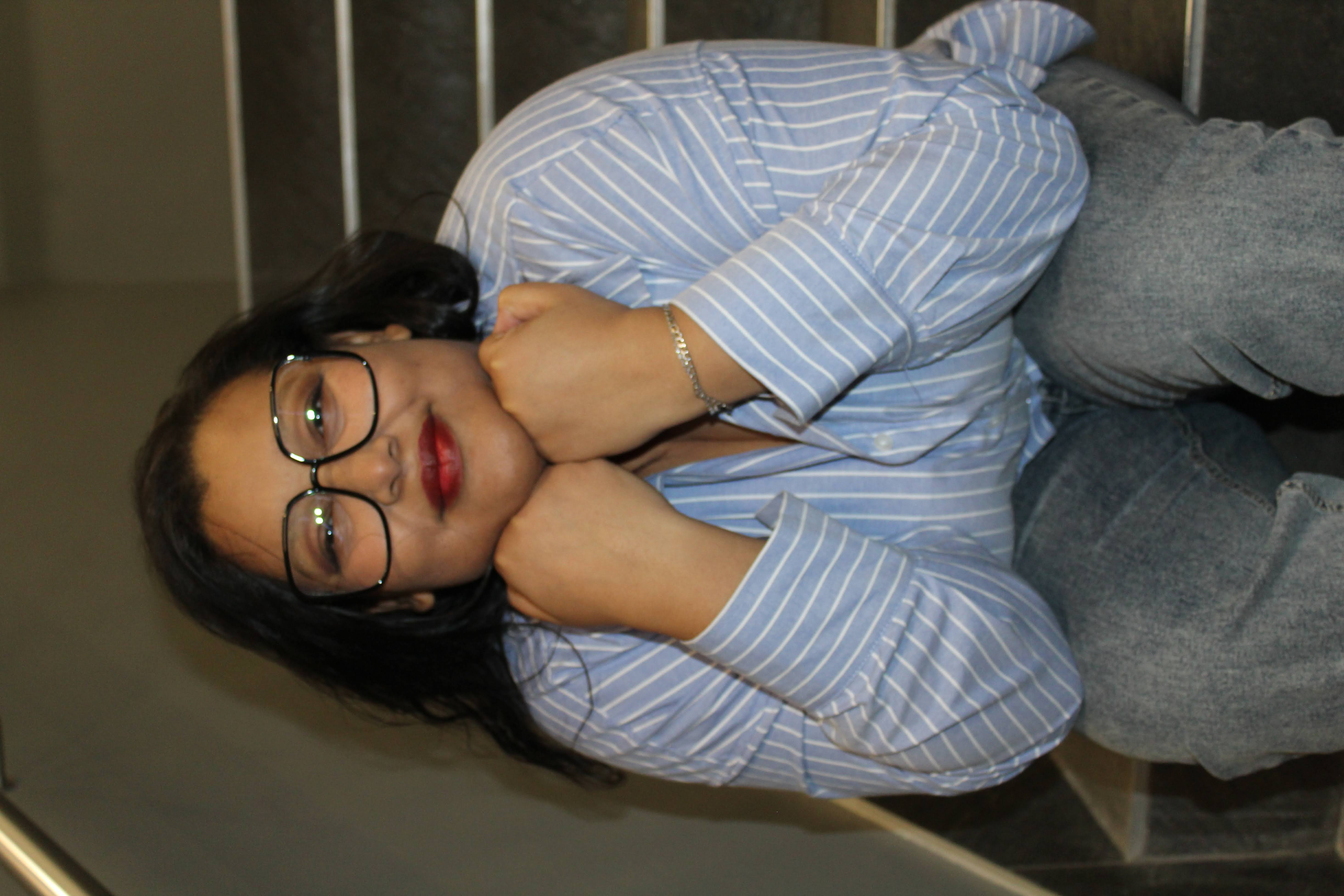
About the author
Shaheena Links
Shaheena Links comes from a long line of storytellers. From a young age, she used to count her Oumie's teeth, and hung onto every syllable. And with a degree in Communication Science, she's gotten pretty darn good at communicating! She is a published author of the short story 'Woodstock Wonderwall', a poetry collection, 'Lost and Found (Again)', and a holiday novella, 'Mistletoe and Mayhem'. She regularly genre-hops between romance, science fiction, dystopia, speculative fiction, fantasy, mystery and poetry. When not writing, Shaheena can be found taking long afternoon naps or talking about life and love on her podcast, 'The Skinne Bekke'.
View all work by Shaheena Links