A Woman. A Body. A Testimony.
Jennifer Grace Morris reviews 'Disabled, But' by Kirsten Deane
Share this piece
Pass the story on to your people.
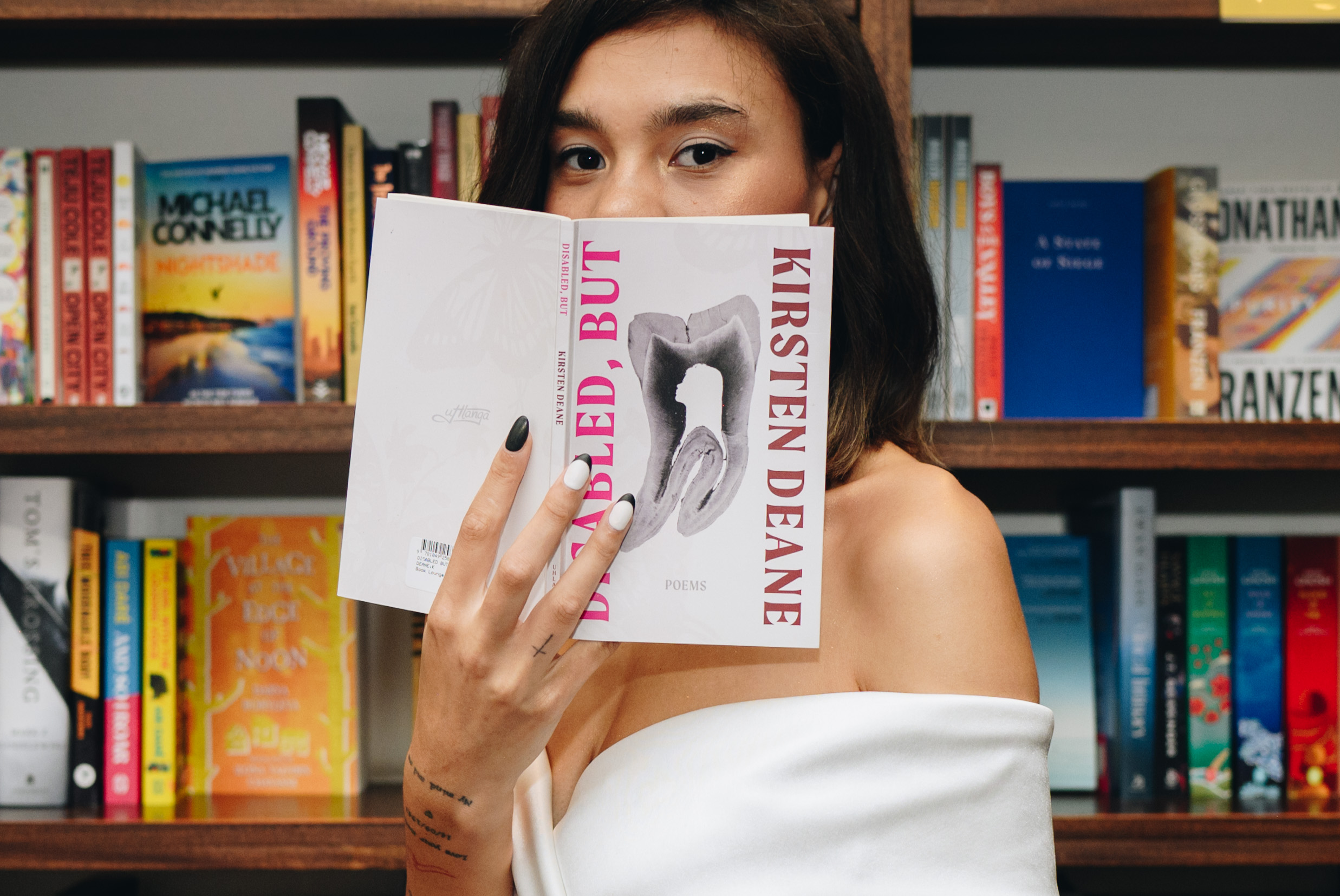
Publisher: uHlanga Press
Type: Poetry collection
Date Released: March 2026
Retaill Price: +/- R260.00
Format: Paperback (80 pages)
There were several moments where I genuinely had to pause and reread: reread the lines, the words, the structure – because I did not want to miss anything.
I found myself paying close attention to how Dean shapes her poems and how carefully she structures each line. Her writing is deeply engaging, and I felt drawn in. I wanted to take my time with every poem.
So, instead of reviewing, I reread, carefully . . .
In her debut collection, Disabled, But, Kirsten Deane writes with startling intimacy about disability and the experience of inhabiting a body that can feel disobedient and uncontrollable, tracing its impact on her family, community, and her romantic lovers.
The poems explore Deane’s experiences of self-love and internalised hatred.
The poems explore a young woman who wants to shrink even as she grows.
The poems explore the act of learning to live with pain and discomfort as constant close companions – even as trusted friends.
Not shying away from body horror nor vulnerability of womanhood, Deane writes from a place not simply close to the bone, but from the very marrow. Accessible and estranging, Disabled, But is evidence of a powerful and essential new voice in South African poetry.
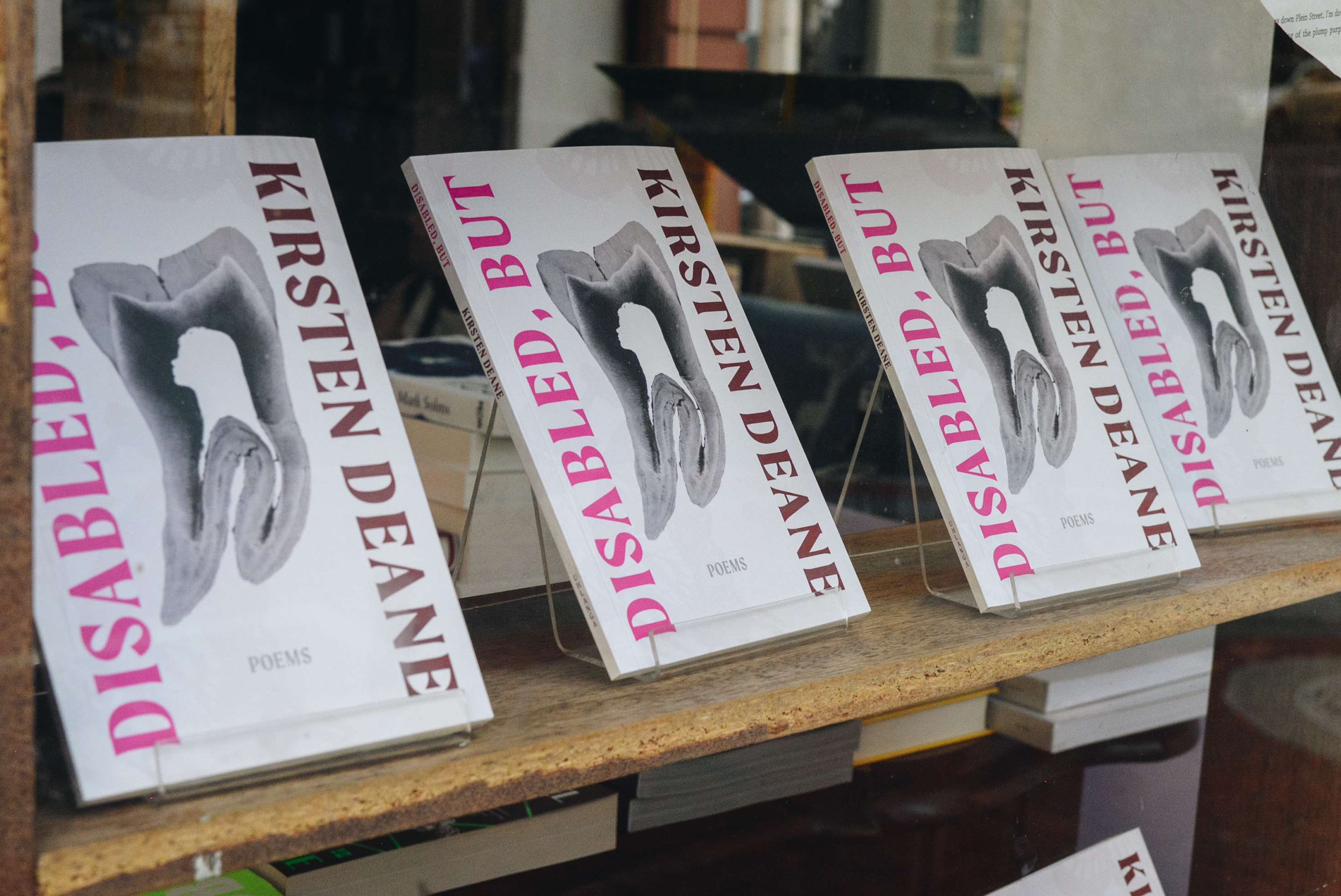
The collection is divided into three parts.
In Part 1 of this collection, titled Good, Deane invites the reader into her world through a childlike voice. To briefly mention, the poems in Good refer to Deane’s adolescent life, navigating womanhood beyond a disability diagnosis. Good challenged me to look at the body as an ensemble, evidently questioning my linear thinking. The very first poem, also titled Disabled, But, deserves the most praise; it made me question, pause, and that’s what poetry should do.
“They call this act seizures or fits or con vulsions” (line 6, page 10).
In this line, Deane’s brilliant and deliberate use of irregular spacing functions as a form of visual-syntactic cueing. The disrupted units of breath and meaning disturb the reader’s sense of rhythm and time while mimicking the spasmodic movement suggested by “seizures,” “fits,” and “convulsions”. To my understanding, when a body is in seizure, it does not move according to ordinary patterns; it interrupts, stutters, contracts, and releases. Deane’s spacing therefore makes the line itself convulse, forcing the reader to experience interruption not only as subject matter, but as rhythm, syntax, and visual form.
Deane’s skill as a poet lies not only in making from echoing seizure, but in showing how seizure is named and contained by language. By splitting “convulsions” into “con vulsions”, Deane slows the word down and makes the reader encounter it as both a clinical term and a bodily event. The fractured word suggests how diagnosis can divide lived experience into symptoms, categories, and medical descriptions.
This is, of course, one of the many tools Deane uses in her poetic license, and I find her craft to be unconventional yet impactful. Poetry, as an art form, can easily become verbose in flowery language, or so condensed in societal pleasure that its connection to reality becomes unclear. Deane denounces that; she attacks the convention of simplifying trauma and tragedy, which is what I admire: a writer saying what they want, how they want, because it stays true to them.
Throughout Good, the speaker’s tone feels so young, even innocently childlike at times, yet the content itself is incredibly mature. It is as though the speaker is a child who had to grow up too quickly – someone who had to understand difficult things early and develop the mindset of an adult before their time.
Honourable mentions from Good are the poems Skin and Nails and Parts of my Feet.
After I finished reading Good, I am still in awe of Deane’s voice. It carries the messages of struggle so beautifully to the reader. The poems allow us to invade their privacy, as though we are flies on the wall, quietly witnessing something deeply personal unfold. I hope that cliché makes sense, but that is the feeling I am left with: Deane’s writing invites the reader in, but it also makes us aware of the intimacy and vulnerability of what we are being allowed to witness.
In Part 2 of this collection, titled Pretty, Deane turns inward, displaying the speaker’s mental and emotional landscape after first inviting the reader to confront the pain and fragility of the human body, as she did in Part 1.
The tone of these poems veers away from the narrative that the realities of women's life experiences need to be condensed and softened. Writing a Romance provides a clear exploration of how most women have their vulnerability violated in the pursuit of a future.
“you want me to paint a picture of myself” (line 21 , page 49) reveals the speaker presenting a scenario where her partner wants them to present and expose her most vulnerable experience. In order for the speaker to “paint” herself for her partner, the speaker must return to memory and confront the trauma attached to it. In a modern society where oversharing and vulnerability are viewed as a weakness, a character flaw if you will and evidently a tool of manipulation in this generation, this exchange does not function as a barrier between the speaker and the partner; the trauma instead becomes a point of intimacy, allowing the partner to move closer instead of being pushed away. Even though the partner asks her to unravel the uncomfortable truth, she is not ready to admit the pronoun “me” reminds the reader that ownership is taken from this experience: this is her memory, her body, her choice to tell her story. By choosing to share her traumatic experience, she reclaims power that was taken from her.
I commend Deane’s depiction of the difficult process of opening oneself up to another person. Although such vulnerability comes with strength, Deane reminds the reader that this is indeed an act of strength and growth. The poems in Pretty purposely present growth as beautiful by suggesting maturity does not only develop physically but also emotionally and psychologically. An outward growth, the physical image of the body maturing and mirroring the ideal adult, is often confused with the internal growth, the internalised trauma of childhood and experiences that we refuse to resolve and become a habit in our daily lives.
Honourable mentions from Pretty are the poems Ssshh, Loving Lupus and Sixth Sense.
In Part 3, the final part of this collection, titled Skinny, Deane explores the experience of body dysmorphia and anorexia. The final selection of poems focuses on the outward body, showing how mental illness manifests physically and affects the body.
The poem Metamorphosis is printed in landscape. As I physically turned my book to read the poem in its proper form, I was at first taken aback by the story-like flow of the poem. As the reader, I was watching this scene unfold: the scene of the speaker sneaking through the kitchen cupboards to dose herself with “detox” pills.
Although the speaker admits to feeling her body increase in size, she filters this experience through the childlike imagery of “James and the Giant Peach” (line 25, page 66). This contrast softens the speaker’s reference to anorexia, allowing a painful bodily experience to be approached through the familiar language of a children’s story. The speaker thinks of themselves as a giant peach that needs to lose weight drastically, hence the use of “detox” pills that they secretly use.
Skinny in its entirety explores the experiences of a woman in her adult body, which strongly contrasts Good that explores the adolescent mind that had a mature understanding of the body.
Honourable mentions from Skinny are the poems How Small Things Work, Voicemail, Baby Doll, and To My Unborn Child.
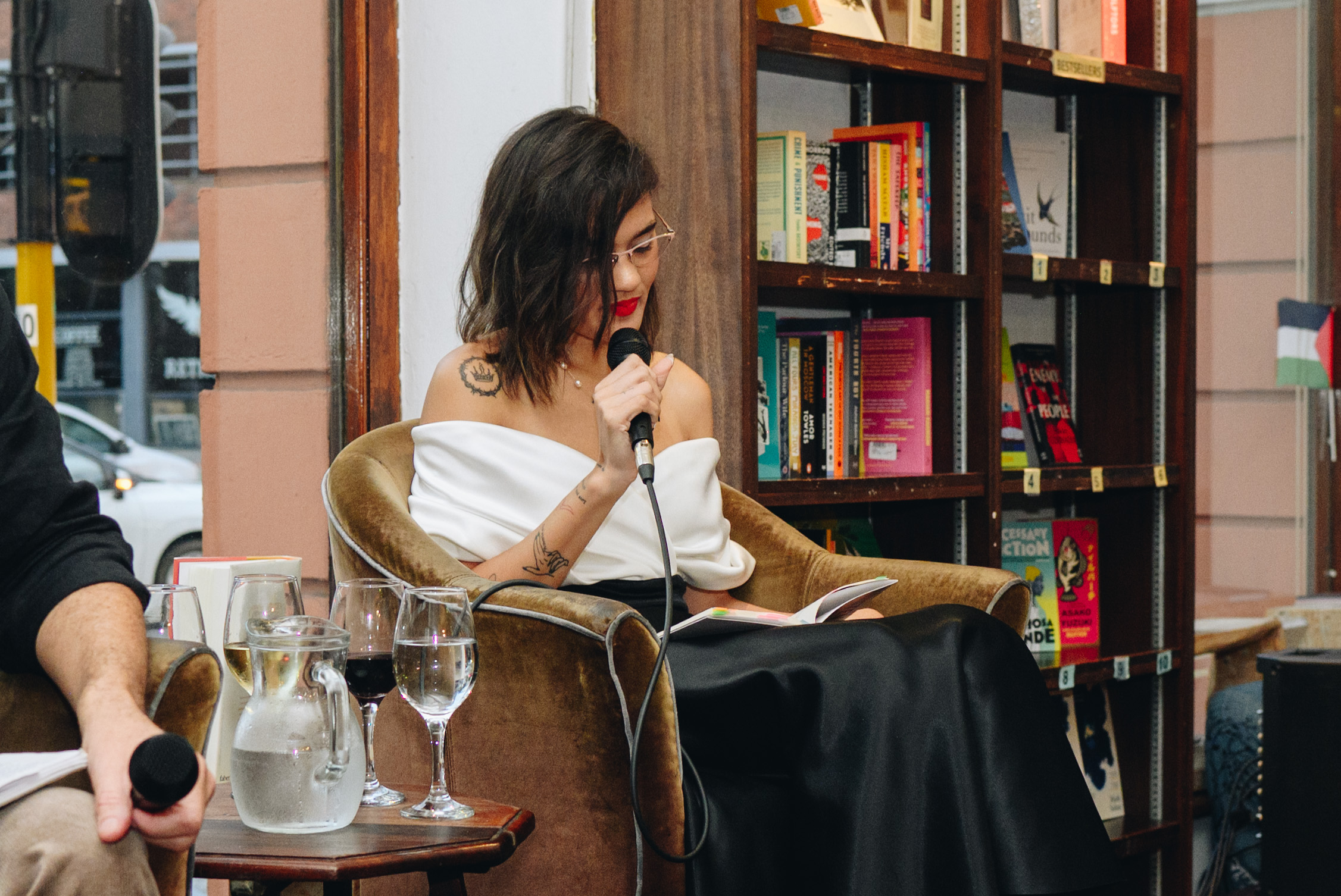
There is something about Deane’s writing that grips my heart. It not only moves me emotionally; it also makes my mind twist and turn – how Deane achieves this balance in Disabled, But is simply powerful.
It is important to highlight that the poetry collection’s central theme is the process of entering womanhood while navigating life after a disability diagnosis. As a non-disabled reader who recognises the privilege of not knowing what it is like to live in a disabled body, this collection deepened my understanding of disability, vulnerability, and the daily negotiations of pain. Deane has allowed me to change my normative perspectives and has allowed me to think beyond the norm society made me believe.
Disabled, But will continue to the very end to question how the female body is seen and appreciated.
I commend Deane for not only bringing visibility to a marginalised group, particularly disabled people in a Cape Town context, but also for portraying disability with intimacy, complexity, and care.
I commend Deane for speaking against the Coloured norms of “huis sake” problematic events not being spoken about outside of the household structure – an unwritten family rule that runs through generations of coloured households, enclosing that trauma within the family unit and not exposing it to the public. I acknowledge that my adolescence formed the building blocks of my adulthood, and that many of those blocks were made of shame; I can recognise this because Deane acknowledges it as well.
I commend Deane for revealing the character-building moments in her life, as well as the consistency of trauma and how it continues to shape the way life is experienced. Through this, Deane suggests that society must stop painting over pain and instead acknowledge it as part of the process of healing and growth.
Finally, I commend Deane because, just like her, I am a woman, too, and I refuse to soften my experience as a woman to appease society's standard of the strong, Coloured woman.
About the author
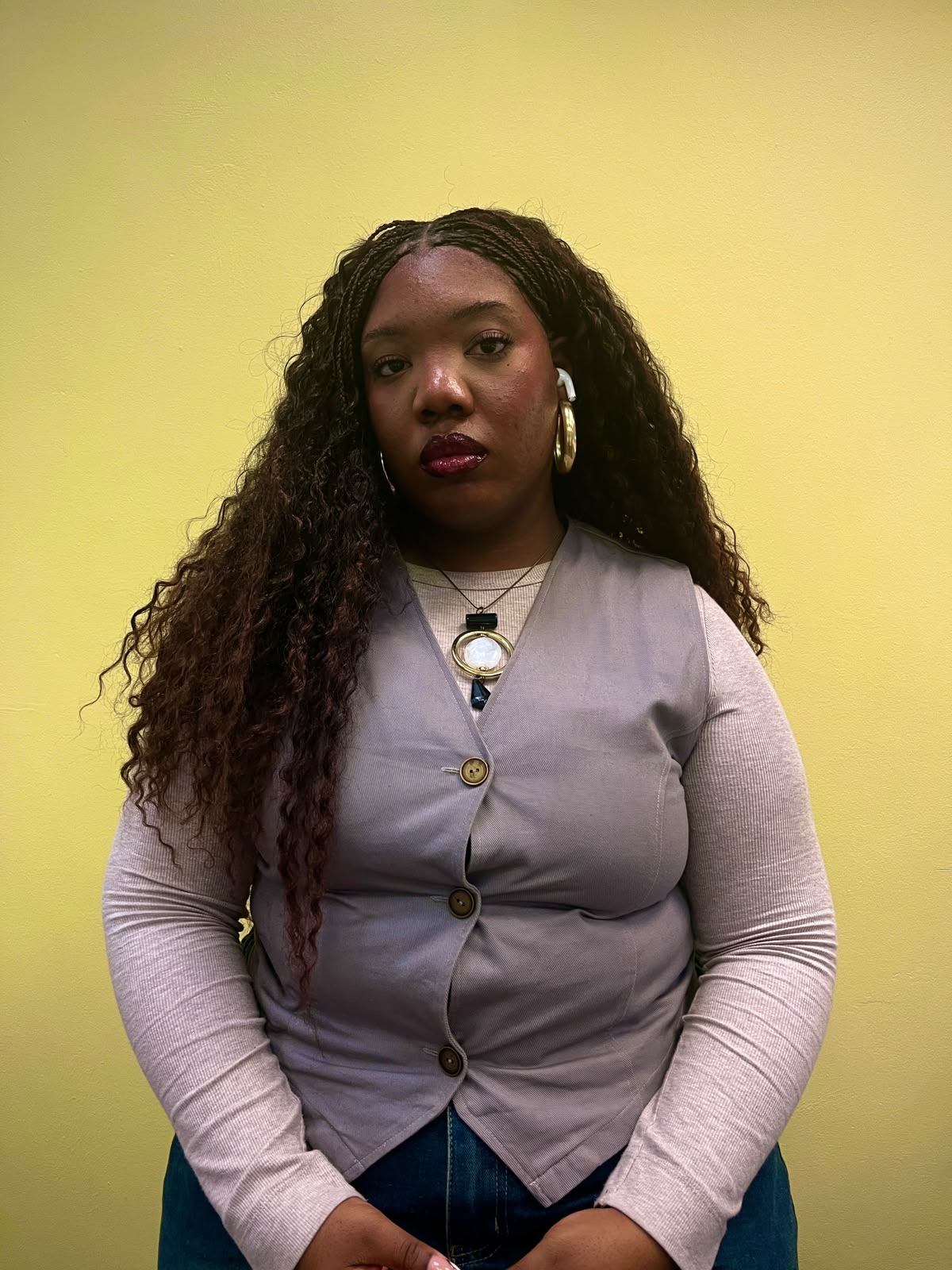
Jennifer Grace Morris
Jennifer Grace Morris a mixture of alles en more. She is known to dive between poetry and various literature devices that reflect the dialogue of life. Studying at UCT with English Literature and Sociology as majors, she learned to dig beneath the surface of society. Her love of literature is also extended to theatre, proclaiming her self as, "Die Drama queen", where she uses dramatic arts as a medium to express all that words can’t say. And if you don’t hear her speak, her eyes will say a thousand words. If it’s not through writing or performing, she uses unique sneakers, preferably Nike, and maximalist streetwear to explore her mixed plus-size identity.
View all work by Jennifer Grace Morris