A Mother’s War Inherited. A Daughter’s Healing Thwarted.
Fazila Cariem reviews 'We Inherit the Fire' by Kagiso Lesego Molope
Share this piece
Pass the story on to your people.
Publisher: Penguin Random House South Africa
Type: Novel
Date Released: April 2026
Retail Price: +/- R360.00
Format: Paperback (276 pages)
I wanted to read this book simply because I was drawn to the title.
I was intrigued by the topics of generational cycles and emotions we fuel simply because they form the baseline of our history. And I was curious to find out whether the author would demonstrate how to extract the good from the bad and find a place of peace beyond the turmoil: the good being - yes, the reality of the nightmare that was the past is undeniable, but here are a few healing processes. A functional way through storytelling of how redemption of a person and people can be achieved.
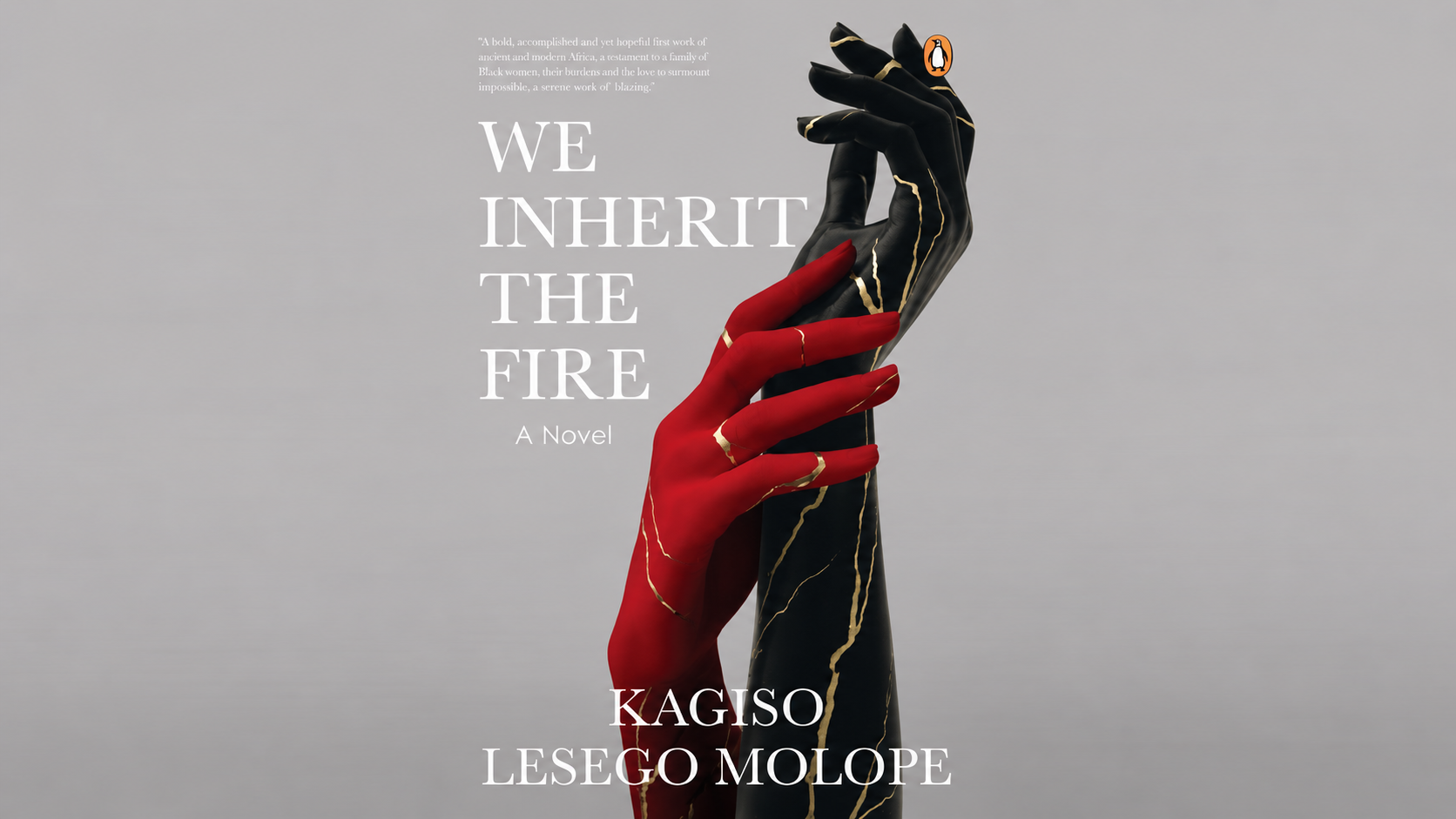
Then, there was the cover – two hands intertwined with different colour markings symbolized the deep cultural roots, and as I started reading, the story did not disappoint.
The plot itself is deceptively simple.
Molope presents the relationship between a celebrated anti-apartheid freedom fighter and her daughter, exposing the fractures beneath the public mythology.
The story is about Kewame, who had been imprisoned for four years during Apartheid, at the age of nine or ten. After leaving prison, Kewame grows up and marries a man named Kgosi ‘King’ Melodi, who treats marrying her as a testament to his own virtue, and views her as a trophy – proof of his willingness to embrace a woman with a troubled past – rather than as an equal partner deserving of love. He never truly offers the healing, companionship, or emotional refuge that a marriage at that stage of her life should have provided. Instead, he remains closed off, and at times his resentment surfaces, as though her survival and sacrifice cast an uncomfortable light on the comforts he never had to earn.
Despite this, they end up having four daughters.
One of the daughters, Kelelo, is quiet but extremely observant.
She desperately seeks the softness and nurture of her mother, only to be met with one who is disconnected from reality.
What interested me most was the tension between the Kewame’s public identity and her private reality. She occupies an almost sacred space as a "Mother of the Nation" figure – someone who is admired, respected, even mythologised by those around her; however, she is emotionally unavailable, disconnected, and deeply unhealed within her own home and family, which deeply affects Kelelo – the eldest daughter.
A defining turning point in Kelelo's life comes when she is forced to leave her township school and join her sisters at a school in the suburbs. There, she experiences racial microaggressions from members of the school community, who make assumptions based on her race and township background. These subtle acts of prejudice become woven into the fabric of her daily existence, often slight enough to be dismissed individually, yet constant enough to leave lasting scars.
Determined not to be seen as difficult or angry, and haunted by the fear of becoming like her mother, Kelelo learns to swallow her questions, silence her objections, and endure what she knows is wrong. In the process, she suppresses not only her voice, but a vital part of herself.
The narration of this novel is done in a dual point of view, that of Kewame and then Kelelo.
This gives the reader not only insight but empathy for both. I struggled trying to determine who was right vs wrong and eventually decided that this story was not about right vs wrong – it was more about who was open to acknowledging their issues and moving forward.
One of Molope's most striking stylistic choices is the use of dialogue without quotation marks.
But as I read on, I realised that the novel uses a dual first-person narrative, with Kewame and Kelelo each recounting their own experiences directly to the reader. This creates an intimate effect, almost as though I had been entrusted with the family’s secrets from two different perspectives. The effect fascinated me because it constantly reminded me that I was receiving the story through a particular lens. Rather than disappearing into the narrative by accepting what was being presented, I was encouraged to question the narrator’s perspective and reliability.
I found this technique particularly effective, given the novel’s preoccupation with memory and inherited narratives. Without quotation marks, the story became less concerned with objective truth than with how people remember, interpret, and pass down their experiences. Instead, the novel invites readers to think, question plausibility, and consider their own narratives as they chase a particular direction. Are we lying to ourselves and trying to convince others?
On a political level, with reference to Kewame’s identity as an anti-apartheid freedom fighter, I interpreted the lack of quotation marks as a further “eff-you” to colonialism -- a way of showing that she, and by extension Molope as the writer, would not conform to its rules or conventions.
The strongest aspect of the novel is undoubtedly its characterisation.
Kewame is a deeply compelling figure because she resists easy judgement.
She is both victim and perpetrator, hero and damaged parent.
Her experiences under apartheid have shaped her understanding of danger, survival, and motherhood. Yet those same experiences make her incapable of providing the emotional connection her children need.
What stood out to me was her obsession with protecting her children from physical harm while remaining blind to the psychological harm her absence creates. Having survived incarceration and state violence, she understands visible threats. What she struggles to recognise are the quieter wounds created by neglect, depression, and emotional distance.
Kelelo, meanwhile, becomes an exploration of what it means to enter womanhood without the guidance of a fully present mother. Her longing for connection drives much of the emotional weight of the story.
Rather than portraying either woman as wholly right or wrong, Molope presents both Kewame and Kelelo as products of South Africa’s unjust history, struggling under burdens that neither fully understands. As I have mentioned before, the story is not concerned with assigning blame or determining whether Kewame or Kelelo is right or wrong. Instead, it focuses on who is willing to acknowledge their issues and move forward, whilst also exploring the hostility that can exist between women. Molope resists the assumption that women will automatically understand or support one another simply because they share the same gender. Kewame and Kelelo do not always see eye to eye, and their unresolved pain prevents them from looking beyond their conflict and recognising the burdens they both carry. This is an honest portrayal of the mother daughter relationship dynamic, further complicated by generational trauma. As mothers what do we keep that burns through us, how do we heal it and how do we manage what we pass down to our offspring? And the lesson is to be self aware and conscious of that constantly. The novel demonstrates that generational trauma is rarely passed down through deliberate actions. Rather, it reveals itself in silences, emotional withdrawal, fears left unspoken, and patterns repeated without examination. What makes Molope's portrayal particularly powerful is her refusal to simplify either woman into victim or villain. Instead, she presents a relationship shaped by history, circumstance, and survival, asking difficult questions about what children inherit from their parents beyond genetics and culture. Ultimately, the novel suggests that understanding and self-awareness may be the first steps toward breaking cycles that have persisted for generations.
In society today, women still compete and instead of banding together like a community we look for reasons to assert superiority and ‘cancel’ others when actually our true strength lies in unity. As a woman in a post-apartheid and democratised South Africa, I learned that the biases remain, the need to prove yourself as a POC is that much harder because the conversation is not being given the outward platform it deserves, which means we need to keep pushing the discomfort of confronting it. I believe other women, and men, can support this call to action by once again - considering their own biases and fighting against their default patterns.
The emotional realities depicted in the novel felt painfully authentic.
One of the novel’s greatest achievements is its exploration of how apartheid continues to shape generations born after the political transition. The legacy appears less through overt political discussion and more through family dynamics, emotional patterns, and inherited feelings of inadequacy or displacement.
Kewame, as the mother, cannot fully engage with her present with her family because she remains psychologically trapped in the past. Her children, in turn, inherit the consequences of that entrapment.
The novel captures something rarely discussed: that trauma is often transferred not through stories told, but through love withheld, emotions unmanaged, and fears left unresolved.
The power of this exploration lies not only in what Molope reveals about inherited trauma, but also in the restraint and precision of her prose, which demonstrates many of the qualities I associate with literary fiction.
Rather than constructing an exhaustive world, Molope gives the reader carefully chosen details and trusts them to complete the picture. She colours within the lines instead of painting the entire landscape. The settings are built through atmosphere rather than inventory. You feel a place before you can necessarily describe it.
I was particularly struck by the contrasts between township and town life. Differences emerge through language, clothing, names, social expectations, and modes of self-presentation. Molope doesn't overexplain these distinctions; she allows them to emerge organically through observation.
As a writer myself, the novel made me think about the demands literary fiction places on readers.
Is this approach easier than traditional plot-heavy storytelling or secondary-world worldbuilding?
I'm not convinced it is.
Literary fiction often asks readers to do more interpretive work. The connections aren't always explicit, and meaning exists in the spaces between scenes, dialogue, and memory. Readers must remain attentive, actively constructing the larger picture from fragments. In South Africa’s ever-growing literary scene, stories like We Inherit the Fire are important because we do not often see the pain from a POC perspective carried through a time like Apartheid and what it truly means for the women who carry it.
We Inherit the Fire is less concerned with what happened during apartheid than with what happens afterwards.
What does freedom look like when the people who fought for it are still imprisoned by their memories?
And what happens to children raised by parents who survived enormous suffering but never had the opportunity – or perhaps the ability – to heal?
The novel suggests that apartheid did not simply end when its legislation was abolished. Its psychological consequences continue across generations, shaping identity, family relationships, and self-worth. One of the novel’s most powerful observations is that public greatness does not necessarily translate into private emotional competence: a person can be regarded as a national hero and still fail those closest to them. In this way, the story examines how unresolved trauma ripples through families, leaving children to inherit wounds they did not experience directly but must nevertheless spend their lives navigating.
We Inherit the Fire is a quiet, intelligent novel that trusts its readers to connect the dots. In doing so, it leaves behind a lingering question: if trauma can be inherited, can healing be inherited too?

About the author
Fazila Cariem
Fazila Cariem describes herself as a corporate email survivor. And her survival coping mechanism: artful expression whichever form it takes, whether it be writing, what passes for dancing on geriatric hips or gat maakens. She finds that to not just be the true elixir of life but the very thing that sustains her through all of her day to day forty plus working mom/ wife/ sister/ brudda/ muthafucka roles that she needs to play. And she encourages others, especially people of a similar POC background, to not neglect this part, this valid and vital creative part of themselves. Because without using our voices, how will anyone hear us.
View all work by Fazila Cariem