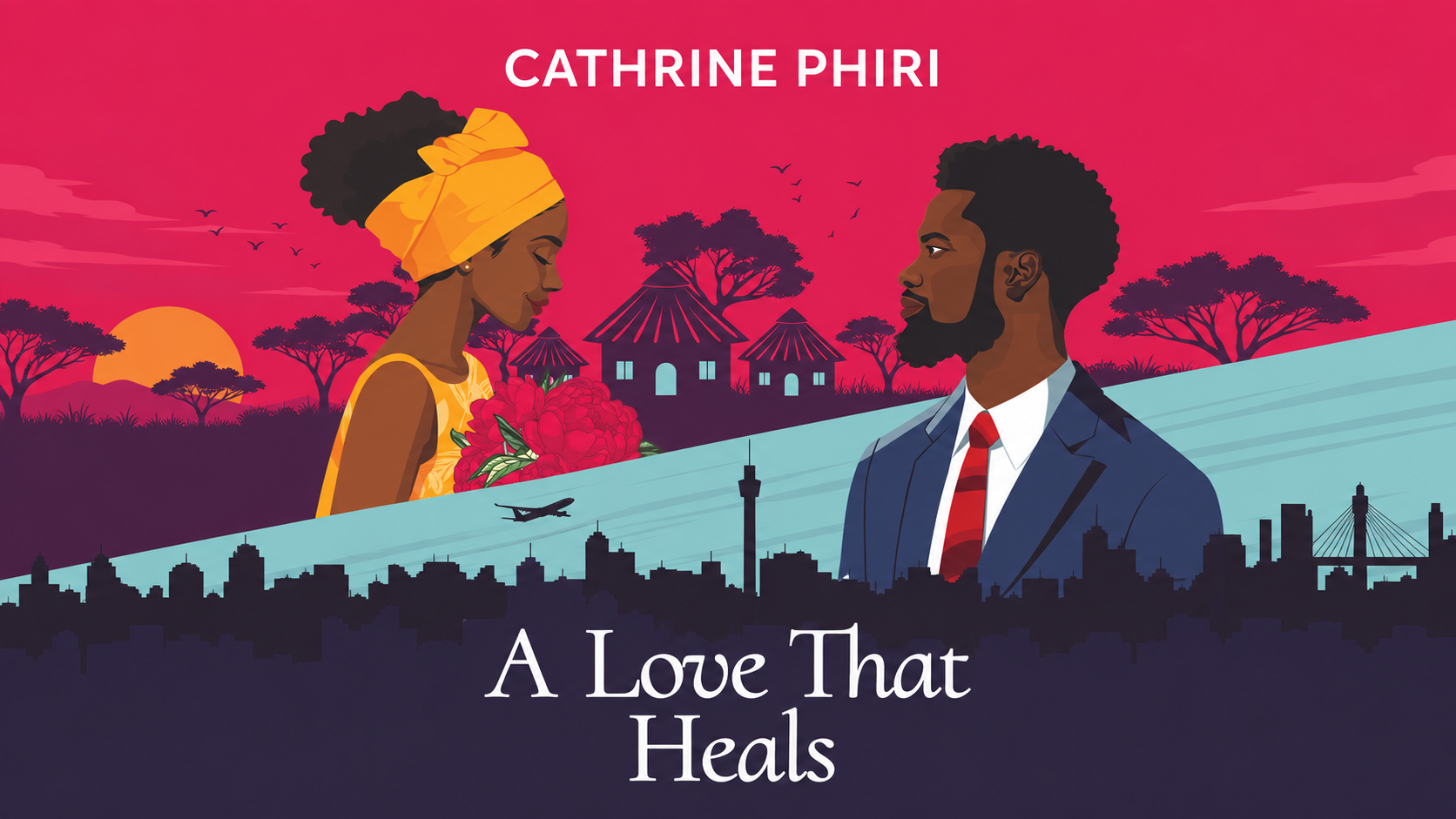
A Love That Sadly Needed More Healing
Taybah Taliep-Braaf reviews 'A Love That Heals' by Cathrine Phiri
Share this piece
Pass the story on to your people.
Publisher: Kwela
Type: Novel
Date Released: May 2026
Price: +/- R 260
Format: Paperback (256 pages)
A Love That Heals is described as a heartfelt story of hope, perseverance, and two lives brought together by fate.
The novel follows Thandaza, an unemployed LLB graduate who moves from rural Polokwane to Johannesburg, trying to find opportunities for employment to help support her grandmother. Her life changes when she meets Steven, a successful restaurateur, who falls in a "love at first sight" way. What follows is a clean, faith-centred romance that explores healing from past hurts, learning to trust, and finding love that is patient, kind, and intentional.
I really wanted to love this novel.
The premise had so much potential, and I genuinely appreciated what the author was trying to do. We don't often get soft, wholesome romance stories set in South Africa, and I loved that this was written as a romance where faith and personal values played such an important role.
Unfortunately, the execution didn't quite work for me.
My biggest concern was the writing style. At times, the prose felt overly polished or formulaic, which made certain passages feel less natural than they might otherwise have. The frequent use of em dashes also became distracting, particularly because they appeared so often. More importantly, some of the prose and dialogue felt mechanical, which made it difficult for me to connect fully with the characters and their emotions.
Moreover, instead of showing us what the characters were experiencing, the novel mostly told us. We were given lists of emotions and observations rather than being allowed to experience them ourselves. There was very little description, whether sensory or emotional, so I never felt immersed in the story. Even during scenes that dealt with heavier topics, everything felt glossed over. The narrator would simply tell us what happened or how someone felt, and then we'd move on. There wasn't enough space to sit with those emotions.
That also affected the characters.
Thandaza Nyathi was abandoned as a baby in Mamolo, south of Polokwane, and raised by a woman she calls her grandmother. Life has never been easy for them and Thandaza’s dream is to build a better life and take care of her gogo. She decides, with the encouragement on her grandmother, to move to Johannesburg in search of new and plentiful (surely) opportunities await.
When Thandaza arrives in the restless City of Gold, she is confronted by rejection and empty promises. She starts to feel despondent and like all hope is lost, when fate intervenes. One morning in Yeoville she meets Steven, a successful restaurateur and businessman, who seems to epitomise everything she’s ever prayed for.
We were constantly told that Thandaza was kind, beautiful, insecure, or healing, but I never really felt like I knew her. Beyond being an unemployed LLB graduate who somehow doesn't realise she's incredibly attractive, she fell flat and just felt very bland for a main character.
In contrast, Steven got much less page time from his own perspective, but he was the more interesting character to read. I found myself wanting to know more about him because the glimpses we did get hinted at someone with greater depth.
The dialogue didn't help either.
Both the conversations and the characters' inner thoughts felt very formal and unnatural. At times it almost sounded like people giving speeches rather than having conversations.
Since the story is set in Johannesburg, I also expected a little more local flavour. Besides the occasional "yo bro" between the guys, there wasn’t much South African vernacular or rhythm in the dialogue. I kept thinking, "No one actually speaks like this, surely?
The romance itself is sweet, although it develops rather quickly. Steven and Thandaza seem almost perfectly suited to one another from the outset, leaving little room for genuine tension or uncertainty. I enjoy a gentle love story, but I still want to feel that the relationship deepens naturally over time.
That said, I especially appreciated Thandaza’s decision to remain a virgin until marriage and Steven’s respect for that choice. The novel never treats her decision as strange or as something that needs to be “fixed”. Instead, Steven is patient and understanding, and he never pressures her, which feels unusually refreshing in contemporary romance.
However, not every romantic gesture landed in quite the same way for me. There were also a few moments that were clearly intended to be romantic but came across very differently to me – RED FLAG ALERTS! I mean? GETTING INTO A STRANGER'S CAR? In South Africa? Be FOR REAL. That immediately had alarm bells ringing in my head, but apparently these occurrences are meant to be sweet and show Thandaza’s naive and innocent nature.
Similarly, Steven paying her rent, buying her numerous gifts, and being very persistent about spending time together at the very beginning of their relationship are presented as sweet, caring gestures. It is written unironically, which took some getting used to for me, personally. I understood Phiri's intention, but in reality, I would view some of these behaviours as potential red flags or even examples of love bombing. Context matters, and it's important to acknowledge that actions which look romantic in fiction could easily be controlling in real life. But we're talking about a fictional world here, so please ignore my (probably) unnecessary ranting about red flags.
The pacing was also weird.
Most of the novel moves along gently, and fast for the most part, but the big, main conflict only really appears right near the end. It then gets resolved so quickly that it doesn't have much emotional impact -- and there was A LOT of potential there. After spending so much time building up the relationship, I expected a stronger payoff.
I don't usually read books looking for things to criticise. In fact, I generally prefer to focus on what a story made me feel rather than picking apart its technical aspects. But with this one, the issues were difficult to ignore because they kept pulling me out of the reading experience.
The novel had a great deal of potential and could have been remarkable, but the romance lacks the chemistry and emotional intensity needed to make it fully convincing. There are too few sensory details, descriptions, or intimate moments to immerse the reader in the characters’ world. I wanted to experience the emotions, atmosphere, and physical textures of their relationship, rather than simply being told that a connection existed.
Overall, A Love That Heals has a genuinely lovely concept. I appreciated its focus on respectful love, healing, faith, and waiting until marriage. Those are themes I'd love to see explored more often, especially in South African fiction.
I just wish the story had trusted the reader a little more.
Show me the emotions instead of telling me about them.
Let the characters breathe.
Give them room to feel like real people.
With richer character development, more immersive writing, and stronger emotional depth, I honestly think this couldhave been an incredible book.