
The Man Behind the History: The Life of Albie Sachs.
Sumaya Adams reviews ‘Albie Sachs: Father, Son and Soft Vengeance’ at Baxter Theatre
Share this piece
Pass the story on to your people.
Script: Gail Louw
Direction: Fiona Ramsay
Starring: Graham Hopkins
Venue: Baxter Studio, Baxter Theatre
Genre: One-man show / Biographical Drama
Performance Dates: 13 October – 31 October 2026
Albie Sachs is a name associated with South Africa's struggle for freedom, the fight for justice, and the birth of our democracy.
I had the pleasure of experiencing Albie Sachs: Fathers, Sons and Soft Vengeance at the Baxter Theatre, which brings Sachs’ life story to the stage through the writing of Gail Louw. The biographical drama was a deeply emotional experience that left me with a deeper appreciation for the man behind the name.
Throughout South African history, certain names become so familiar that we recognise them without necessarily knowing the story behind them. We learn about Apartheid, the resistance against it, and the people who fought for a democratic South Africa. Albie Sachs was one such name for me. I knew who he was and understood his role in shaping our Constitution, but beyond that, my knowledge was rather limited.
A quick internet search would reveal that Albie Sachs was a South African lawyer and anti-apartheid activist who fought against racial segregation and injustice. He defended people persecuted under apartheid laws and continued his activism whilst living in exile. In 1988, apartheid security agents targeted him in a car-bomb attack in Mozambique, causing him to lose his right arm and sight in one eye. Despite this, he remained committed to justice and reconciliation, later helping to draft South Africa’s democratic Constitution.
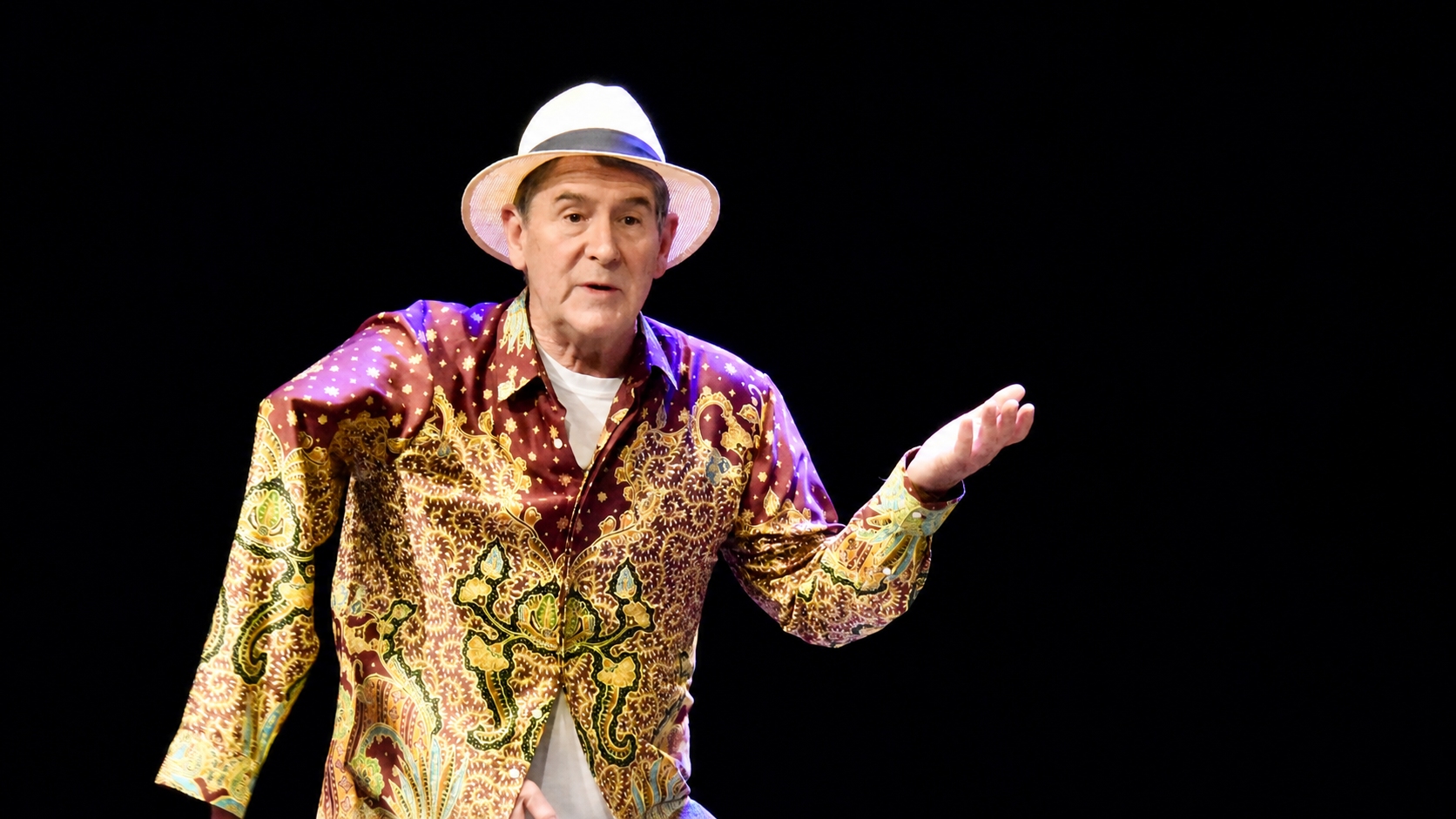
There is a different kind of connection that happens when a story moves beyond the page and comes to life before you. Gail Louw’s writing invites us to meet that person, with all his complexities, contradictions, humour and vulnerabilities. Through Graham Hopkins's remarkable performance, Albie becomes more than a historical figure. He becomes a man we are invited to understand on a more personal level.
Hopkins delivers the story with such conviction that, had I not known who Albie Sachs was, I could have easily believed that the man on stage was recounting his own life. His portrayal felt real, and the emotions didn’t feel manufactured for the audience's benefit. When he cries, there are real tears.
When grief takes hold, we see it in his face and body. Even the simple act of wiping his nose with a handkerchief adds to the authenticity of the moment. These are small details, but they matter. And they draw us closer to a man whose life is unfolding before our eyes, making it difficult to remain a detached observer.
What makes Hopkins's performance particularly compelling is the physicality with which he inhabits Sachs’ experiences. Following the car bomb attack that cost Sachs part of his right arm, a black glove conceals the affected arm. As the story progresses, a carefully designed prop, credited to James Dee under the programme's designation of “Short Arm”, mimics the movement of the remaining portion of the limb, moving in remarkably convincing synchrony with Hopkins's left arm.
The effect is striking.
Rather than relying on dialogue alone to tell us what has happened, the production allows the actor's body to become part of the storytelling. We're made aware of the physical reality of Sachs’ injury, but we're also witnessing the emotional journey that follows the injury.
And that journey is far from just a simple story of resilience.
Initially, the character experiences a sense of euphoria in having survived the attack, followed by the anger and grief that accompany the realisation of what has been lost. There are moments of celebration as Albie relearns how to do things with one hand, even showing the audience how to tie his shoe with one hand. Each small achievement represents a victory of its own.
However, adjusting to life after the attack brings its own challenges as Sachs has to navigate the physical realities of living with one arm. His encounter with a prosthetics doctor brings about a confronting question. Sachs is told that the remaining part of his arm is too long to accommodate an elbow joint and that it could be surgically shortened to make a prosthesis possible. Imagine being asked to surrender even more of your body to accommodate a device intended to replace what you have already lost. The suggestion makes his eventual decision not to use a prosthesis all the more significant.
Why should he have to alter his body further to satisfy an expectation of what a complete or normal body ought to look like?
The discomfort of those who encounter him without a prosthetic arm reveals something troubling about the way society views disability. There is an expectation that he should restore the appearance of wholeness, as though looking more familiar to others is somehow more important than accepting himself and the events that have shaped his life.
I really appreciated the way the production explores Albie's decision to embrace his half arm.
There is something very powerful about a man refusing to let other people's expectations determine how he should live in his own body. As an audience member, I appreciated the decision to place Sachs, a man whose body had been permanently changed by the attack, at the centre of the story without allowing that physical difference to define his entire identity. The loss of his arm is an undeniable part of his story, but it does not determine who he is or what he is capable of. His decision not to use a prosthesis also invites us to consider society's expectations around physical appearance and the pressure to conceal or compensate for differences that fall outside what is considered typical. Rather than presenting his body as something incomplete, the production challenges us to question why physical difference is so often associated with limitation. It also raises questions about whose bodies we are accustomed to seeing represented on stage, and whose stories deserve to occupy that space.
Albie’s story becomes about more than surviving an act of political violence; it is a reflection on identity, dignity, and the freedom to exist without having to make oneself more palatable to the world. In a production concerned with justice and human rights, this personal decision feels entirely at home.
This attention to the physical realities of Sachs’ lived experience is further reflected in the production's thoughtful staging.
The set design by Fiona Ramsay and Graham Hopkins does not depend on elaborate scenery to communicate the weight of his experiences. A ladder covered in white becomes a hospital bed, while small ottomans wrapped in white fabric suggest clinic beds. Sheer, gauzy draping softens the space, and six sepia-toned photographic prints by ELSIGNS add another visual layer to the stage. These elements are simple, yet their effectiveness lies in how they allow the audience's imagination to complete the picture.
The ladder functioning as a hospital bed is especially effective. Its upright structure allows Hopkins to remain visible to the audience while representing Sachs lying in a hospital bed. It is a practical staging choice, but one that also keeps the focus firmly on the performer. We are left with the actor, the words and the emotional weight of what he is conveying, rather than elaborate scenery competing for our attention.
This restraint is complemented by Oliver Hauser's lighting design, which changes according to the scene. The bright clinical lighting of the hospital scenes immediately establishes a different atmosphere, while other shifts in lighting help move us through the changing circumstances of Sachs’ life. The lighting supports the performance and guides our attention while also reinforcing the mood, without distracting from the story. The stage remains relatively uncluttered, yet the combination of light, fabric, portraits, and carefully chosen props gives the production a distinct visual identity.
Sound plays an equally important role in creating a world around a performer who is alone on stage. Dean Pitman's sound design brings the hospital environment to life through the beeping of medical machinery, while the sounds of cameras capture the intrusion of journalists into Sachs’ hospital experience. The freedom songs evoke the broader struggle beyond the walls of the hospital, connecting his individual story to the collective fight for freedom for all. Together, these sounds create a world around Hopkins without requiring a large cast or elaborate scene changes.
Perhaps the most striking element of this production is the way the voices of Sachs' father and his son, Oliver, enter the performance. Although Hopkins is the only performer physically present on stage, the exchanges with these omnipresent voices create the impression of conversations taking place around him. The voices allow the relationships space to exist, while also giving us access to parts of Sachs’ life that cannot be understood through his political history alone. The man we meet is not simply a lawyer, activist or survivor. He is also a son shaped by his father and a father whose own convictions sometimes complicated his relationship with his child.
It is through these personal exchanges that the production's humour becomes particularly important. There are moments of genuine laughter, and the comedy doesn't feel separate from the more serious themes. When Sachs discovers that Oliver has been taking shrooms, his response, “Revolution was my shrooms,” is wonderfully unexpected. The line captures the generational divide between a father whose defining experiences were rooted in political struggle and a son whose experiences belong to a different world. The story of Oliver's mother adds another unexpected comic moment when she decides to try shrooms herself and locks herself away in her room for six hours.
Another memorable moment comes with the phrase “Spectacles, Testicles, Wallet and Watch”, a little bodily self-check Sachs performs while in his hospital bed. It is the sort of humour that might seem incongruous in a story marked by such profound loss, yet it feels entirely human. People do not stop being funny simply because life has become difficult, and laughter can coexist with pain in ways that are both surprising and necessary
The repeated variations of “I am here, therefore I am”, “I joke, therefore I am” and “I walk, therefore I am” also linger in the mind. Each variation becomes an assertion of existence, a reminder that Sachs is still here despite what has happened to him. The line about joking is especially fitting in a production that understands the importance of humour without using it to diminish suffering. His ability to laugh, to keep moving and to remain present becomes part of the way he defines himself.
Beneath the humour, however, lies a life guided by an unwavering commitment to justice. Sachs’ father encourages him to become involved in the struggle and to do something with his life that will improve the lives of others. This expectation becomes part of the inheritance passed from father to son. Sachs grows into a man whose sense of justice becomes a kind of currency, something by which he measures his choices and his responsibilities to others. Yet that commitment, however admirable, also comes at a personal cost.
His relationship with Oliver offers us an honest reflection on what it means to be the child of someone whose life is devoted to a cause larger than himself. As a boy Oliver, resents not having the kind of father other children around him had. There is something understandable about that childlike resentment. A child does not necessarily see the historical significance of a parent's work; he experiences the absences, the differences and the ways in which his family does not resemble those around him.
The production does not ask us to dismiss Oliver's childhood feelings simply because his father was fighting for justice. Instead, it allows us to recognise that both experiences can be true. Sachs can be a man whose contribution to society is extraordinary and a father whose choices leave his son with complicated feelings. This honesty makes their relationship all the more affecting, particularly as we witness Oliver's own struggles unfold.
Initially, Oliver does well at school. But as he grows older, his relationship with education begins to deteriorate. He comes to hate school and eventually stops attending. His world grows smaller as he becomes increasingly antisocial, struggles with depression, and gains thirty kilograms. The child who once resented having a father who was different from everyone else's becomes a young man navigating difficulties of his own.
There is a very telling observation about the COVID-19 pandemic being the best time for someone like Oliver. For someone who struggles socially, a period in which isolation becomes the norm can offer a strange kind of relief. The circumstances that left many people feeling disconnected from the world may have felt more comfortable to someone who already found social interaction difficult. It is a poignant detail because it invites us to consider Oliver's experience on his own terms, rather than seeing him only through his relationship with his father.
And yet, Oliver's story doesn't end in withdrawal and despair. He eventually finds his way back, returns to school, and graduates. His journey towards that moment makes the ending all the more moving because we have witnessed the difficulties that preceded it” to maintain the present relevance of the experience. When Albie takes his son's hand in his and raises it before the audience, the gesture carries a significance that extends beyond a father's pride in his son's achievement. It recalls the raised hands of freedom fighters, a gesture associated with solidarity, resistance, and victory.
Here, however, the struggle is deeply personal. Oliver has overcome battles of his own, and his father is there to acknowledge that achievement.
I found this moment profoundly moving. Throughout the production, we witness Albie's commitment to fighting for the freedom and dignity of others, but here we see him honouring a different kind of struggle: his son's. The man who devoted so much of his life to improving the lives of others is also a father witnessing his child find his own way forward. It is a beautiful convergence of the public and the private. The political and the personal. Oliver's achievement doesn't erase the difficulties that came before it.
It just gives us another way to understand the perseverance required to overcome them.
The raised hand also brings the relationship between father and son into sharper focus. Oliver's eventual recognition of the man his father was, and his gratitude for having had him as a father, becomes a moment of profound emotional release. There is something deeply emotional about the moment when a child begins to understand the person his parent was beyond the role of mother or father.
Oliver's appreciation does not erase his childhood disappointment. Instead, it suggests that understanding can grow with time. He comes to see the bigger purpose that shaped his father's life and the values that remained with him throughout it.
That question of recognition extends beyond the family and into the country's history.
One of the most thought-provoking aspects of Sachs’ story is his awareness that even his experience of solitary confinement in prison came with a degree of privilege. He reflects on the fact that he was acknowledged and praised for sacrifices that many Black South Africans were also making, often under circumstances in which they endured even greater hardships. His questioning of why his own sacrifices received such recognition raises an uncomfortable but necessary question: whose suffering becomes visible, whose resistance is remembered, and whose contributions are celebrated?
It is difficult to ignore the possibility that Sachs’ whiteness, together with the visible and tangible nature of his injury, played a role in how his sacrifice was recognised. The loss of part of his arm was something the world could see. The suffering and sacrifices of countless Black activists were not always afforded the same public attention or historical acknowledgement. This is not to diminish what Sachs endured, nor to suggest that his contribution was undeserving of recognition. Rather, it highlights the unequal ways in which sacrifice can be recorded and remembered.
The fact that Sachs himself questions this disparity makes the reflection particularly significant.
His sense of justice, then, is not simply about opposing an unjust system. It also involves questioning the structures through which society distributes praise, recognition, and historical importance. That willingness to interrogate his own position adds another dimension to the man portrayed on stage. He is not presented as someone who has all the answers, but as someone willing to confront difficult questions, including those that challenge the way he himself is seen.
I was also struck by the audience in attendance. The audience appeared to be predominantly white and older, with approximately twenty people of colour in the theatre by my count. I found this surprising, and the observation stayed with me as I considered the themes of the production.
A single audience cannot tell us everything about who engages with South African history or theatre, and I would not presume to know why each person was there. Nevertheless, sitting in that space while watching a story about the struggle for freedom, sacrifice, and the unequal recognition of those sacrifices gave me pause. It made me think about who gets to encounter these stories, whose histories we choose to revisit, and how important it is that the stories shaping our collective memory continue to reach different generations and communities.
By the time the production reached its conclusion, all these threads (the injury, the humour, the struggle, the questions of privilege and the complicated love between a father and son) had come together in a way that was deeply personal.
In its final moments, the production returns to the deeply personal relationships that shape Sachs' life, reminding us that the legacy of a person is not measured solely through public honours or historical achievements, but also through the relationships we nurture and the ways in which we come to understand one another across generations. The audience responded with a standing ovation, and I understood why. Graham Hopkins carried us through an extraordinary range of emotions, portraying Albie Sachs with a conviction and vulnerability that made the experience feel intimate and personal. I left the Baxter Theatre feeling deeply emotional, with a renewed appreciation for a man whose story I thought I understood, and for the countless South Africans who sacrificed so much in the fight for our democratic country.
What will stay with me is the realisation that there are parts of a person's life that history books cannot fully teach us. They can give us the dates, the events, and the public record, but they cannot always convey the private grief, the unexpected laughter, the difficult conversations between a father and son, or the quiet decisions through which a person learns to live with what has been taken from him.
This production brought me closer to those parts of Albie Sachs’ life. It reminded me that behind every name we associate with history is a human being shaped by relationships, guided by convictions, and forced to make sense of a world that does not always offer us easy answers.
We inherit the democracy that so many fought for, but we must never become so accustomed to its existence that we forget what it cost. Leaving the theatre, I felt a deeper sense of gratitude for those who gave of themselves so that future generations could live with the freedoms they were denied. And I was reminded that honouring their sacrifices requires more than remembering their names. It requires us to keep asking difficult questions about justice, recognition, and the kind of country we choose to build in their memory.

About the author
Sumaya Adams
Sumaya Adams is a Cape Town-based book reviewer, literary contributor, and enthusiastic collector of fictional trauma. She spends an unreasonable amount of time reading – sometimes with six books on the go, at once, because apparently one story at a time is far too sensible. She can demolish eight episodes of her favourite series in one sitting and has a particular appreciation for blood, betrayal, monsters, morally questionable characters, and spectacularly bad decisions. When she's not reading or disappearing down one of her many hobby rabbit holes, she's probably got 90s R&B playing somewhere in the background and is emotionally attached to a book that is most certainly going to ruin her life. And somewhere in all of this chaos is, a novel that she's been writing for the past three years, is on its way, one day, but she will need to stop reading, long enough, to actually finish it. Probably.
View all work by Sumaya Adams