How Language Remembers
Rushdiyah Narker reviews ‘Kom Fietna Saam Mareldia’ at Baxter Theatre
Share this piece
Pass the story on to your people.
Script: Gaireyah Fredericks, in collaboration with Celeste Matthews Wannenburgh
Original Direction: Lee-Ann van Rooi
Starring: Gaireyah Fredericks and Celeste Matthews Wannenburgh
Venue: Masambe Theatre, Baxter Theatre
Genre: Dramedy
Performance Dates: 7 October 2026 –17 October 2026
Walking into the Masambe Theatre, I am met by the melody of the salwaat (prayers and blessing in form of recital) playing softly.
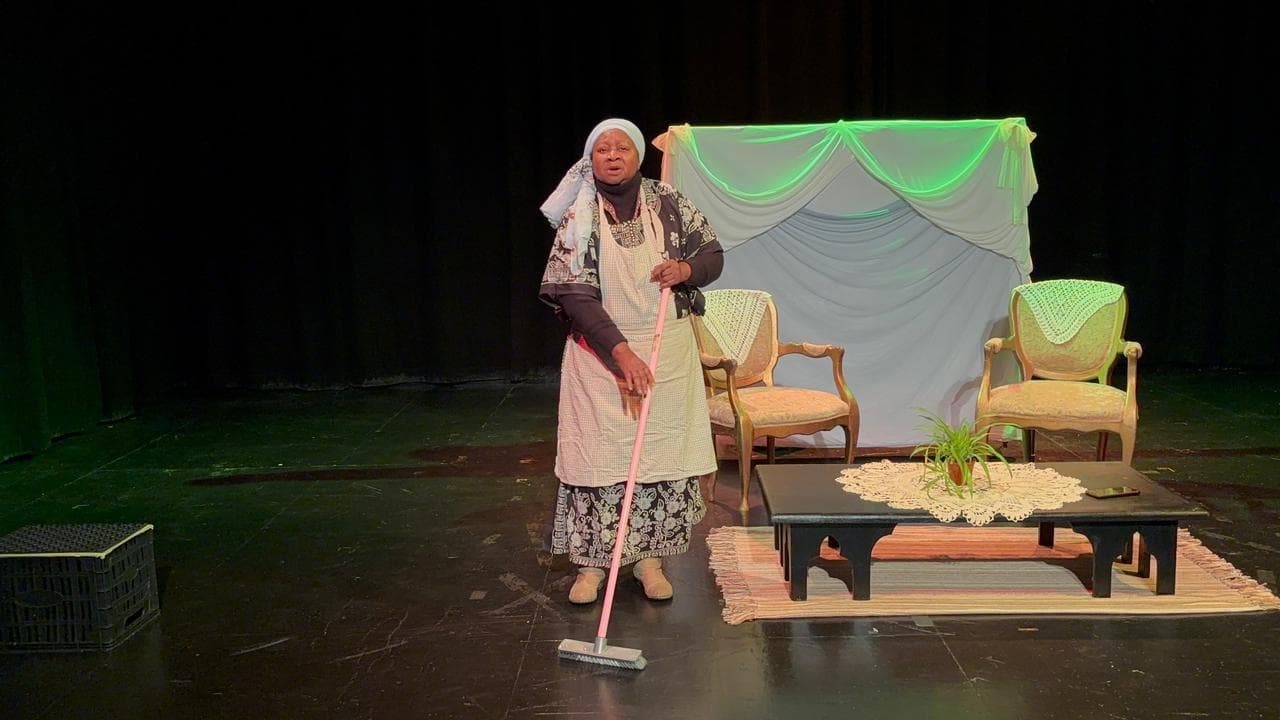
The stage is set like a lounge in a family home: a big, colourful armchair beside a wooden chair with a soft, colourful seat, both in front of a large window with curtains draped to either side.
A coffee table sits between the chairs with a lekker big doily spread across it, and photographs hang on the walls.
The stage is intimate and close to the audience, and I am ready to be this near to the actors while they perform.
We sit in the second-to-last row.
There are people in the rows in front of us, but none obstruct the stage. Chatter fills the room until the announcement that the show is about to begin. Everyone settles, and Mama walks onto the stage with a broom, sweeping. She speaks directly to us, saying she must finish her sweeping first. I did not expect to be included in the play. I thought I would be watching, not an active member of the story. But how can we be invited to Kom Fietna Saam Mareldia if we are not included?
Originally commissioned for and premiered at the 2026 Suidoosterfees as part of the NATi Theatre Festival, Kom Fietna Saam Mareldia is an intimate two-hander dramedy adapted from Gaireyah Fredericks’ award-winning short story collection, Een Voet Innie Kabr (2024, Kwela). Centred on Auntie Mareldia and her interactions with her granddaughter, Humayra, the production unfolds across three scenes performed by Gaireyah Fredericks and Celeste Matthews Wannenburgh.
As other characters emerge, their stories explore generational conflict, family secrets and the tension between honesty and silence.
Ultimately, the play celebrates the enduring bonds of family whilst honouring the voices of mothers, grandmothers and elders whose stories shape future generations.
The play is written in Kaaps and Cape Muslim Vernacular. It is important to establish the difference between Kaaps and Afrikaans, yet there is a misconception, too, about Kaaps and Cape Muslim Vernacular. Kaaps is a historically significant variety of Afrikaans, rather than an incorrect or informal imitation of Standard Afrikaans. Its vocabulary, pronunciation, and linguistic conventions reflect the complex histories of Cape communities.
Kaaps has long been portrayed as inferior. Many of us who grew up with parents who spoke Kaaps were encouraged by those very parents to learn English and avoid speaking like them. Their lived experiences had taught them that the way they spoke made them seem less than others; therefore, staging a play in Kaaps at the Baxter Theatre challenges the perception that Kaaps is merely an informal language. Alongside the release of the Kaaps Dictionary, Kom Fietna Saam Mareldia marks another important step towards recognising Kaaps as a language of historical and cultural significance.
Although Kaaps and Cape Muslim Vernacular share linguistic characteristics, they should not be treated as interchangeable. Cape Muslim Vernacular, a term used in linguistic scholarship, has distinctive vocabulary, pronunciations and historical associations with the Cape Muslim community.
This language sounds safe and familiar. The dialogue echoes conversations I have heard in my own community, whilst the characters remind me of people I have met and whose company I have enjoyed on many occasions. The scenes feel so close to home, particularly in the interactions between Mama and Humayra, that it is easy to forget I am watching a play.
The play is divided into three sections.
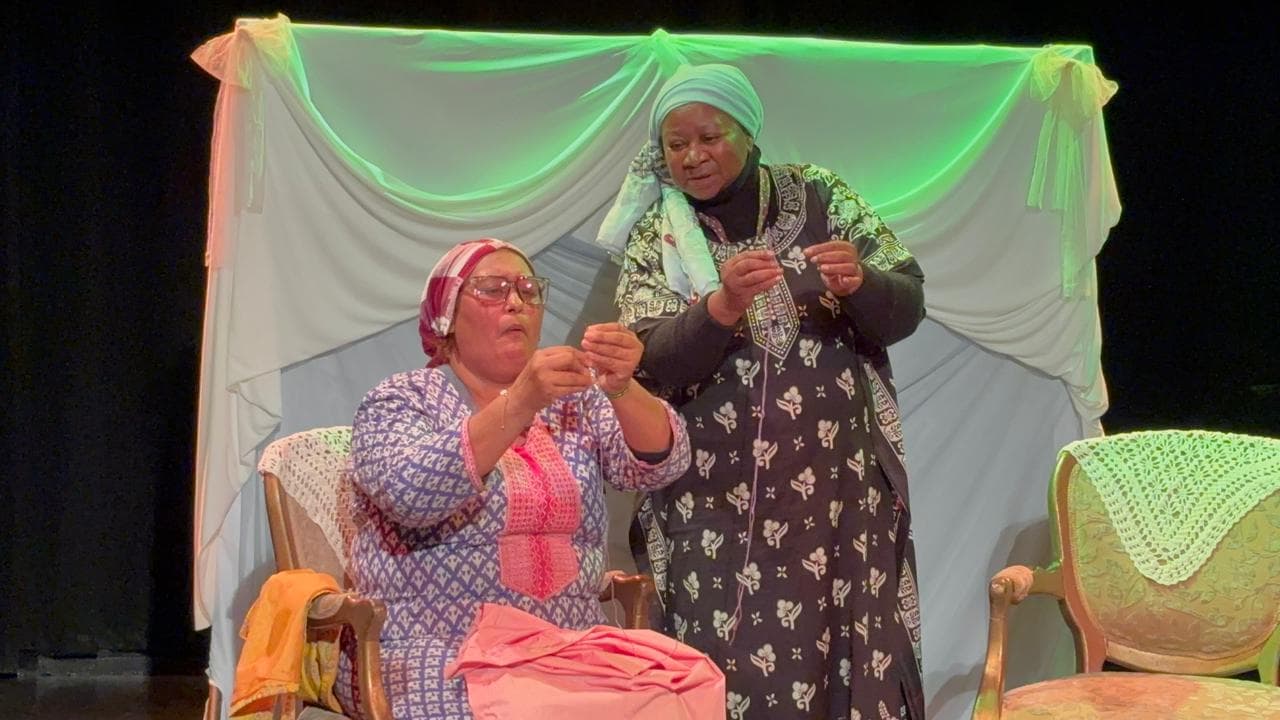
In the first part, Mama is teaching Humayra how to sew. Mama’s strong matriarchal personality shines through immediately in how she corrects her learner. We are introduced to the first encounter with apartheid as Humayra tells us about her grandfather. Wannenburgh paints a hilarious picture of an offstage character, and you have to experience it to understand why it is so funny. When she says, "Is ‘n waare storie," (it’s a true story) there is a double meaning in that claim, because I have been in conversations where a person was described in exactly the same way. The crowd was guffawing right along with me.
There is a way words are used in the Cape Muslim Vernacular that can be difficult to explain when it requires translation. To me that is an indication of how words preserve cultural memory. And the significance of this within a culture that relied on oral storytelling as an archive is not lost on me.
Cape Muslim characters have historically been vulnerable to stereotypical representations, particularly when their accents and expressions become sources of comedy.
Mama and Humayra are important on the Baxter stage because they show us emotional depth and agency.
They are not the butt of a stereotypical joke. The humour of the show comes from the cultural history the words hold. But the actors bring forth the history of how we have simultaneously LIVED while Apartheid happened to us. Why are Mama and Humayra important on Baxter’s stage? Are they there for emotional depth and agency, allowing their language to communicate vulnerability, wisdom and conflict rather than functioning solely as comic entertainment?
The second segment is more reflective, with the actors taking on the personas of two men.
The men appear to have known each other for a very long time and, now in their old age, they look back on how they have lived.
Do they have sins to repent for?
Do they wish they had done things differently?
Here, the audience is introduced to Faanie en Mailie. Faanie is the brother of Mareldia. A wash of blue light signals the transition from Mama Mareldia’s lounge to the next scene. Fredericks and Matthews Wannenburgh rotate the wall that forms part of Mareldia’s living room, change costumes and reposition the structure towards the front of the stage. The reversed wall transforms the domestic setting into what appears to be an outdoor space, perhaps a street corner, where the two performers, now portraying Faanie and Mailie, take their places on plastic crates.
The segment shows us that growing older means the body starts to have ailments that affect quality of life. But it also demonstrates the ability to look back on our lives and see the events from a different perspective. Perhaps less defensive. The characters discuss the past through new lenses that come with age and acceptance that we are only on earth once and it’s important to make it count.
I loved how these two men could sit and talk through their feelings. They discussed fears and the past and had some hard truths to face. They didn't cower or brush aside each other's feelings. Instead, the one was a support for the other. It makes me think about how, as I've gotten older, my friendship circles have become smaller; how the people close to me are people I trust to be honest, open and willing to discuss difficult topics without fear of being punished. This segment between these elderly men shows us how important friendships between people who know each other for many years can be. You don't have to explain things to them because they already know. There's a comfort in that shared knowledge.
It was a bit of a challenge to see the female actors as the male characters, because their appearance was clearly female, despite the outfit changes, but they portrayed the emotional vulnerability of the characters in the scene in a way that made the scene reflective for the audience. It was a switch from the previous humorous scene, but it was a step into a darker part of the lives we live, tackling things like colourism in families and corporal punishment.
Faanie recalls his interaction with a family member who he feels he could have treated better. Mailie reminds him that he reacted to being locked up in a room in the back because he was dark.
What runs through the entire production is the way apartheid affected our everyday lives: how racism, classism and colourism became a norm in our community, and how we often policed ourselves without the government having to do anything.
Faanie and Mailie bring up the pencil test as they discuss their childhoods.
If you do not know it, the pencil test was an infamous, unscientific method used by the apartheid government to determine a person's racial classification under the Population Registration Act of 1950. A pencil was pushed into a person's hair and they were asked to shake their head. If the pencil fell out, they had "passed" and were typically classified as White or Coloured; if it stayed, they "failed" and were classified as Black.
They describe how the pencil was put into someone's hair and if it fell out, they passed the test, but if the pencil stayed, the test failed. Within the play it is mentioned as a thing people did back then, and we still hear stories of the pencil test happening today, be it more informally.
In South Africa, colourism is a form of discrimination where people face unfair treatment, or gain privileges, based on the shade of their skin. Its roots lie in colonialism, when lighter-skinned enslaved people were often given indoor domestic work while darker-skinned people did hard manual labour in the fields, and in apartheid's strict racial categories, which decided a person's rights, jobs and where they could live. Today it survives in beauty standards that link lighter skin to beauty, wealth and intelligence, and in the dangerous skin-lightening creams many people use to meet those expectations. I remember darker members of my family being told not to play in the sun too long for fear of getting darker. A boy from the neighbourhood I grew up in was forbidden from marrying a girl because she was dark-skinned, and when he did it anyway, his family cut him off. Another way we police ourselves.
The third segment, the production shows us medical racism – a topic gaining traction worldwide that remains taboo in our communities.
In this segment, the audience became the members of society who shame women for their grief, which I felt was a staggering way to make the point. Under apartheid (1948–1994), medical schools and training programmes were strictly segregated, white patients were shielded from being examined by Black medical students, and Black practitioners faced systemic career constraints.
Hospitals, ambulances and emergency services operated under racial separation, leaving townships and rural areas severely under-resourced. In my own research into endometriosis, women’s stories highlight how that bias still shows up in patient disbelief, uneven pain management and lower life expectancy in marginalised communities. In the book The book Medical Apartheid by Harriet A. Washington we have learnt how Black bodies carry the history of racism: where we are thought to tolerate more pain, where medical textbooks are still based on white male bodies, and where medication trials are done on white male subjects. There is no space for Black women to exist with their pain within this history.
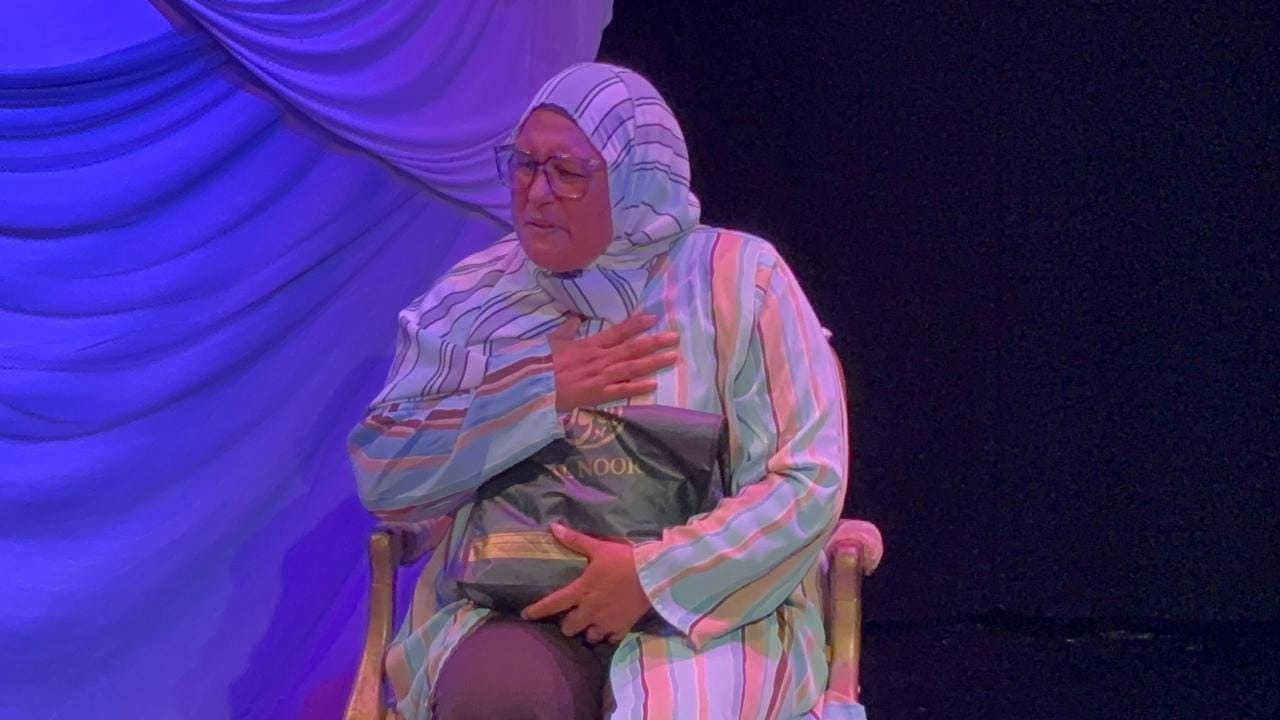
Humayra recounts her experience of labour in the hospital. She speaks of being left alone while in labour, how the medical staff dismissed her concerns and how they spoke about her babies as if they were numbers and not people.
The third segment is also when Humayra comes to visit Mama to pack away the doekmal rokkies (naming ceremony) of her twins.
This performance had me sobbing, and I was not the only one. Creative Director at Babas and Brasse, Zubayr Charles, also mentions that although he watches a lot of theatre, and seldom cries, this scene hit too close to home and left him sobbing. In the intimate space of the Masambe Theatre, the air was heavy with emotion.
Just as Een Voet Innie Kabr explores the notion that a mother has one foot in the grave whilst giving birth to new life, Kom Fietna Saam Mareldia similarly examines the delicate relationship between life and death. Beneath its humour, the production offers a poignant reflection on motherhood, intergenerational trauma and the enduring bonds between women. Grief emerges not merely as an individual experience, but as something carried across generations, shaping relationships, memories and the ways in which families navigate loss. The production reminds audiences of the cyclical nature of life, where birth and death, love and loss, and joy and sorrow remain inextricably intertwined.
This meditation on mortality resonates with the words of Allah in the Holy Quran, particularly Surah Ali 'Imran (3:185), "Every soul will taste death."
The same declaration appears in Surah Al-Anbiya (21:35) and Surah Al-Ankabut (29:57), reinforcing the inevitability of death within Islamic teachings. Yet, whilst death marks the end of an earthly existence, the production invites audiences to consider what remains after someone has passed: the memories they leave behind, the traditions they preserve and the stories that continue to live through future generations.
In this sense, Kom Fietna Saam Mareldia is as much a celebration of life as it is a contemplation of death.
As the production continues to develop, there is room for Fredericks and Wannenburgh to refine the storytelling, particularly in its pacing and the transitions between scenes. Having watched the production twice, I noticed a marked improvement in the second run.
During my first viewing, the opening felt unnecessarily drawn out, taking too long to establish the characters and draw the audience into their world. By this second run at Baxter Theatre, however, the opening felt tighter and more purposeful, allowing the characters to settle into the story much sooner.
Fredericks and Wannenburgh already had a strong rapport during their first run, but their chemistry felt more natural the second time around. The pauses between lines, which occasionally disrupted the rhythm of the dialogue during my first viewing, became more organic and purposeful.
These improvements demonstrate the production's potential, but greater attention to pacing and the rhythm of the dialogue would strengthen the emotional impact of the story.
I came into the theatre to the sound of the salwaat and left with a swollen face and a full heart, understanding why that sound weighs so heavily on the characters. The two actors tell these stories with such conviction that it feels as though they have lived through them themselves. There is an authenticity to the production that comes from their shared love of storytelling, particularly their commitment to sharing stories seldom told. The play reminded me how language remembers. The words carried a history I miss, and hearing them spoken aloud, in their own tongue, made that history feel present instead of distant. That is why it matters to have a production like this on a theatre stage.
A short story can hold many histories, but a stage allows an entire room to experience them together. Mama Mareldia invited us to sit with her, and I am grateful that I did.
About the author
Rushdiyah Narker
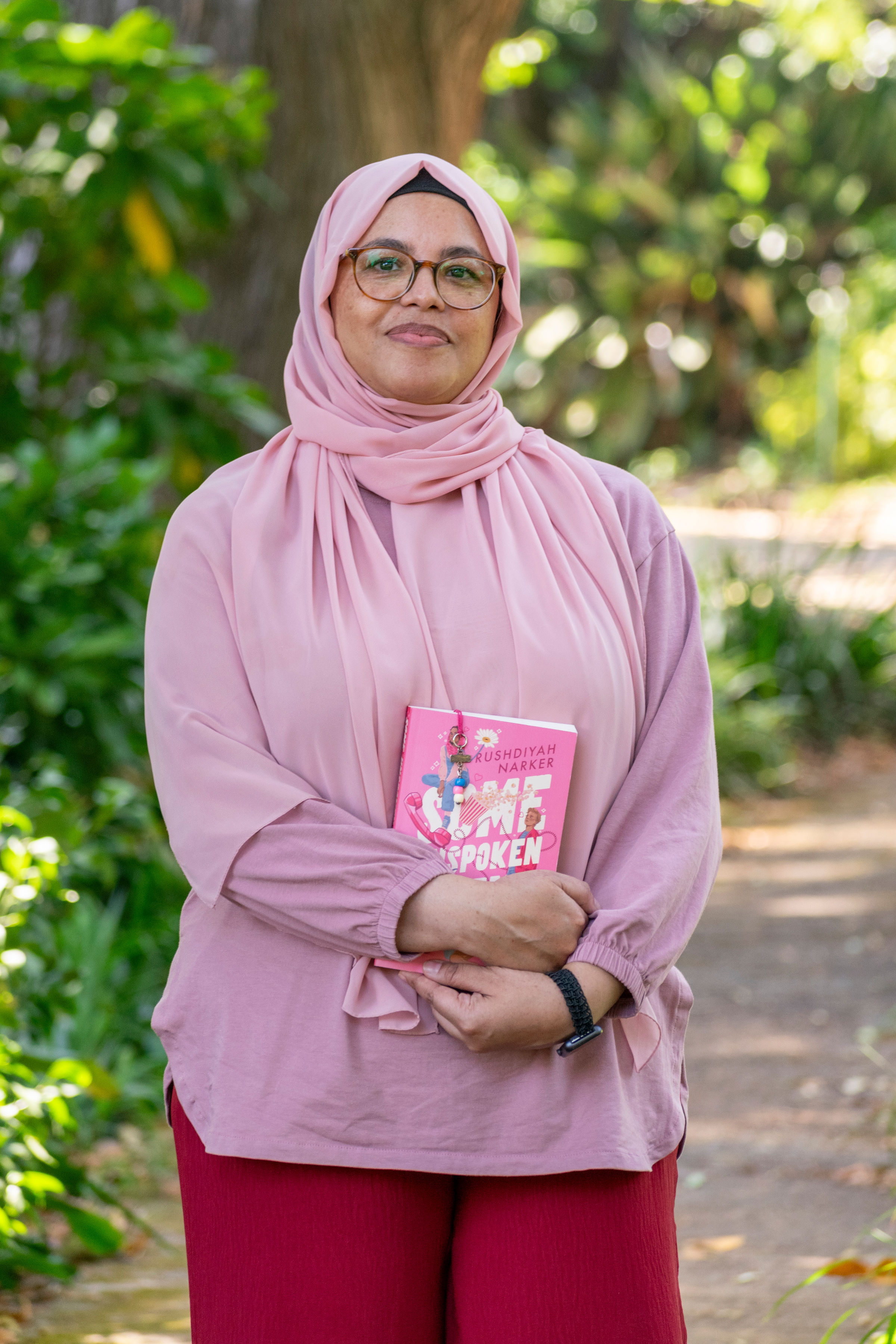
Rushdiyah Narker has moved from making up stories in her head to writing them down. She uses the skills she learnt while getting her Masters in Social Anthropology to write stories about the culture she grew up in. 'Some Unspoken Thing' is her debut young adult novel enjoyed by kids 13 to 60 years of age. For funsies, she reads a book a day and loves to go to the theatre, galleries, and movies to experience different forms of storytelling.
View all work by Rushdiyah Narker