
A War Beyond The Frontlines
Cue The Cape reviews of ‘Until I Arrive’ at Baxter Theatre
Share this piece
Pass the story on to your people.
Script: Lindokuhle Melaphi
Direction: Lindokuhle Melaphi
Starring: Lindokuhle Melaphi
Mentored By: Tiisetso Mashifane wa Noni
Creative Supervision: Sylvaine Strike
Venue: Baxter Theatre
Genre: One-woman show/ Drama
Performance Dates: 29 September 2026 – 3 October 2026
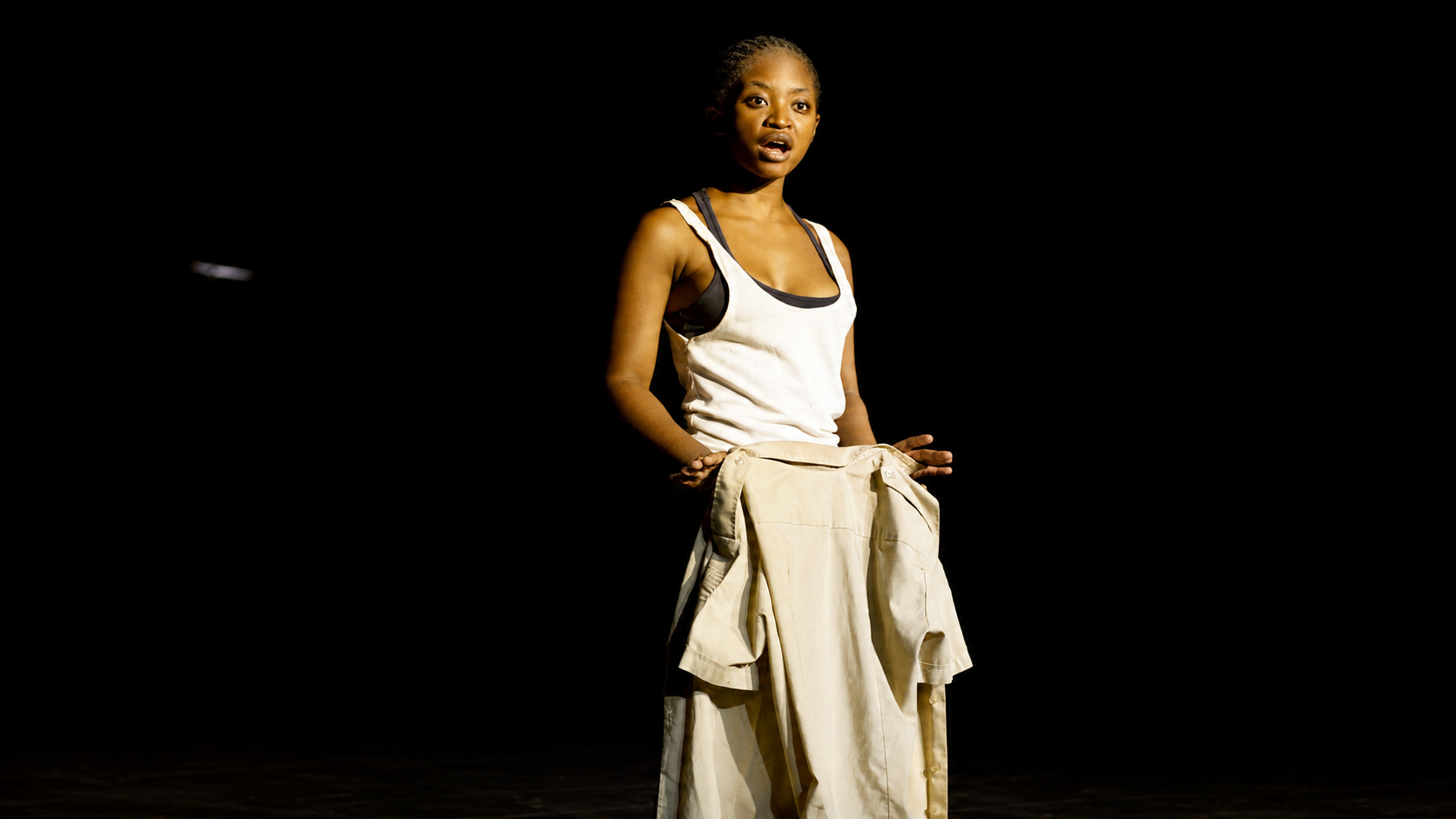
Until I Arrive is a solo play written, directed and performed by Lindokuhle Melaphi, staged at the Baxter’s Studio Theatre. This sixty-minute play was one of the two winners of the annual 2026 Zabalaza Theatre Festival at Baxter Theatre – additionally the production won an award for ‘Best Script’.
Noticeably missing for this iteration of the play’s original director at the Zabalaza Festival, however, award-winning actress and multidisciplinary theatre maker, Tiisetso Mashifane wa Noni took a mentorship role in the direction. Sylvaine Strike, considered one of South Africa’s most notable directors of theatre, solidified this creative team with her creative supervision. Despite Melaphi’s deeply impactful acting and persuasive writing paired with Mashifane wa Noni’s mentoring and Strike’s supervision, the question one must ask is, “Can an actor direct themselves in a one-woman show?” – as Melaphi is credited as the production’s director as well. Melaphi certainly has the acting chops to hold her own when it comes to delivering a compelling performance. She is, after all, a popular television actress with qualifications in drama performance. However, the production's effective use of movement and its emotional resonance also suggest the value of the creative guidance provided by Mashifane wa Noni and Strike. Together, Melaphi’s writing and performance, Mashifane wa Noni's mentorship, and Strike's creative supervision make for a poignant production worth watching.
The play follows Lisakhanya October, a young female soldier who is part of the South African military force. This strong one-woman show leans on expressive and energetic physical theatre techniques to capture the story of Lisakhanya’s life. With the use of the narrative jumping between multiple timelines and ranging from: Lisakhanya’s initial training days in the military, her early childhood, and then fast-forwarding back to her time on the frontlines – this is done all with Melaphi portraying a myriad of characters.
Within the rigid, male-dominated structure of the military, Lisakhanya learns that showing vulnerability is often equated with weakness. She has spent years building a hyper-disciplined exterior, relying on strength, control, and resilience to command respect from her peers and superiors. However, her greatest and most harrowing conflict is not fought on the front lines, but within her own family and within her own mind.
The play begins with Lisakhanya, as a child, being very proud of her father’s achievements in the military and her childlike sense that they have a good relationship over the telephone. He is initially kind and interested in her life, but as Lisakhanya gets older and her father is away for longer periods, we see a major shift in how he discards her and her mother. This trajectory left me feeling disappointed, as Melaphi clearly reveals the consequences of Lisakhanya’s father’s dwindling investment in his family.
Seeing a child hurt by both her father’s words and actions and how she grows into a woman who places the responsibility on herself to win him over is an all too familiar story for many South Africans who have to bear the brunt of male abuse in their homes and families.
This production explores lifelong disappointments, examining childhood trauma, abandonment and their lasting effects on mental health. These themes are particularly relevant to us as South Africans, as we continue to grapple with a nationwide crisis of gender-based violence, whilst many fathers continue to deprive their children of healthy relationships with them. The production further brings these concerns into sharper focus through a striking scene of domestic abuse, which interrogates the distorted yet pervasive belief that manhood is achieved through emotional detachment, dominance and brutality.
The creation of limited employment opportunities for people of colour dates back to both slavery and post-slavery colonial policies. It was re-packaged under Apartheid and in a post-democratic South Africa limited employment opportunities for people of colour still exists. This long cycle spanning over one-hundred years contributes to South Africa’s tragic history of deliberate, extended separation between men and their families, causing inevitable detachment. Lisakhanya’s father, however, is a privileged man who is highly respected in the military. His position of rank and authority makes his deliberate emotional and financial abandonment of his family different to the norm. Until I Arrive, therefore, explores the belief that being hardened and tolerating pain makes a man, and that mental health is a myth. I ask myself: Is there an element of men feeling all of their pain yet being conditioned to remain silent by society and in the military, causing them to lash out instead of being transparent about their emotional and mental states? It is my opinion that this may create some context and understanding of Lisakhanya’s father’s behaviour and destructive decisions because he starts off as her hero, yet becomes progressively scarier, more tyrannical and apathetic towards his family the longer he remains in combat, but this play does not excuse his abuse. Until I Arrive speaks for many home situations and courageously tackles what many of us have accepted as normal.
Whilst Lisakhanya’s home situation is something that a lot of South Africans can identify with when it comes to manipulation and gaslighting from bread-winners, particularly being forced to absorb verbal, mental and domestic abuse and thus losing their sense of who they truly are, eventually depending on the praise from the ones we will never get it from. Melaphi’s writing therefore examines how a father and husband’s abandonment and abuse can impact his family creating a fixation with the perceived notion that fathers and husbands like this could change for the better, and one day finally embrace their families.
In many South African cultures, being silent is a sign of respect and gratitude, especially to male breadwinners and patriarchs. Just like Lisakhanya, so many of us, despite our nuanced lived experiences, can relate to carrying unspoken stories of internalising harmful actions caused by her father. In my experience, I have observed that most women in these situations are never given scope to stand up for themselves or even grasp the fact that they’re not at fault.
I felt great frustration with the relationship between Lisakhanya and her father.
Why?
Perhaps this play was as angering, because I have had many conversations with people I know, mostly women, who have found themselves abandoned by fathers, yet refuse to develop relationships with their children. All of these men damage their children’s sense of reality and confidence in themselves by being deliberately emotionally detached. Although this theme is not a story I can personally identify with, these conversations made Lisakhanya’s experience all the more frustrating to witness.
At first, one gets the sense that Lisakhanya joined the military because of her father’s influence or eventual encouragement. However, as the story unfolds, Melaphi’s thoughtful characterisation of Lisakhanya as an impressionable little girl who simply wants to be with her father, alongside her portrayal of a mother growing increasingly frustrated by sparse phone calls with her husband, gradually reveals a far more painful reality. Lisakhanya’s father has never truly been present, nor does he want to be. Through clever dramatic irony, this fact becomes clear to the audience long before it occurs to Lisakhanya, as her mother tries to protect her from the ugly truth that her father has completely lost interest in them.
The emotional weight of this fractured father-daughter relationship is further reinforced by the production’s acting and staging. Melaphi brings Lisakhanya’s life to the stage with conviction and drama in a performance fitting for the Studio Theatre’s stripped-back and empty set. The performance is further supported by vocal techniques that complement the production’s quality physical theatre. Lisakhanya comes across as a high-energy, ambitious woman, talking to the audience about her upbringing, personal struggles in adulthood, military life and how she finally overcomes her dependence on the delusion that her non-existent relationship with her father will one day grow.
As mentioned, the Baxter’s Studio stage is transformed into a bare black-box performance space, where the minimal use of lighting, sound and a single chair proves that Melaphi does not need an elaborate set or multiple props to move her audience. The chair plays its own set of roles, fleshing out this story: it becomes a sofa repossessed due to her father’s financial abandonment, seating in school transport, a heavy object she must repeatedly lift during her father’s military bullying and, most notably, her mother being beaten by her father.
However, the production’s inventive use of a single prop is only one aspect of Melaphi’s impressive physical performance. Equally compelling is her ability to embody multiple characters, shifting seamlessly between their distinct personalities, emotions, and physical mannerisms. In one scene, little Lisakhanya wants her father to know what her elementary social life is like, whilst her mother desperately asks him for money to cover their basic needs. Melaphi’s embodiment of jumping between all characters demonstrates convincing storytelling through her careful understanding of how people move according to their age and emotional state. She achieves these shifts by passing an imaginary phone between mother and daughter, whilst changing her seating position to distinguish the two characters and their relationship with each other.
Melaphi’s creation of three distinct people in one family helps the audience identify each character and understand how they function within their family unit. She fleshes out each character through their own posture, tone of voice, thoughts, feelings and responses to each other and the events of the production. We see an aggressively dismissive father and husband who doesn’t care about anyone’s opinion but his own; a mother and wife whose faith in her husband is dying whilst she anxiously scrambles to take care of her daughter and protect her husband’s image in front of her; and a daughter whose entire upbringing is shaped by her own delusions of her father being the best dad, always excusing his actions and instead being critical of herself and her own worth.
Melaphi’s ability to switch seamlessly between these characters is further evident in the subtleties of her through subtlety. I loved the way she broadened her chest, lengthened her spine, rooted her voice, and tensed herself up to play an austere, pompous man. The mother is played with a ‘grounded’ physicality, relaxed in posture and often leaning towards Lisakhanya, which is the complete opposite of her husband, who always stands up straight and talks down to everyone. The character of Lisakhanya is taken from a little girl whose unfiltered impulsivity, naïvité, fidgeting, and innocent statements drew laughter from the audience, to a grown woman who is a live wire, taking her position in the military very seriously. She looks for the solution to every problem, but often replicates her father’s rigid physical stance. Lisakhanya’s visceral and growing hatred expressed through Melaphi’s growling, bellowing voice and intimidating physicality, as she stretches herself upwards and forwards to tower over Lisakhanya, is a testament to her professional physical theatre training and skilful vocal control. By drawing on a deeper vocal register, so unlike her natural speaking voice, Melaphi creates the illusion of a powerful, terrifying man whose military authority extends into his treatment of his family.
As the storyline continues, Lisakhanya’s father meets her father on the frontline. He is a tyrant, raising his voice and pausing to watch her struggle before calling her useless, like her mother. Lisakhanya slowly crumbles under pressure during a military exercise. These memories of his verbal and physical abuse stir up unaddressed emotions, eventually causing her to collapse to the ground in defeat. The collapse is carefully choreographed as Melaphi holds the chair above her head, representing a heavy object, before gradually losing her balance, breathing deeply and audibly as the chair appears to grow heavier with every insult. The once strong, fit soldier falls not because of the physical demands of the exercise, but because of her father’s words. This is evidently a style of combat she was not prepared for. For me, this was the moment I felt the most frustration with Lisakhanya’s father and the greatest empathy for Lisakhanya. The audible gasps from the audience suggested that others were equally affected.
Beyond its immediate emotional impact, this scene also reveals the cycle in which Lisakhanya remains trapped. What I understood from this production is that Lisakhanya went in search of her father’s acknowledgment but instead found herself transported back to her home where he caused her and her mother so much pain and fear. She is trapped in a cycle. It reminded me of the popular cliché, “insanity is doing the same thing over and over again and expecting different results.” To me, this touches on Lisakhanya’s mental state, in a perpetual state of needing to the point of putting herself in harm’s way, trying to attain a relationship that will never come to fruition.
This production left an impact on the audience. This was apparent through audible gasps, whispered comments of empathy for Lisakhanya’s character and lastly a standing ovation from the entire audience. I cried and laughed during this show. I believe that many audience members attached themselves to the ups and downs of this story through the quality of Melaphi’s physical theatre mastery, use of different voices and the way in which she accesses and harnesses breath to express emotional shifts.
I do wish that this production had a went in even further with the final with Lisakhanya’s final confrontation with her father. When people finally get the chance to express bottled-up matters, there is usually an irate outburst. On the other hand, and through Melaphi’s performance, I did ask myself: has Lisakhanya’s military training made her less in touch with her emotions as she seeks to be more like her father, unintentionally cutting herself off from some of her would-be emotional expressions?
Is it possible that she does not want to give him the satisfaction of watching her have an absolute melt-down because she feels that displaying her exact emotions is a sign of weakness?
Has she truly moved on, or is there more for her to do and to still grow?
I did, however, like that she does not give him a chance to respond to her statements, walking away from him when he is shocked by her words and tries to explain or excuse himself. This shows Lisakhanya is releasing herself from the grip of her father’s brutality and she is realising her self-worth. It is a step in the right direction, whether she has all the answers or not.
For me, and many other South African women, Until I Arrive is inspiring.
We know most people who find themselves in a comparable situation would not be able to find their voices in the face of life-long abuse.
Until I Arrive reminds us that we can conquer our taught, damaging beliefs about ourselves and let go of the fear of not being liked by people who aren’t good for us anyway, even if it’s a parent.
It hurts, but we can overcome it.
About the author
Cue The Cape
Cue The Cape is a novice writer whose attention span is fully dedicated to theatre, and having a lot to say about it. The concept of Cue The Cape grew out of a sudden urge to share opinions on theatre in short bursts, for readers who might want to know what a show is or was like from the perspective of a life-long theatre-goer and Musical Theatre devotee who has studied singing, dancing and acting. Moving dinner table discussions about shows between friends and family to online platforms is a new endeavour for Cue The Cape who is slowly coming out of their shell.
View all work by Cue The Cape