I am obtuse, and I love it.
Jennifer Grace Morris reflects on her journey with hair
Share this piece
Pass the story on to your people.
I stand in front of my dresser mirror, picking out the edges of my brown-blackish afro, making sure that it looks like a fluffy cloud framing my face. I can't stand a deflated afro. My eyes glance to the primary school pictures of me in my maroon uniform framing the walls. Suddenly, pride fills my chest as my bedroom lights warm the room as the sun sets below the curtains.
I can’t help but reminisce about a time when my hair wasn’t always this vast exploration of my identity.
In 2016, I was at Mountain Road Primary School, and already I had the dysfunctional thought that Coloured girls had to have a specific hair type. At that time, children my age were talking about who they were going to be playing marbles with and what food they were going to eat at lunch. I'm spending my last period of lunch thinking about who I am going to sit with. The Cape Malay girls with shiny, sleek black hair sat in one corner, and the girls with braids and cornrows sat in another corner. The boys never seemed to be worried about hair; they were more concerned about who played soccer best.
The girls never said anything, but who needed words when side eyes spoke the loudest? I remember as I walked out to the playground, a group of girls with middle parts in loose ponytails snickered as I walked towards them. I turned myself right around and received the same rejection from girls in tight cornrows. In that light, I received either not being Black enough or not being Coloured enough. My tight, coily curly hair was too thick to be considered Coloured, and my accent was too thick to be considered Black. That's when I resorted to the fat, racially obtuse character that kept everyone laughing or entertained instead of questioning where I belonged.
After begging my mom for hair that blows in the wind, she took me to the salon for a fresh blowout and flat iron. As excited as I was, sitting in that black leather salon chair, I couldn’t help but stick out like a sore thumb. Looking in the mirror in front of me, with the shrinkage of my hair looking back at me, I turned over to the right and the left and realized I slapped me. All the women around me had a uniform look: they were all coloured with straight hair. It was at that moment that an unspoken standard stood out, and it was clear as day that I didn’t particularly fit that standard.
My hair, in stark contrast to the flowy straight hair, was thick and tight 4c type coils in the back and 4b in the front. It took me years to understand these. In primary school, my hair was dik [thick] with heat-damaged hair from attempting to straighten my hair every morning for a couple of days.
My mother had always been an advocate for the fact that there were different variations of Coloured. She reinforced that the term Coloured was not only about the texture of my hair, but also the culture that surrounded me. However, I still chased after acceptance. Even though yes, I was a mixed-race Coloured woman with a Coloured mother from George, and a Black father from Zimbabwe – a long story for another published piece -- I never thought that my hair in its natural coily state screamed Coloured, so instead of thinking there were different types of Coloured, I just believed what I saw.
In our Coloured community, there has always been this silent notion that hair was the gatekeeper of your identity. During the early 2000s, it was socially embedded that the way you styled, dyed or even combed it spoke volumes about the image you wanted to portray. My flat-ironed hair, at the time, represented my desire to conform to an ideal of beauty that equated straight hair with desirability, respectability and social acceptance. Still, I was not satisfied.
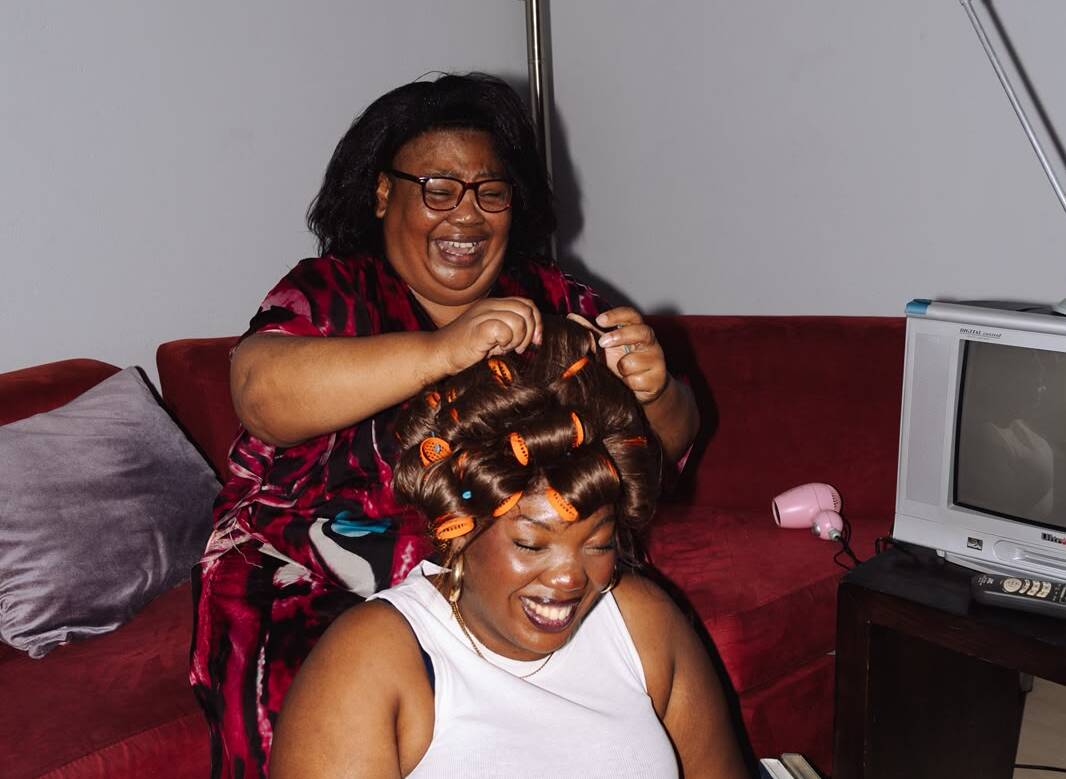
As the hairdresser poured the perm solution onto tight rollers, I hoped my acceptance would process too. The second experience of my hair acceptance journey was the chemical perm solution that smelled like a relaxer in a tiny salon. The smell didn't compare to the actual Dark and Lovely creamy relaxer my mother applied on my hair as I sat between her legs on the floor.
In the year 2019, I started high school – an all-girls’ high school. The start of Grade 8 was riddled with anxiety. On the first day, hundreds of girls walked past me with different hairstyles. Compared to Mountain Road, which was predominantly Cape Malay girls and boys with pin-straight hair, Good Hope had girls with cornrows, box braids, dreadlocks, goddess locks, and afros; it was expression galore! There was a sense of freedom in the air.
For the very first time, I considered going natural and attempting to grow an afro.
The young girls, especially those who wore their afros, glowed. The other girls in their unique hairstyles glowed too; no one seemed left out. Something sparked inside me: a new desire to know who else looked like me, and I decided to find that similarity in my family. It was then that I reverted my hair to its natural state.
At school, I didn’t have to explain who I was. Yet, for the first time, I also wanted to explore who I was and where my mother came from. Despite my mom being coloured and my dad being black, I needed to know more. It was an itch that needed to be scratched, and I knew one person who would help me. My mother’s uncle refused to be called anything that made him sound old; to be fair, he doesn't look his age either. While I was back in George on a school holiday, sitting in our tiny living room, I gathered the courage to ask where our roots came from. Uncle John after lots of pleading told me that great-great-grandparents were racially diverse – my ancestors were of Ethiopian descent.
Hearing uncle John speak, I found a different angle by looking at the texture of his hair. Hair is made from a series of genetic fibres, all unique and special. I found power in the fact that my hair was my own experience of being coloured and Black. Confidence began to rise in my chest when I walked into a room, and my hair spoke for me. In the same walk of living within my own identity, I found power in the fact that I make a difference in spreading diversity within the coloured community. Whilst holding my head up high, with my afro, braids, or sleek-back bun, I become the representation I wish I had when growing up.
The older I grew, the more I realised the weight I carried in how I carried the title Coloured. It made me question if my identity was a social standard I saw as a goal or a choice of representation. I chose to diversify the word Coloured. High school was my space to experiment and I went wild. Every month was an opportunity for me to see the length my hair could go. Box braids were my go with a classic middle part. The faux dreadlocks were definitely a confidence booster and the fact that hair fell on my back was extra added points. By the time I was at university I truly felt no limitation. I spent my whole first year bleaching my hair blond and red. My second year I focused on the different hair textures I had with different ways to curl hair with creams, gels and foams.
My phone buzzes on top of my dresser, pulling me out of the memory. I blink and find myself back in my bedroom, standing in front of the same mirror, my fingers still picking gently at the edges of my afro. The sun has almost disappeared behind the curtains now, and the warm light in my room makes my hair look even fuller, even softer, even more mine.
I look again at the primary school pictures on my wall. For a moment, I see the younger version of myself who thought she had to choose where she belonged. I wish I could tell her that she was never too Black, never not Coloured enough, never too much of anything. She was simply still learning the language of herself.
Now, when I wear my afro, my braids, my sleek-back bun, or whatever version of myself I feel like stepping into, I no longer see my hair as something that needs to explain me. It is not an apology. It is not a question. It is part of my story.
My hair has taught me that identity is not something I have to shrink, straighten, or soften to make other people comfortable. It is something I get to define for myself. And maybe that is what growing up has given me: the courage to stop asking where I fit in and start creating space for myself instead.
So, yes, she is obtuse – racially, culturally, beautifully obtuse – and she loves it.
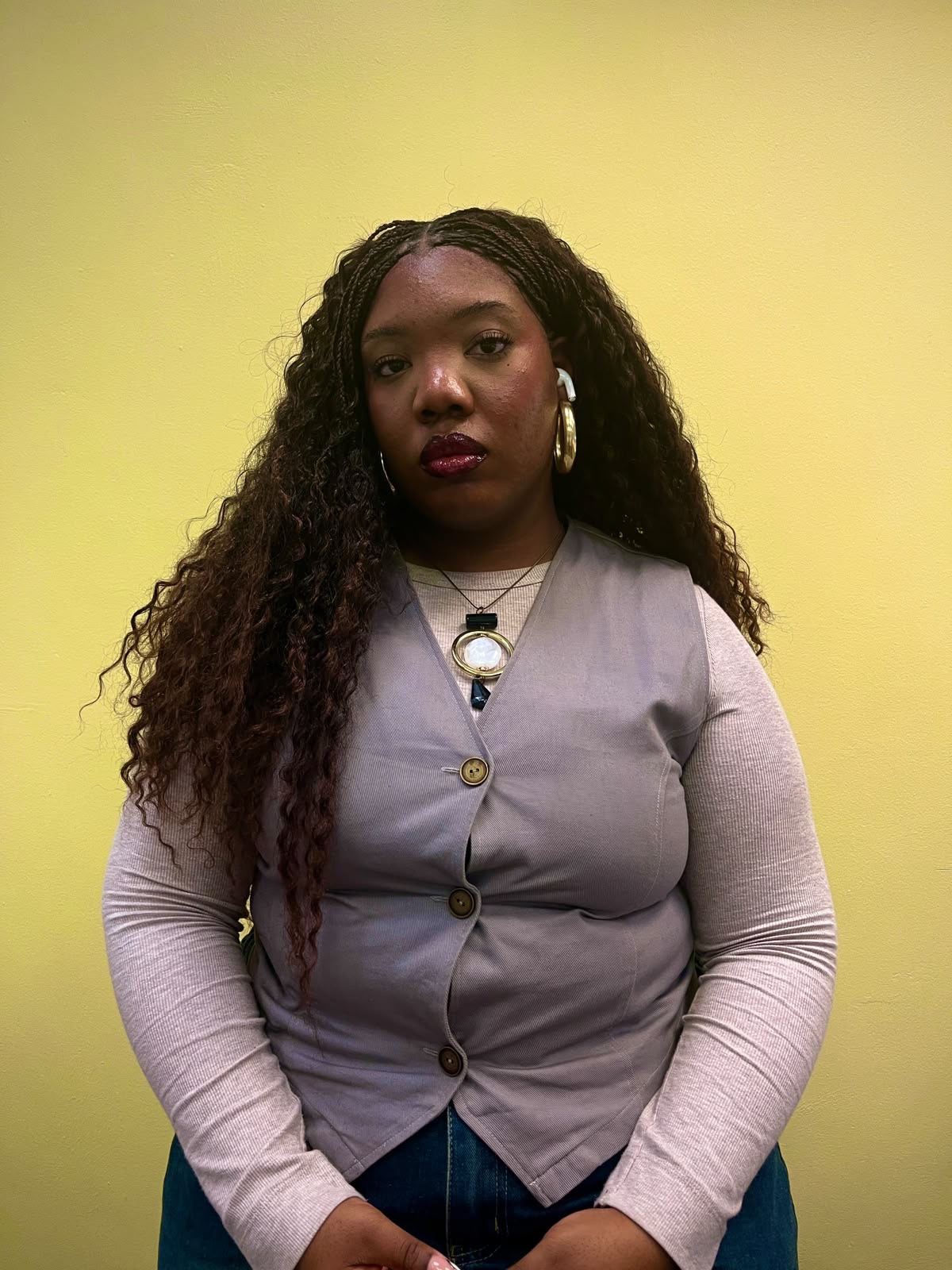
About the author
Jennifer Grace Morris
Jennifer Grace Morris a mixture of alles en more. She is known to dive between poetry and various literature devices that reflect the dialogue of life. Studying at UCT with English Literature and Sociology as majors, she learned to dig beneath the surface of society. Her love of literature is also extended to theatre, proclaiming her self as, "Die Drama queen", where she uses dramatic arts as a medium to express all that words can’t say. And if you don’t hear her speak, her eyes will say a thousand words. If it’s not through writing or performing, she uses unique sneakers, preferably Nike, and maximalist streetwear to explore her mixed plus-size identity.
View all work by Jennifer Grace Morris