When Ghosts Come Knocking…
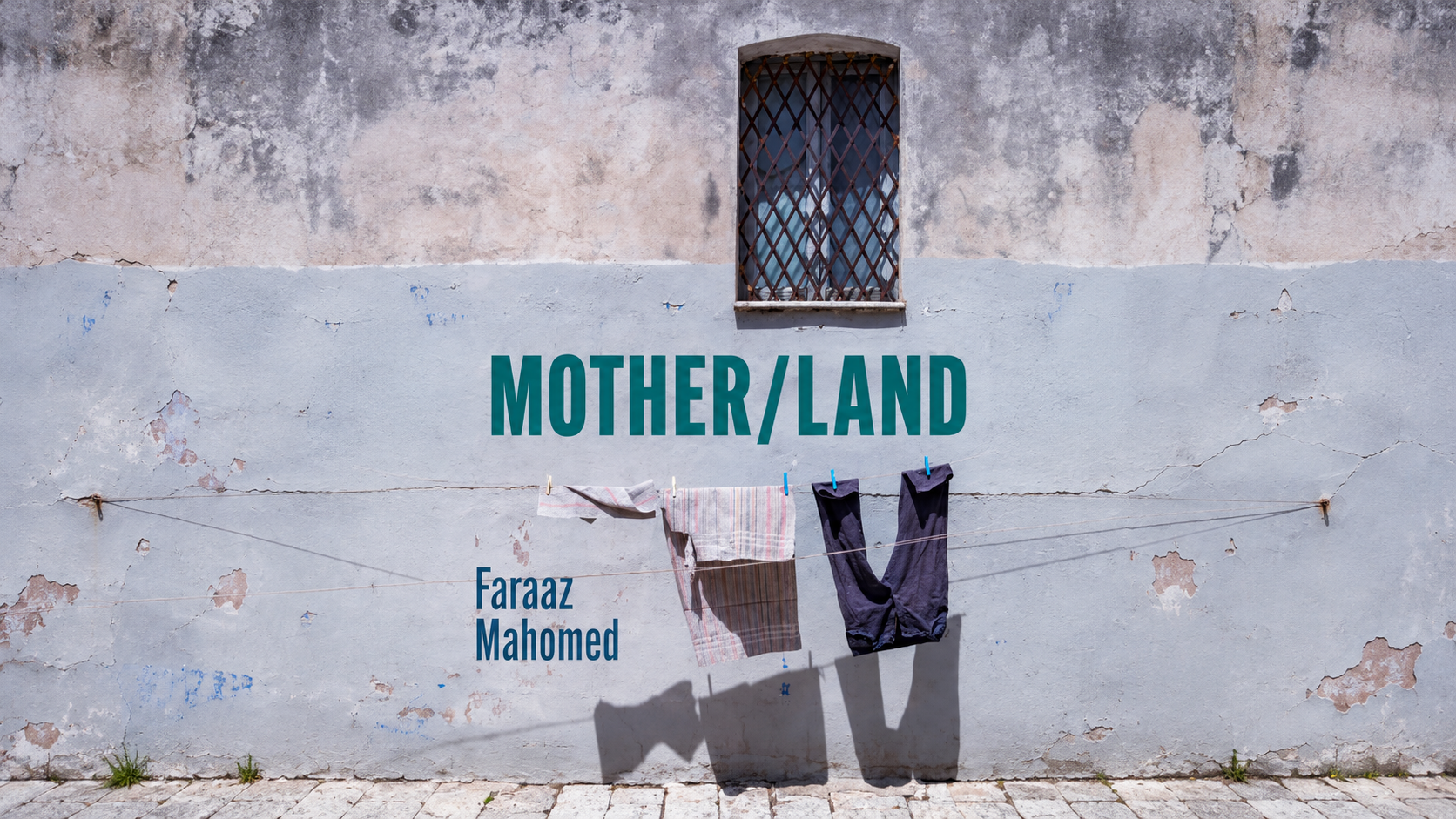
Fatima Bheekoo-Shah reviews 'Mother / Land' by Faraaz Mahomed
Share this piece
Pass the story on to your people.
Publisher: Catalyst Books
Type: Novel
Date Released: August 2026
Retail Price: +/- R320.00
Format: Paperback (285 pages)
Faraaz Mohamed’s debut novel opens with a striking, surreal image: the ghost of protagonist Salim Bardien’s mother, Sawligha, appears to him in a New York classroom – this happens on the very day a student in Cape Town throws a bucket of excrement at a statue of Cecil Rhodes. Although these events unfold thousands of kilometres apart, they introduce two seemingly different worlds: Salim’s deeply personal confrontation with his past and South Africa’s public reckoning with its own history. What initially appears to be a coincidence soon reveals itself as an important connection between the two.
From page one, Mahomed signals that the novel won’t separate the personal from the political, or the past from the present. The statue, which stood at the University of Cape Town, commemorated Cecil Rhodes, a British imperialist whose legacy remains closely associated with colonial oppression and racial dispossession in South Africa. In 2015, the students’ protest against the statue helped spark the Rhodes Must Fall movement, which questioned why a figure associated with colonial injustice continued to be honoured in a democratic South Africa.
The pairing in this novel is deliberate.
A statue is meant to be fixed, settled, until someone forces the country to see what is actually buried in the foundation – its ugly past.
And Salim’s mother turns out to be much the same – a fixed, settled presence he never thought to question, until her return reveals that what he took for granted about her rests on secrets.
It is this unexpected collision of the personal and the political, the supernatural and the historical, that makes the novel’s opening so compelling. I was immediately hooked by the audacity of Mahomed’s storytelling – a ghost and a protest on the same page felt like a promise that this book would trust its reader with some strangeness, and for the most part, it does.
These opening images set the tone, but the central mystery takes shape a little further into the same chapter, when a stranger named Bertha arrives at Salim’s office holding a stack of old love letters. They were written by Salim’s mother, Sawligha, to Carl Lamprecht – a former apartheid official involved in the same forced removals that hollowed out Cape Town neighbourhoods like District Six. Bertha, it turns out, is Lamprecht’s daughter, and she provides Salim with a revelation that dismantles everything he thought he knew about his own family. Mahomed handles the emotional weight of this discovery well; the truth unravels scene by scene, the way news of this nature tends to land.
And much of this gradual unravelling owes itself to the novel’s narrative structure, which allows the past and present to unfold alongside each other. The novel moves between Salim’s life in 2015 and his mother Sawligha’s life in the late 1960s, and the shifts are never disorienting. Each chapter is headed with the narrator’s name and the date, so the timelines read more like an interwoven family history than an interruption of each other.
Salim’s chapters are told in first person; Sawligha’s shift into a close third person, close enough to follow her thinking without being inside her head.
Rather than presenting Sawligha’s past through the letters Salim discovers, Mahomed gives Sawligha a narrative of her own – an independent thread that gives the reader access to a past Salim never gets. It’s an effective choice; it lets Sawligha remain a little unknowable, exactly as she is to her son.
It is in Sawligha’s chapters that I fell in love with this novel, specifically the sections that follow young Sawligha as her world is torn apart by the same forced removals in District Six, Cape Town. These chapters feel grounded and specific in a way that the present-day chapters don’t.
At first, I didn’t mind the shift. I gave Mahomed the benefit of the doubt and assumed the two timelines sounded different by design, a way of marking how far apart his characters’ worlds are. As the novel went on, though, I started to wonder whether that was really the plan.
In Sawligha’s world, I could smell the samosa she sneaks on her walk to campus. I could feel her unease too, walking through a neighborhood already being carved up by who's allowed to stay where, with Table Mountain as its backdrop. Yet, every time the novel cut away from Sawligha and back to Salim, I felt the loss of her. I suspect Mahomed wants his reader to feel the same sense of disconnection that Salim experiences in relation to his mother, but this is not executed convincingly, and it is here that my mixed feelings about the novel start.
The present-day chapters are more uneven: Salim, for long stretches, is more reactive than active, absorbing revelations, listening to Bertha, listening to his mother’s ghost. It’s not that Salim is a dull character on his own terms: he is thoughtful, self-aware, quietly funny with his daughter.
The problem is the structure.
Sawligha’s chapters have real stakes moving underneath them: a marriage, a neighborhood, a decision closing in. Next to that, Salim’s plot can feel like a waiting room. I found myself, more than once, wanting to skip ahead to her sections.
Furthermore, Mahomed’s prose is dense and heavily imaged throughout the novel, and it doesn’t always work in his favour. In scenes that call for emotional clarity, the intricate phrasing creates distance instead of intimacy, and I noticed myself re-reading sentences because I’d actually lost the thread of what was actually going on. This is most visible in the subplot involving Bertha, whose circumstances unexpectedly draw Salim into a difficult personal situation. The premise itself risks melodrama, leaning on a sudden medical crisis that is not warranted for the reader to manufacture an emotional bond between characters, and the writing doesn't always resist that pull either. I wanted to feel more for this predicament than I did, and it is Mahomed’s use of prose that got in the way.
Another striking example of Mahomed’s overwrought prose, which has stayed with me, occurs when Salim receives a kiss from his wife and her lips are compared to “a mango that had reached the season for its plucking.” I did not like this as it compared a woman’s lips to fruit which is such a cliché. The comparison feels unnecessary, drawing attention to the language rather than the intimacy of the moment. Mahomed merely reaches for vivid, sometimes startling imagery in a moment that might have landed harder with plainer language.
Stylistically, Mahomed favours long, layered sentences stacked with similes and metaphors. Readers drawn to dense, image-rich literary fiction will find much to appreciate.
His dialogue, however, feels far more effortless. Throughout the novel, both in Sawligha's 1960s chapters and in Salim’s present-day calls with his family, the dialogue moves naturally between English and Afrikaans, lending the characters real authenticity without the need for excessive explanation. It’s where the writing feels most alive to me, unshowy and exact.
One of the most interesting threads is how the novel draws a distinction between apartheid-era racial division and the different but related racism Salim experiences as an immigrant in America. For the most part, it succeeds in making these experiences feel connected rather than merely similar, even if it occasionally states the connection outright instead of trusting the reader to notice it. These were among the few moments when I felt slightly talked down to.
The novel’s exploration of racism and displacement carries additional weight when one considers Mahomed’s own family history: his great-grandfather lost his home under the same apartheid legislation. There’s something quietly urgent about this kind of storytelling. I found myself thinking about the questions I never asked my own grandparents while I still could, and the assumption that there’d always be another chance to ask.
In this sense, novels like Mother / Land function as an archive, preserving the histories and experiences that families so often put off discussing until it’s too late.
But the histories we inherit are not the only things that shape our sense of identity. Faith is a quieter thread here, alongside the novel's louder reckonings, and it’s something I found myself particularly drawn to as a Muslim reader, even if it isn’t something the novel dwells on at length. I think that says as much about me as it does about the novel – we tend to notice, and hold onto, the details in a story that let us see something of ourselves reflected back. Salim has drifted from Islam, and this distance from his faith surfaces as one of several unresolved tensions in his marriage. His relationship with the siblings he grew up with is similarly strained and becomes more complicated.
A few of these moments landed for me personally, but this is a novel for any reader drawn to stories about inherited history, displacement, and family secrets – Muslim or not, South African or not.
The ending takes a real risk, shifting the narration in its final pages to a different character.
My first reaction was some resistance. I wanted the resolution to come from Salim and not someone else. But I realised the shift broadened the story rather than being a cop-out on the author’s part. After all, the questions of identity, inheritance, and apartheid’s lingering scars were never Salim’s alone to resolve. These are histories that extend beyond individuals, often passing from one generation to the next without ever being fully confronted. Reading it, I thought about my own family's silences on these issues, quietly filed away, and wondered which of them I might one day find myself carrying, only half understood.
Ultimately, Mother / Land is at its absolute best when Mohamed trusts the quiet, human moments to carry the emotional weight. What stuck with me long after closing the cover wasn’t the ornate phrasing, but the deeply human, flawed characters and the raw questions Mohamed leaves hanging in the air.
Instead of tying up centuries of intergenerational trauma with a neat bow, the book lets those wounds breathe.
It’s a grounded, memorable debut – and it leaves you genuinely eager to see where Mohamed goes next.
About the author
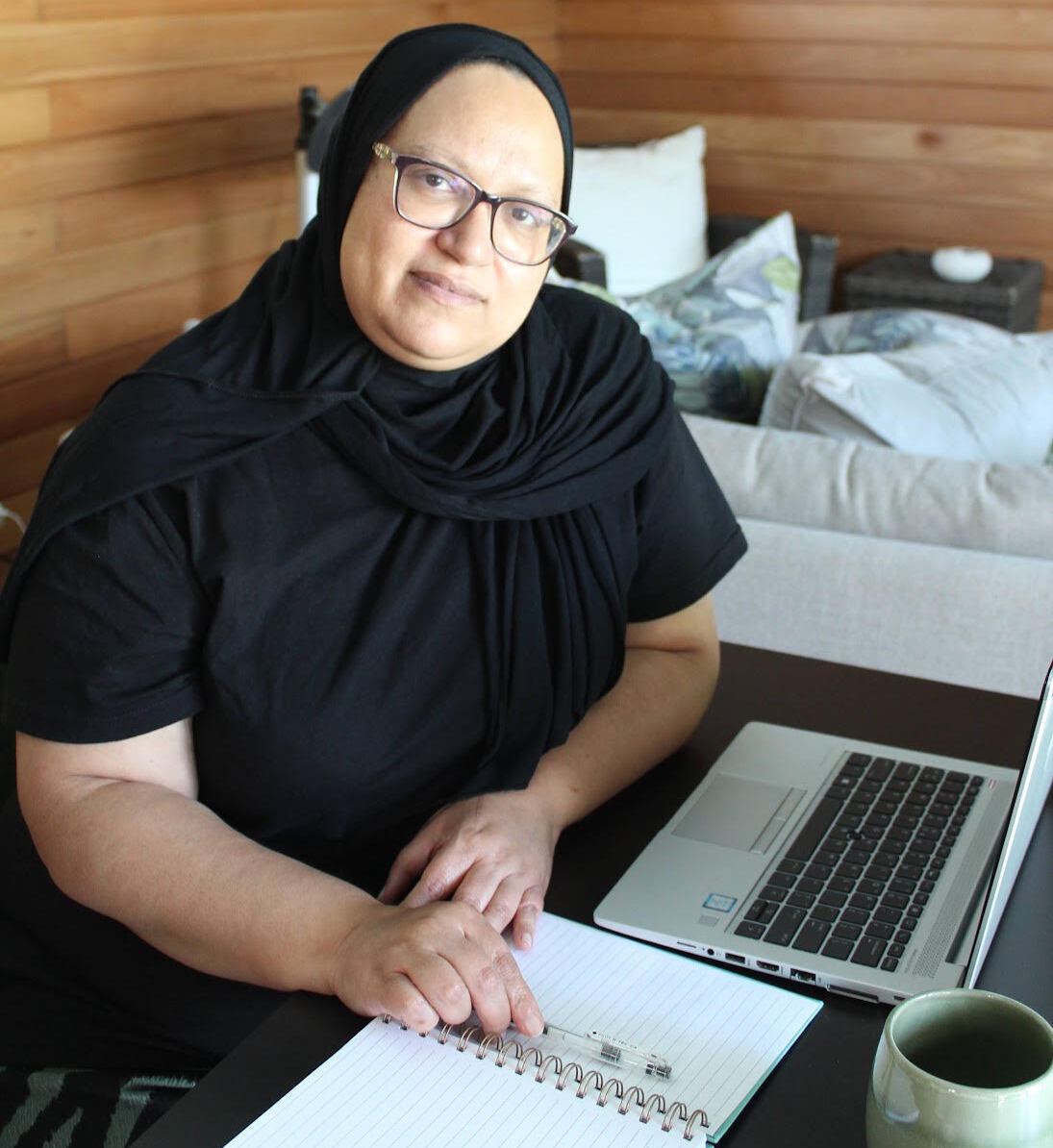
Fatima Bheekoo-Shah
Fatima Bheekoo-Shah is proof that one woman can wear a ridiculous number of creative hats and still somehow find time for a decent cup of tea. She's the founder of 'The Book Doula', where she ghostwrites, coaches, and midwifes other people's manuscripts into the world. Under the pen name BF Queen, she writes award-winning romance that has readers reaching for the tissues (or the fan, depending on the chapter). She's currently working on launching Write & Sip, her women's writing workshop for women who’ve always been interested in creative writing, but when she's not doing that, Fatima can be found colouring in like it's a competitive sport, deep-diving into true crime rabbit holes, or experimenting in the kitchen with whatever's left in the fridge. Contemporary romance is her home turf, but really, she just loves a good story, especially if it ends with a happily ever after.
View all work by Fatima Bheekoo-Shah