Relics of the End
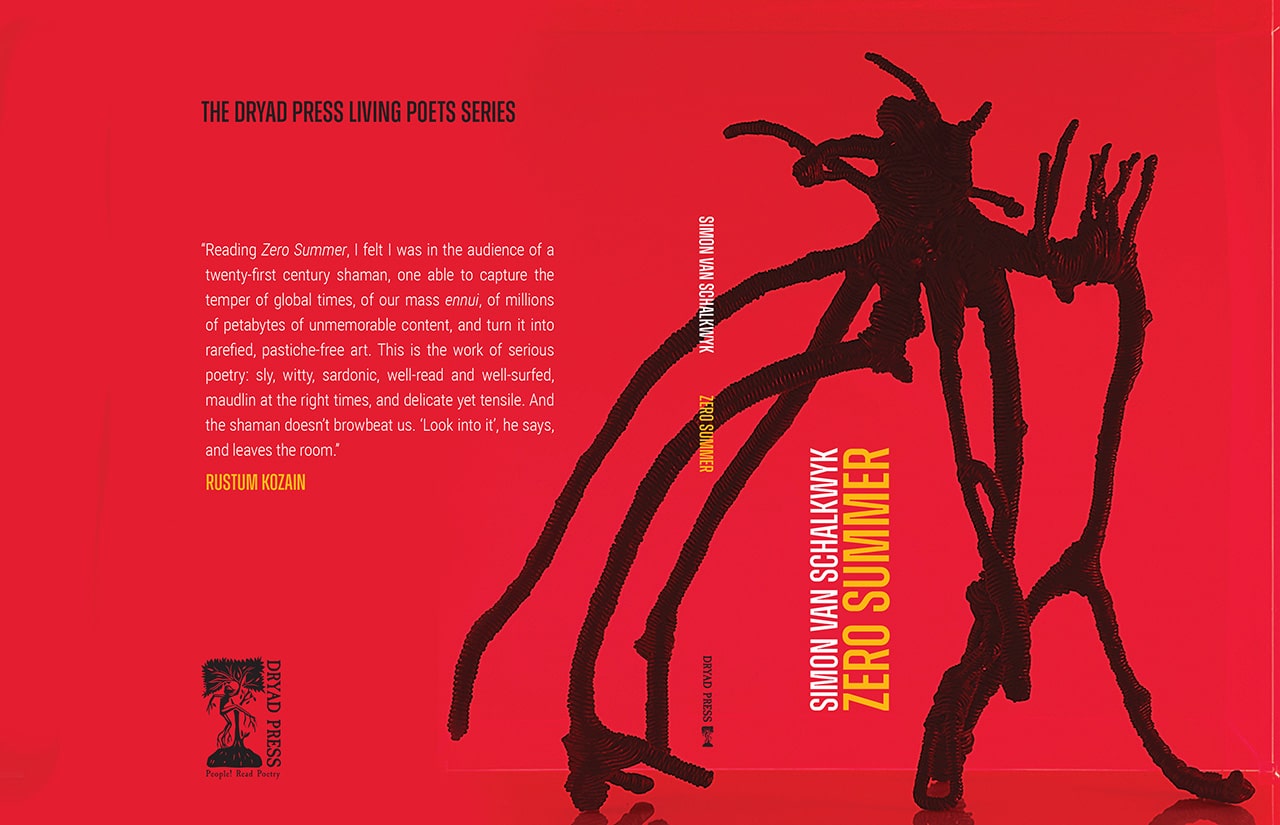
Jude Hunt reviews 'Zero Summer' by Simon van Schalkwyk
Share this piece
Pass the story on to your people.
Publisher: Dryad Press
Type: Poetry collection
Date Released: May 2026
Retail Price: +/- R250.00
Format: Paperback (100 pages)
From his first poetry collection, Transcontinental Delay (2021), to his most recent, Zero Summer, Simon van Schalkwyk traces the ways in which history threads itself through contemporary everyday life.
Building on this concern with time and history, Zero Summer explores how time collapses in on itself as people’s lives become increasingly entangled with digital spheres of belonging and dis-belonging. Through a series of emotional and circumstantial contrasts, the collection conveys a profound unease with the growing sense of disconnection that defines contemporary life. This alienation extends to the natural world, and confronts us with the environment society has neglected and placed in crisis through its relentless culture of consumption.
When I first started reading Zero Summer, I felt a jarring sense of familiarity in the contemporary anxieties Van Schalkwyk articulates around the increasing digitisation of citizenship, and the depletion of the environment in the process.
I continued reading because I was interested in how the speaker mediates both despair and hope, and consequently conceives the space for world-making in the face of disaster.
Described as immersing the reader in a stark poetic landscape shaped by alienation, extinction and the spectre of an ending era, Zero Summer ranges across nature, history, technology, and contemporary culture. The collection mirrors the hidden connections between our inner lives and the larger forces that are transforming the world around us. In this collection, van Schalkwyk captures the temper of the twenty-first century with a voice that is sly, sardonic, and deeply humane.
With a tone that is uniquely blunt, Zero Summer makes for a compelling visualisation of what humanity has destroyed and lost in pursuing material excess.
In this collection, the speaker paints catastrophe with the persistence humanity has to pivot in the face of great endings. Amidst the enormity of the ruins humanity sits with, there is the will to make something of whatever remains. Zero Summer relies on mysticism and imagination to demonstrate a path forward from the current era.
Zero Summer is nostalgic for the lost art of human critical thought, while inviting readers through sardonicism to imagine what we will make of our new beginning with the current colossal loss and consequent ache. Van Schalkwyk embraces the obscurity of the future, while openly expressing a valid sense of grief for the world that once was before the arrival of “[an] entire generation of A.I. unicorns…” (Line 2, Page 9). Van Schalkwyk transports the reader through several locations across South Africa, Lisbon, Greece, the clouds, and the sky itself, and relates an image of the world that is somehow both catastrophic and regenerative. The speaker reckons with spatial resilience over time, while reflecting the human tendency to panic in the face of destruction at our own hands.
As a reader, I found this version of the future and the speaker’s register to be counterproductive to establishing nihilism. Though, as I continued reading, it became clear that resilience sits at the crux of Zero Summer, in that it does not offer a clear finality that what humanity has lost can be recovered or rebuilt. Instead, Van Schalkwyk echoes a more unnerving sentiment that life has and will always persist even as what we recognise as the world changes or vanishes.
The collection is divided into five parts.
The title of the first part, strange signals from Akrotiri, recalls the lost city in Greece that came to an end during the volcanic eruption on the island of Santorini. Immediately, I was situated in an environment that is now archaeological and exists today to preserve a specific history. In this collection, however, Van Schalkwyk presents Akrotiri neither as an ancient ruin nor as a tourist destination. Instead, he uses it as a metaphor for contemporary civilisation, inviting readers to reckon with the transformation of the world into data and the growing influence of computer-based and cloud-based systems over daily life. Van Schalkwyk urges us to question whether humanity is a witness to history or those who live amongst its remains.
Time in Zero Summer is anything but linear.
Disasters that have occurred in the past are positioned to rehearse for disasters that are yet to come. Van Schalkwyk draws on the historical destruction of Akrotiri following the volcanic eruption in roughly 1600 BCE, reimagining this archaeological site as a poetic landscape through which contemporary disasters can be understood. Within this imagined landscape, historical destruction becomes a means of anticipating future catastrophes, including environmental collapse, pandemics, nuclear warfare, and anxieties surrounding artificial intelligence. In this way, one historical period of destruction doubles into another, collapsing the distinction between past, present and future. This becomes clear where there are repetitive references to digital technology as archaeological relics produced by capitalism. The speaker is posited as an archaeologist, in some sense, who analyses the industrial archaeology of the contemporary world, and reframes the optimistic sentiment through which technology has been promoted. These elements, from “the cloud-spires” (Line 7, Page 8), “facial recognition tech” (Line 6, Page 9), and “cloud-based platforms” (Line 7, Page 10), are all that the speaker is able to excavate from the devastation of techno-optimism underlined by capital pursuit.
Geography is as unstable as time is in Zero Summer.
Between Akrotiri in Greece, the McDonald’s Drive-Thru in Melville, Johannesburg (title, Page 28), “Miradouro de Santa Catarina” (Line 1, Page 46) in Lisbon, these locations are connected by their shared conditions of environmental destruction. It is different in “Alert Level 5”, where sites are connected through the speaker’s screen as, “Inside, I wait out the apocalypse, / doom-scrolling through the world’s bad news” (Lines 1–2, Page 16). Despite the fragments of comfort from the inside, there is a lack of unity in the way the speaker comprehends the space around them. While listening to podcasts and engaging with the rest of the world through a screen, the speaker expresses a deep sense of isolation even amidst digital connection; this is reminiscent of the global COVID-19 Pandemic defined by social distancing and isolation. Instead of being a part of the world the speaker observes, they tune themselves out of these realities, and nestle into the comfort offered through watching J plant outside, or witnessing how “[in] time, a flower blooms, a bee arrives, / a poppy bursts its alien pod” (Lines 25–26, Page 17) in their garden.
As a reader, this reminded me of the height of the pandemic during 2020, when physical travel was temporarily banned due to the high risk of contagion. Reading it, I could recall the precarity of each life during that time. Here, Van Schalkwyk contrasts the ease with which crises circulate across the world with the way humanity is increasingly being restricted to screen spaces. Rather than acquiring nostalgia, Van Schalkwyk’s revisitations of past crises only magnify how past destruction lingers in the present.
Honourable mentions from this section, strange signals from Akrotiri, are the poems “A.I. Unicorns” (Page 9) and “Alert Level 5” (Page 16). These poems in particular demonstrate the longevity of catastrophe for individuals and collectives, especially in the advent of digitised citizenship.
While Part 1 uncovers the debris of civilization, Part 2 investigates humanity’s relationship with nature in the digital age. The title, nature, our alibi for everything, suggests that nature is now less of an ecological reality than it is a convenient tool for discourse. Concrete Islands (Page 27) illustrates this well.
On the radio, a first-time caller complains
about urban ruin, blames Liberation
for hastening this decay back into nature.
Meanwhile, beside marooned embankments,
people are sleeping
on increasingly unaffordable beds of grass.
This final stanza reveals the irony in how we envision and practice humanity in society today. It is not the mere complaint of this “first-time caller” (Line 15, Page 27), nor the invalidity of their claim and the blame they place on Liberation, but rather that “people are sleeping” (Line 19, Page 27) on stolen land as the shallow complaint is broadcast throughout the country. In both literal and visual style, Van Schalkwyk exposes the way that discourse can mask perpetual structural inequality. While the real violence of “urban ruin” (Line 16, Page 27) remains in political grip, liberation movements are still blamed. Concrete Islands resounds the truth of how nature has been and still is being politicised across geographical landscapes.
Hyperventilating at the McDonald’s Drive-Thru in Melville, Johannesburg (title, Pages 28 – 29) is a depiction of a meltdown of sorts. The poem reflects valid current anxieties about the state of the global environment of extinction, and takes place in a central landscape that symbolises global capitalism – McDonald’s. However, the speaker outwardly reveals how deep the American dream runs by his urgency to up-and-leave – “This is the American way. Drift. This is the way” (Line 26, Page 29). What Van Schalkwyk manages to do here is expose society’s culture of substituting or replacing aspects of our lives rather than tending to that which is already growing. At the same time, the tone is mournful for histories that are being slowly forgotten, especially in the context of apartheid in South Africa. Van Schalkwyk confronts the inability to separate interpersonal troubles from the anxiety around the state of nature and humanity’s relationship with it.
Parts 3 and 4 of the collection, titled “like a cathedral sheltering The Runaway” and “each day sequesters carbon less”, respectively, explore interconnected questions of history, time, place and nature.
In the third part, Van Schalkwyk illustrates how deeply digital technology has been intertwined with human life and being used to substitute elements of nature. “Cloud Profile” (Page 49) in particular demonstrates the way humanity has replaced features of nature with digital realms. The speaker personifies the sky, its clouds, and it becomes clear that language used to describe nature is increasingly being repurposed and reassigned to digital spaces of existence. For example, the sky is free to “aspire” to whatever it wishes, while the cloud “spends only rain” (Line 1 and 10, Page 49). Van Schalkwyk reveals the emptiness behind the inferences to nature from technological concepts, such as the digital cloud, and instead highlights the way technology incapacitates nature. In other words, Van Schalkwyk problematises the misperceived vastness of technology and brings to light the stark reality of technology’s mark left on the environment.
Throughout the collection, language is used to illustrate the digital infrastructure that underlies our daily lives, which often remains invisible. This language is folded into imagery of nature and remnants of history, making it difficult to separate the two. No longer is the cloud only a phenomenon of our ecology; now the cloud stores and shapes our identities, surveys our memories, and commercializes desire. The natural world has been appropriated in every way, even down to the language of technological capitalism. Still, Van Schalkwyk maintains the intrinsic vulnerability and humanness behind the speaker’s use of this language. The effect of this friction is a powerful thread throughout Zero Summer.
Another poem in Part 4, titled Kali Yuga (Page 66), reminds readers that the systems that drive our current world reward efficiency over a culture of care and community. It is this very quality that drives people in society to dote on the end with “[expressions] of our desire for the miracle / of another world’s intrusion into this one” (Lines 17-18, Page 66). Instead of encouraging this wishful trail of thinking for another world, Van Schalkwyk’s bluntness re-sensitises readers to the world beyond and without the screen. As a reader, this poem in particular reflected much of my personal unease about using social media where we are only offered fragments into each other’s lives, and further disconnected from our own. This poem in particular prompted me to recall what it feels like to be immersed in a space without another world being in reach for distraction.
Throughout Part 4, travelling is no longer a matter of geographical movement, but instead it is driven by emotion. These poems are a reminder that people carry several worlds at once, those which have been curated and inherited from history, digital screens, and those which are imagined. Van Schalkwyk, as a result, reveals how late-stage capitalism has eroded society’s capacity to coexist and remain present with each other.
In Part 5, titled Coda, Zero Summer, is brought to a soft but uneasy resolution.
The poem, Zero Summer (Pages 77–78), takes the same title as the collection, placing the reader back at the beginning, like a loop. Across the first four parts the reader is invited to contemplate how catastrophe lingers, while the final poem imagines what remains in the wake of devastation.
In the aftermath, memories, language, relationships, and unrealised possibilities continue to linger, though do not offer the certainty of regeneration. Rather, these are artefacts that suggest that beginning again requires the world’s full critical attention. Van Schalkwyk manages to construe this in the final poem by juxtaposing depletion in the sense of an ending, with the abundance in beginning again.
In this poem, neither the absence inferred from “Zero” (which symbolises depletion or a return) to the beginning, nor the flourishing symbol of “Summer” (which represents warmth and abundance) outweigh each other. Through this juxtaposition, Van Schalkwyk conveys the unsettling limbo space that exists between endings and beginnings and reimagines what forms of life might remain in the world once capitalism has destroyed itself. Undoubtedly, there is profound despair traced throughout this collection, but Van Schalkwyk’s closing the collection with the titular poem is a reminder that the force of nature and the world itself will continue surpassing every measure of capital extraction used to suppress it.
In its entirety, this collection is intellectually rich.
Van Schalkwyk’s poems reveal history’s refusal to remain in the former. He offers a landscape wherein devastation has been normalised through the mediation of mobile screens, shaping experiences of intimacy and alienation.
For all the sceptical sarcasm threaded throughout this collection, it never entirely abandons the notion of hope, and demonstrates that poetry itself is a means to preserve the relics of history, the present, and the future.
Zero Summer invites readers to question whether we are willing to carry the future, and if not, what will?

About the author
Jude Hunt
Jude is Queer artist and media scholar based at the University of Cape Town in South Africa. In their work, Jude explores storytelling as a tool for transformation which can be communicated through multiple modes and mediums. Jude is currently completing their postgraduate studies in Media Theory and Practice at UCT, paying special attention to infrastructures of care and creating experiential ways of belonging.
View all work by Jude Hunt